


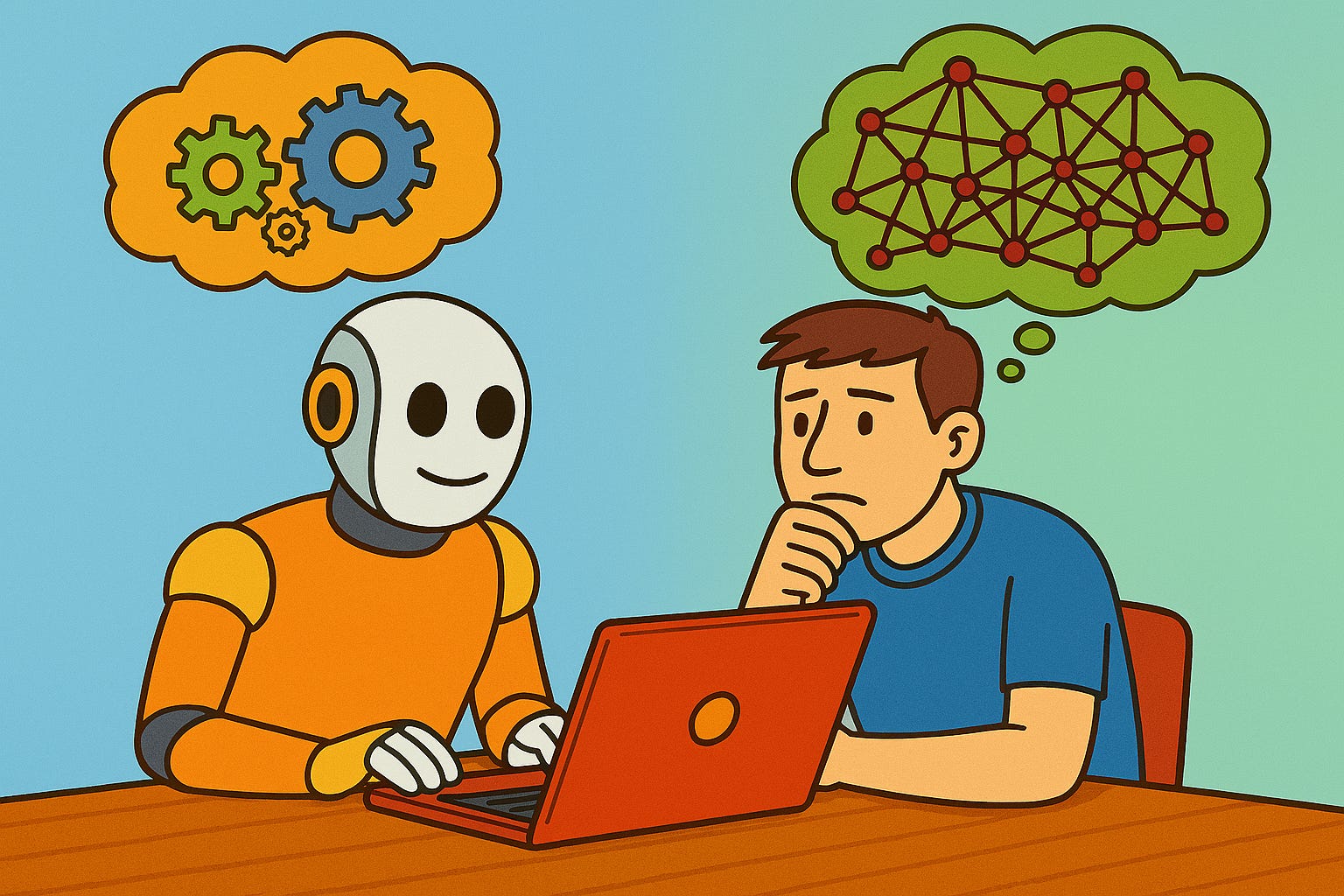
There are no shortage of articles (including a few of my own1) that call out this dilemma:
AI is easily the most powerful tool we’ve ever worked with. AI is incredibly versatile, and can help us in nearly every aspect of our lives. So it’s easy to see why people are so impressed with the technology. But AI has fundamental limitations that people are losing sight of, resulting in an overreliance on a digital brain and an underreliance on their own human brain.
Collectively, we’re all trying to get to a clearer articulation of the optimal partnership between human and AI. This is my latest attempt, and I have Arthur Brooks to thank for planting the right seed in my brain.
In “The Meaning of Your Life”2, Arthur Brooks makes an important distinction between Complex and Complicated. “Complex challenges in life are easy to understand but impossible to solve, so they can only be lived and understood. This is in contrast to the complicated parts of life, which can be hard to understand but are solvable once and for all.”
Arthur establishes this difference early in his book to set up a deep dive into the search for meaning in your life, which comes down to intentionally spending more time on the Complex. We are bombarded with Complicated, such that it grows to fill all available space. One great example he uses is the lack of boredom in modern lives. Boredom used to come when none of your friends were around, when you were in line at the grocery store checkout, or you had just finished your final exams for the year. But now, at the first hint of boredom, we reach for our phones or dive into a streaming show. Whew, what a relief, we don’t have to sit idle. The problem is that this boredom is where our big ideas come from. Boredom is when we ponder, and wonder.3
This framing resonated with me, and reminded of my annual retreats that are intentional periods of boredom binging. I’m certainly going to be covering gems from Arthur’s book in later posts once I’ve finished reading it and incorporating it into my Grand Synthesis.4 For now, I want to use Arthur’s Complex/Complicated framing to help better distinguish AI strengths and human strengths, in hopes of making you less likely to cognitively surrender to AI. Let’s explore.
Comparing Complex and Complicated
The best way to define Complex and Complicated is through a comparison. “The Meaning of Your Life” gave me a handful of comparisons to begin with, then I added a set of comparisons on my own. My final step was to brainstorm with Copilot and polish the table. Here is the result of our joint effort:
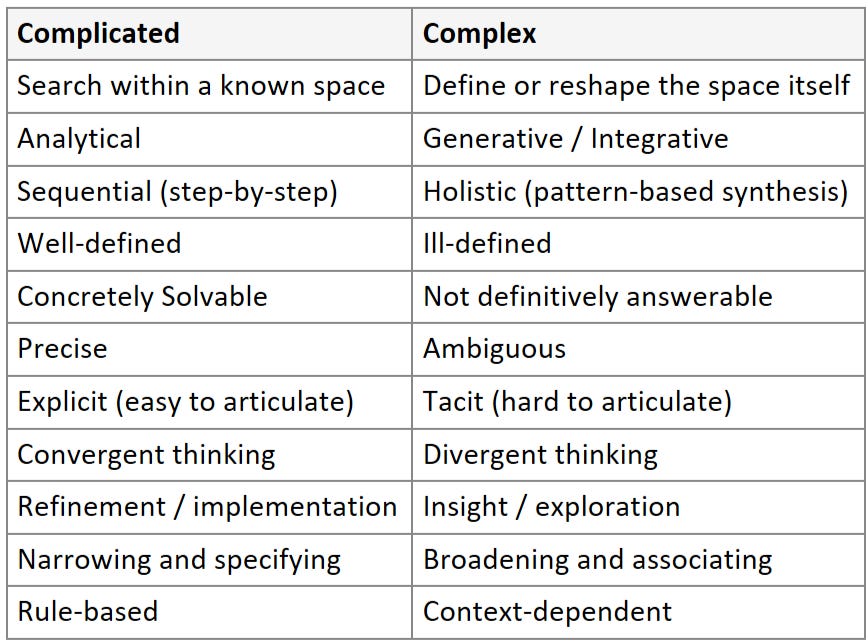
Read through this table several times, slowly. Once you’re at the point where you are seeing this dividing line clearly enough that you hopefully add another row or two of your own, then you’re ready to move on.
Making time for the Complex
Arthur claims that we are spending too much time on the left side of this table. Through our own busyness, and not having the space for reflection, we’re not wrestling with the big problems. And it makes sense when you see the above comparisons. Complex problems are ill-defined. They’re ambiguous. Rather than being rewarded with a final answer, Complex problems have evolving solutions, that will require even more pondering. Why bother?
I Heart Huckabees is one of my favorite movies (#3 on my top ten list, to be exact), and one of my favorite scenes from this movie is when the main characters are guests for dinner with a family that they don’t know.5 Albert explains that he’s working with an existential detective and the kids ask what that is. He gives a couple of examples of questions he’s been wrestling with, “If the forms of this world die, which is more real, the me that dies or the me that is infinite? Can I trust my habitual mind, or do I need to learn to look beneath those things?” One of the kids at the table asks, “We don’t have to ask those kinds of questions, do we mommy?” Mom calmly replies, “No honey.”
The Complex problems are essential to wrestle with. It’s what makes us human. But they’re easily dismissed, as this family does at the dinner table. Maybe Albert’s examples are pretty extreme, but how about a more common Complex problem like, “What am I doing here?” That’s a fun one to entertain.
When I realized for myself that I wasn’t giving the Complex enough attention, I forced myself out of the Complicated auto-pilot and took my first retreat (in April of 2001). What followed was a nine month overdosing on the Complex. I don’t recommend that approach, but it was what I needed, and the result was literally and completely life changing. The good news is that the reset was a one-time disruption. Now I just regularly give the Complex time, and am okay with the answers slowly evolving. I’m living, intentionally.
AI knows Complicated
Look back at the comparison table, and then think about your last dozen exchanges with AI. Where were you and AI operating: in the Complicated domain or in the Complex domain? You may have been moving between these two domains, but make no mistake about it, AI was only working in the Complicated domain.
The sum total of what AI knows is what it has read. Complicated things are easier to explicitly articulate than Complex things. It stands to reason that far more Complicated ideas have been written down than Complex ideas. So, AI’s knowledge base is skewed heavily on the side of Complicated.
Further, what the Complex side of this table shows is that Complex is far less about knowing and far more about pondering. Arthur gave an example of Koko the gorilla, who accomplished the impressive feat of learning more than a thousand words in sign language over four decades. But Arthur pointed out that in all the conversations with Koko, the gorilla never asked a single question. Similarly, AI is waiting for you to ask the questions. AI never starts the inquiry. Does AI wonder? Or, as Philip Dick asks in the title of his novel, “Do Androids Dream of Electric Sheep?”
Tune your partnership with AI
AI can help us with the Complicated. Complicated problems are in AI’s wheelhouse. Deferring Complicated work to AI frees up more time for us to do Complex work. This partnership maximizes the payoff of AI while reminding us through the experience itself what us humans are good at, and good for. This division of labor helps you more clearly answer, “How do I uniquely add value?”6
When I was done with my exchange with AI on this Complicated vs. Complex topic, I wasn’t saying “what’s the point of me being here? AI can do all of this.” I was celebrating the partnership, where I had ideas and thoughts that AI helped me sharpen.
In my “AI’s Love Language is Precision”1b post, I called out four Kettering quotes that point us towards the right balance to have with AI. I want to replay the last of those four quotes here: “There is a great difference between knowing and understanding: you can know a lot about something and not really understand it.” AI knows a ton, but it doesn’t understand it.
My three favorite Copilot gems7 from our collaboration for this post are:
“AI is extremely strong at knowledge. AI approximates understanding.” “AI knows a lot, and sounds like it understands.” - Copilot is telling us why we get fooled, and reminding us to not be fooled. AI sounds like it understands. The eloquence and the verbosity of AI responses hypnotize us. Snap out of it.
“It has pattern knowledge of tacit domains, but not situated participation in them“ “AI doesn’t just know explicit things—it learns statistical echoes of tacit knowledge—but without the real-world grounding that makes human expertise reliable.” - I love the phrase “statistical echoes of tacit knowledge.” You have feelings inside of you that come from a profoundly rich base of tacit knowledge. AI has 1s and 0s inside of it. Celebrate your depth, and bring that depth to your AI collaborations. Going back to the I Heart Huckabees dinner scene, how could AI ever know “what happens when you stand in a meadow at dusk?” 🙂
“Complex problems aren’t solvable until you make them complicated.” - This is the pure gold line for me. This captures the serious work involved in tackling Complex problems, and highlights where AI can best help. Just like with the table that started this post. I had been struggling to fully articulate this dividing line. I took the start that I had and an explanation of where I was trying to go. And in so doing, I made this piece of the Complex problem Complicated, at which point AI can add its value: (1) broad knowledge and (2) rigor.
You make progress on your Complex problems by iteratively turning ambiguity into structure. You move one aspect from ill-defined to well-defined. And then AI helps you rapidly and effectively polish that well-defined piece. Then you tackle another aspect, and another.
Use AI to accelerate and enrich your Complicated work, so that you have more time to fully commit yourself to your Complex work. That’s when you’re uniquely adding value. That’s when you’re contributing a verse. And that’s why you’re here.
Footnotes
3 examples:
Actual Intelligence + Artificial Intelligence = 🥇🏆🎉: Partner with AI; Don’t Defer to it
AI’s Love Language is Precision: “A problem well stated is a problem half-solved”
Touch Grass: Your AI agents don’t need breaks, but you do
I have referenced this fundamental question, that came out of my first retreat, in several posts:
The “Spiritual Capacity” description in Revving Your Energy Flywheel
The “Everyone is a Subject Matter Expert of Something” section of Lifelong Student-Teacher
The introduction of Triage Shield
"How am I not myself" is one of my favorite quotes from that movie. So fun.