


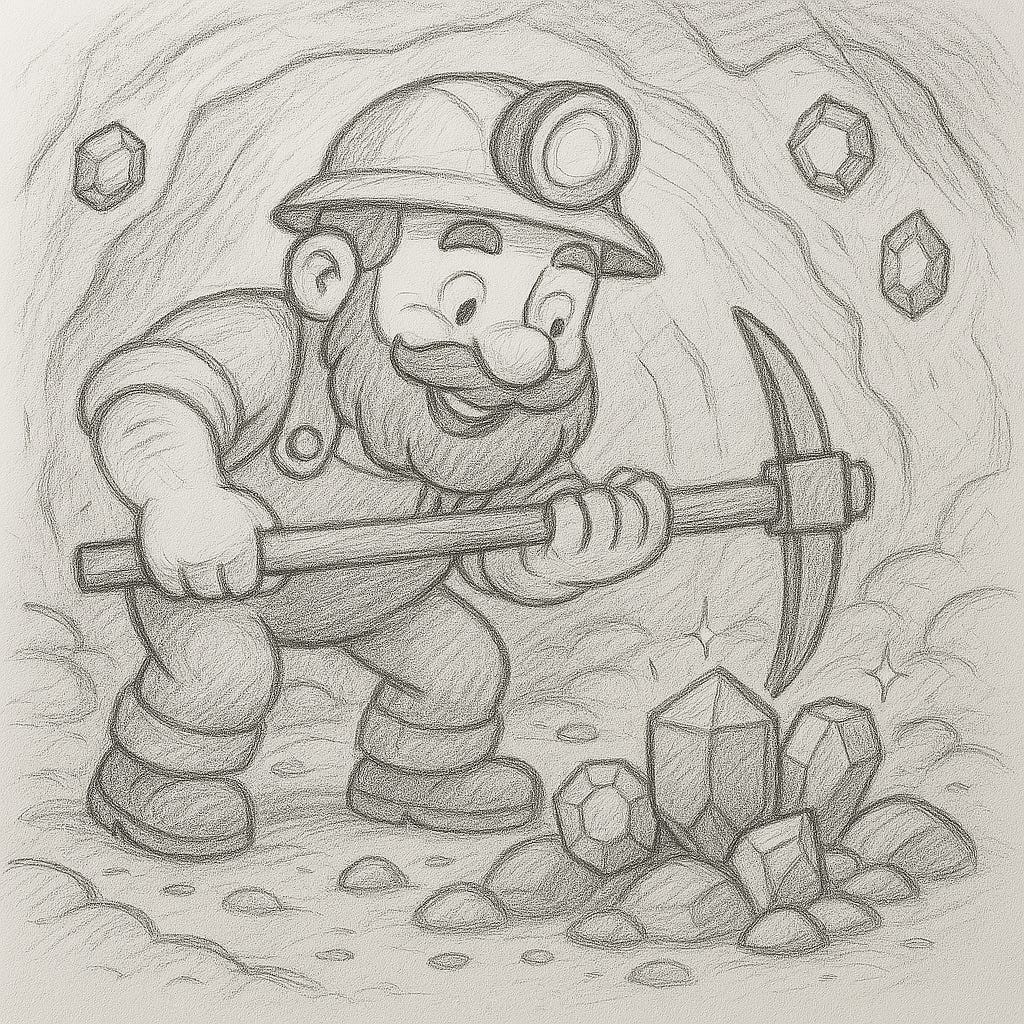
The way that each of constructs our own Grand Synthesis1 is by gathering gems from all the different inputs that you are bombarded with. The book you're reading, the podcast you're listening to, the video you're watching, the meeting you’re participating in, the email thread you're reading, and the conversation you're having … all of these have the potential for introducing new gems for you to collect, and then incorporate into your own worldview.
We're all collecting gems and folding them into our perspective. But we're not all aware of this. And that's the upleveling I want to talk about here: becoming more aware2 of your gem collecting process so that you can encourage it, guide it, and organize the results. You want to intentionally mine for gems, from more and more sources3, and keep your gem collection tidy.
Read With a Pen
I have long described my reading style as "I read with a pen." I underline and I write notes in the margins. The original motivation for doing this was to help keep me engaged in the reading and prevent my mind from wandering (an ADHD coping skill). Later, as I got more interested in the long-term organization of my notes, I found that transcribing these highlights and notes made it all readily searchable, making it easy for me to recall thoughts and learnings.
This reading style has spilled over into other formats as well: "I watch/listen with a keyboard." It's the same concept as above, just a different format, with one less step to final form because no transcribing is required. Once I started doing this, I did attempt to switch to e-books to have all of my notes and highlights start out in electronic form. But I found myself returning to paper books and a pen. For videos and online articles, the keyboard works fine. But for books, I really enjoy the simplicity of the more traditional format. And having a row of books that you've read and that you'd recommend in your office (visible to physical visitors, and in frame on virtual calls for online viewers) increases the discoverability of your recommendations, and invites conversation on these titles.
All of these notes from books, articles, videos, and podcasts are captured in the OneNote external brain that I described in my Grand Synthesis1 post. And now, with Uplevel Pro serving as the public sharing of my own synthesis, I am going to be cleaning up all of these for public consumption and posting them here. Watch this space. 🙂
Don't Miss It
There is a reason I covered Nuance and Generosity3 before this post. Dave Matthews talked about the potential for finding gems in the most unlikely of places. Having an open mind, one where you embrace nuance and are generous to others, is going to increase both the quantity and the quality of the gems you collect.
A great example of this was my experience when I was reading Marie Kondo's "The Life-Changing Magic of Tidying Up". Though I was very excited at the start of reading the book, I quickly found myself disengaging from the reading. And at one point, I noticed that I had gone 20+ pages without underlining or annotating a single time (which is pretty rare for me). As I blew past the midpoint in the book, I was skeptical that I would find any gems at all. Marie's tone was more dictating, and I felt was overly negative as she was being quick to dismiss common practices as misconceptions. I'm okay with a little of that, but it seemed excessive, to the point that I wondered if she was just being contrarian.
But then, in the final chapter, Marie brought it all together, showing how all of the different processes she had detailed unite in a way that can transform your life. The entirety of the book up until that point had been about habits and processes, which was largely redundant with other books I had already read4. But had I not been generous to Marie, I wouldn't have made it far enough into her story to discover her meaningful conclusion.
FOMG
There are so many people that listen to podcasts while they're driving. When I first tried doing this, it was very frustrating to me that I wasn't enjoying the experience. What was wrong with me? It's working great for everyone else, why not for me? After failing to figure it out, I opted to just give it a break. And then, recently, I tried it again. The bad news: it still wasn't fun for me. The good news: I figured out exactly why!
I tried listening to a podcast on a solo road trip to Eastern Washington. I was five minutes into the podcast when the guest said something and I immediately thought, "that's a gem I need to save." But with no keyboard, I couldn't capture it. I panicked, fearing that a valuable gem was going to slip through my fingers. I improvised and said to my phone, "Hey Google; Take a note; Amanda said she wanted to give him radical benefit of the doubt, which is a great example of Haidt's generosity line". Whew! Gem captured.
I kept listening and found myself taking a couple more audio notes. But then I struggled to see how I was going to accurately capture these gems just from these audio notes, given that I normally included references to page numbers (for written) or timestamps (for video/audio). So then I just decided to listen to music for the rest of the drive, and return to this podcast when I had a keyboard in hand. FOMG (Fear Of Missing Gems) is real!
Your own LLM
AI introduced us to the term "LLM": "Large Language Model." It refers to the model that an AI has built from all of the training it has been given. Your own brain is your LLM. And, as such, the more of your brain that you capture in electronic form, be it OneNote, Obsidian, or your tool of choice, the more of your Grand Synthesis you have digitally articulated. You can test how complete your LLM is by training an AI on it and then seeing how well that AI represents you and your ideas.
When I was leaving Microsoft, in my final "Ask Jeff Anything" presentation, I announced my (tongue in cheek) parting gift to Microsoft. I said, "I have always been an advocate for leaving a paper trail. And I have done my best to model this, first and foremost with my blog, but also with our WinUniversity collective effort. Leaving a paper trail is important because you have to write it down … to be able to train an AI on it". And then I showed them ChatBOG, which greeted them with "Hello, I'm ChatBOG, and AI approximation of jeffbog. With bog no longer here, ChatBOG leverages Jeff's writings to answer your questions in a bog voice."
Thinking of your external brain as your LLM, and then reflecting on the above FOMG experience, I found myself saying, "there has to be a better way." I've been scribbling and transcribing, and copy/pasting from transcripts. But if, instead, all of these sources were just aggregated into my external brain, all of my own insights could just be direct annotations on top of this integrated content. We can already add annotations to an e-book we own. Are there tools/add-ins that allow a consumer to annotate podcasts and videos?
How do you capture the gems you've mined? Have you found an efficient way to capture excerpts and your annotations? I’m always on the lookout for ways to improve my mining technique, so add a comment here to share your own pro-tips.
Footnotes
e.g. The Seven Habits of Highly Effective People, Getting Things Done, and Atomic Habits; all of which will be included in my forthcoming gem collection 💎
I don't have my own methods to share, but am very appreciative of learning about yours!