


I have done about a dozen five day riding retreats. The goal is to ride a century a day for five days. In 2019, on Day 3 of my ride from North Carolina to Pennsylvania1, I experienced the hardest single day ride across all of my retreat rides. The combination of added miles (17 miles over the century mark) and intense climb (over 10,000ft) resulted in that day taking close to 11 hours, which is three hours longer than a typical day on these retreats.
I was in the middle of a five day ride. I was hours away from the nearest family member who could come and bail me out. My legs were incredibly stiff from both the climb and the time. And I had three fewer hours to get ready for Day 4. But now was no time to stress … because there simply wasn't the time to stress. I had to get to work. I had completed Day 3, and now I had to set myself up for a successful Day 4.
An ultramarathoner's goal is to maintain high energy, indefinitely. A corporate athlete has the same focus. The execution plan for athlete and corporate athlete are the same: feed off of the energy givers, have a plan for the energy takers, and never waste energy.
Corporate Athlete
The most impactful training I ever experienced was a Microsoft leadership training that I attended in 2012. Across the five intense days of talks, discussions, business simulation, and networking, there were several key learnings that I successfully integrated into my approach and my workflow in the years that followed.
The number one learning for me was energy management. Be aware of your energy, and be intentional about the management of your energy. I was always aware of how much my energy level propelled me, but I didn't realize it was controllable. Up until that point, a common theme of my performance evaluations was my manager applauding me for the infectious nature of my energy and then calling out the downside of the unpredictability of my energy level. That changed immediately after this training.
The pre-read for our offsite was the Harvard Business Review article The Making of a Corporate Athlete2, by Tony Schwartz and Jim Loehr. And Tony was our host for Day 1 of this offsite. There were so many gems in this article and in Tony's opening presentation. The perfect distillation is this visual:
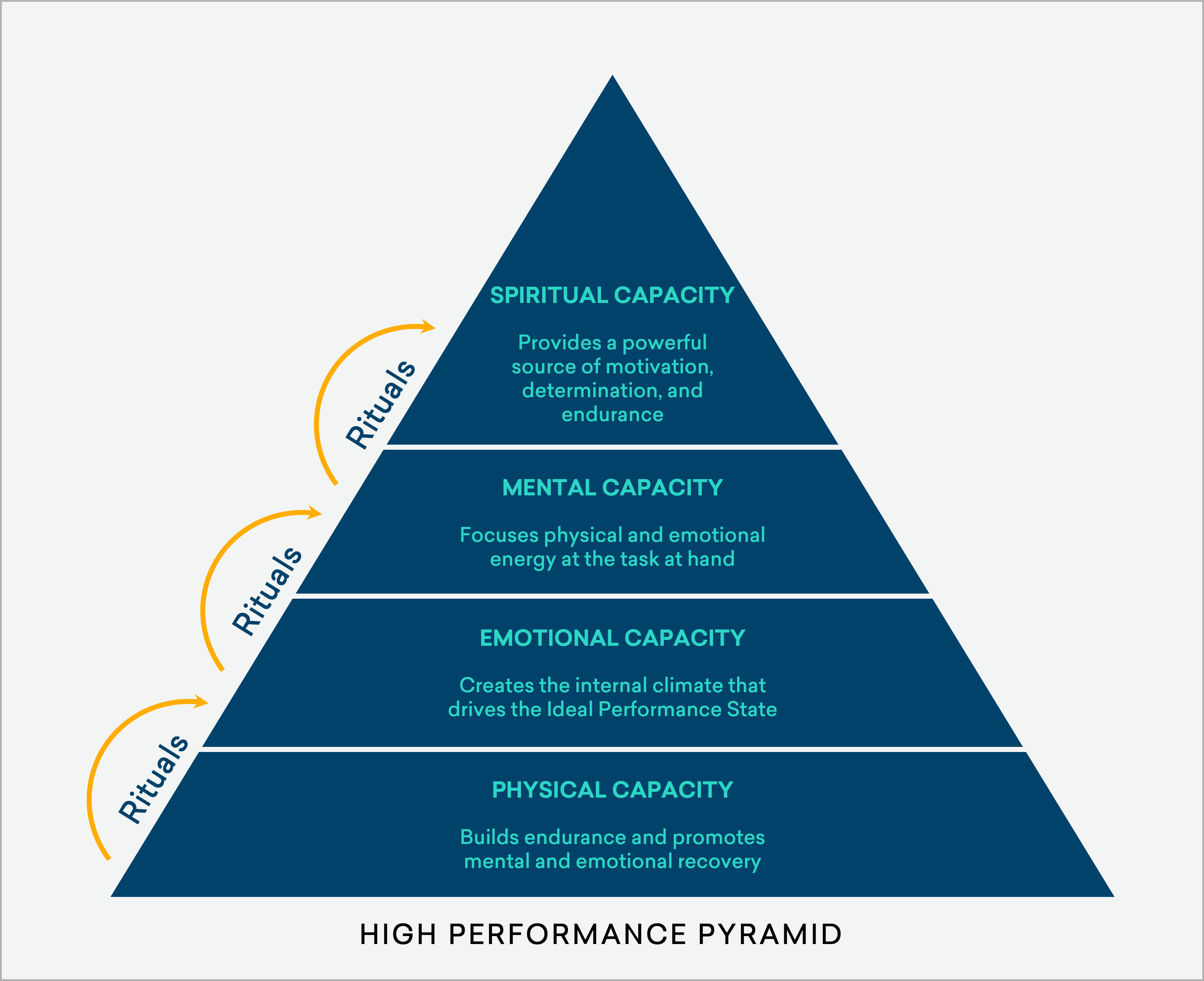
Jim Loehr and Tony Shwartz (2001)
In their book "The Power of Full Engagement"3, they say, "To be fully engaged, we need to be fully present. To be fully present we must be physically energized, emotionally connected, mentally focused and spiritually aligned with a purpose beyond our own immediate self-interest." This is another demonstration of the importance of investing in the Whole Self4. I would summarize these four tiers as:
Physical: Are you fed, hydrated, rested, loosened up, and ready for action? Across an extended work session, get up occasionally and moving around.
Emotional: Are you biasing towards positivity? When dealing with challenges in your project, instead of dwelling on there being a problem, recognize the opportunity for improvement.
Mental: Is your mind focused? Remove distractions and lay out a plan of attack.
Spiritual: Do you have a sense of purpose in your work? Recognize how you are uniquely adding value and, in the words of Teddy Roosevelt, "work hard at work worth doing."
Tony and Jim provide the two key components for effective energy management:
Oscillation: Rhythmic movement between energy expenditure (stress) and energy renewal (recovery).
Rituals that promote oscillation: repeated regularly, these highly precise, consciously developed routines become automatic over time.
Your Energy Flywheel
Reflect on the various activities you do on your job … and at home. Then categorize each activity as either an energy giver or an energy taker. For me, employee 1:1s is an energy giver. And product shiproom is an energy taker. Keep in mind that this is a very individual assessment. I know colleagues that would have reversed the categorization of the two activities I just mentioned. That's fine. This is all about you recognizing what propels you and what drains you.
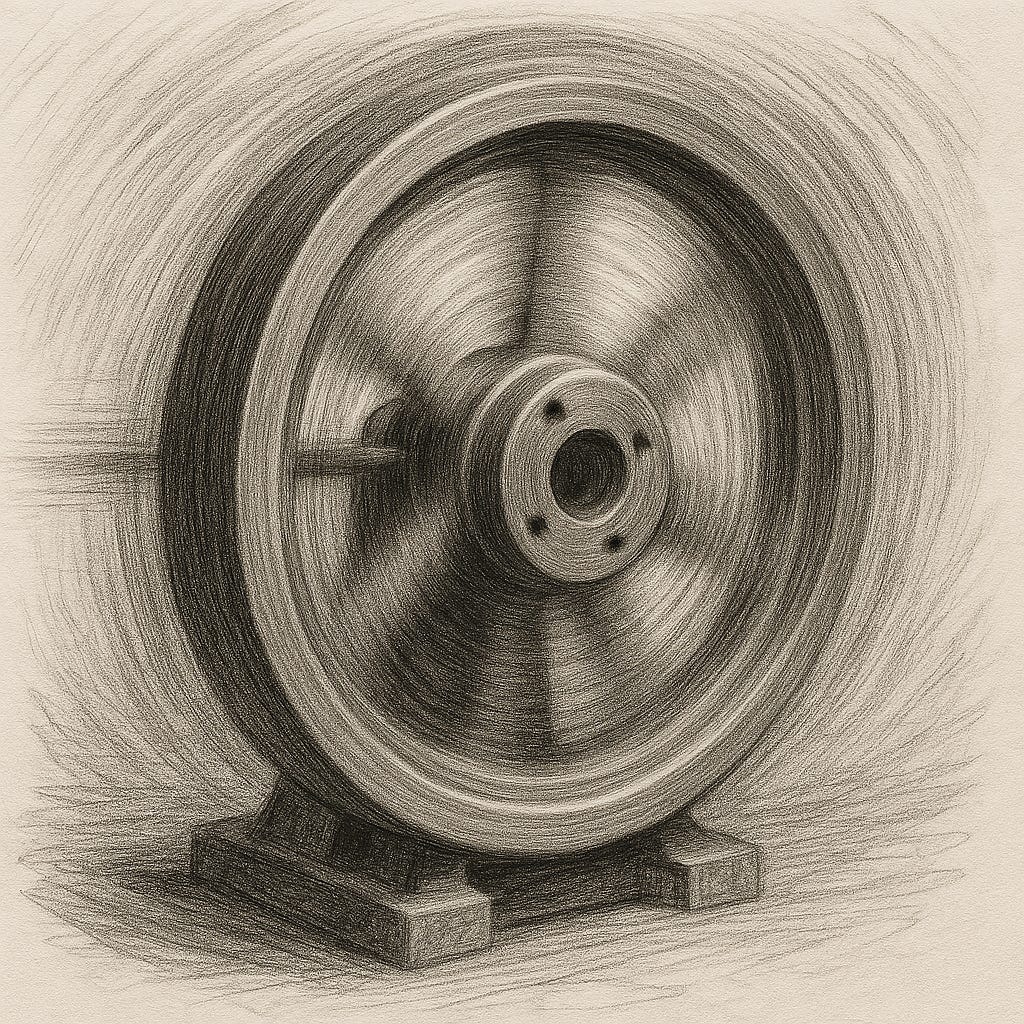
I visualize energy management as having an internal energy flywheel that I am trying to keep spinning, and then over time increasing the flywheel's speed (RPMs: Revolutions Per Minute). A flywheel is a heavy rotating disc used in mechanical systems. Here are the key elements of a flywheel5 that make my "energy flywheel" analogy work:
Specifically designed to use the conservation of momentum so as to efficiently store energy.
Used to provide continuous power output in systems where the energy source is not continuous.
Smooths sufficiently small deviations in the power output of a system.
Will donate a surge in power output upon a drop in power input
Will conversely absorb any excess power input in the form of energy.
You are intermittent in your delivery. You will have energy giving activities that you fly through, and you will have energy taking activities that you have to muscle through. But by adding a flywheel to the system, you will be able to become consistent in your delivery.
Your #1 job is to keep your flywheel spinning. You accomplish this by making sure that all of your energy takers aren't stacked up next to each other. Rather, you have energy givers interspersed to feed energy into the flywheel. This is why it's so common for people to workout in the morning. This activity can be an energy injection to start their day off right. For me, I found that stretching and then writing is my most energizing way to start the day.
Be the Architect of Your Day
Keep your energy flywheel spinning by being the architect of your day. Don't just let your day happen. With all of your activities categorized, design your day so that you are oscillating between givers and takers.
Begin with the inviolates: anchors to your routine that you hold sacred because they are guaranteed energy injectors. What are one or two activities that you can start your day with? As I said above, mine is stretching and writing (I detailed my full morning routine in my Habit-Propelled6 post). What midday activity would serve as a good break for you and a good energy restoration to get you ready for the afternoon? At Microsoft, mine was a lunch time bike ride. Not a fast sweaty ride, but just a meandering pedal all around our campus. 50 minutes outdoors, rain or shine, to reflect on the morning and prepare for the afternoon, while giving my body some attention. I picked this timeslot because it's relatively easy to fend off lunch hour meetings, which allowed me to keep this habit going.
After the inviolates are in place, add in to your calendar all the meetings you're invited to. Mark each meeting as an energy giver or taker. If at this point, your calendar is completely full, then see below for ways to create space. Then you can return to this exercise. What you should have now on your calendar are your fixed time commitments for the day. In the open space on your calendar, look for where you are most in need of energy injection, and place blocks in your calendar for you to do energy giving activities. This will ensure that you are feeding your flywheel. And by having it be on your calendar, it will keep you timeboxed so that you don't miss meetings that follow.
Creating Space on Your Calendar
If you work at a meeting happy company, then you may have experienced the completely booked calendar. If your entire week is already spoken for by meetings, do you think your energy flywheel is going to like that? It might just so happen to work out that those meetings are already balanced between energy giving and energy taking, but that's a longshot. So, if you find yourself in this position, here are the set of questions to ask of each meeting that can result in you creating more space on your calendar:
“Does the meeting need to happen?” What warrants in person discussion vs. what can happen over mail?
“Do I need to be there?” Check your FOMO; and think about effective delegation.
“Does the meeting need to be that often?” Could you get away with meeting every other week?
“Does it need to be as long as it is?” Could you get away with meeting for 25 minutes instead of 50?
“Does it need to be at that time?” Can you request a different time that would be more ideal for you?
Realize your Full Potential
Once you've gotten to the point where you've kept your energy flywheel spinning for a week straight, you're ready for your #2 job: to increase your flywheel's RPMs. You are intentionally designing your days. Now it's time to uplevel your energy management by recognizing the value of carrying energy over day after day.
You don't start each day with an energy flywheel at zero. There is residual energy from the day before. And, with more investment in your energy management, this stored energy level can be quite significant. Just as you can accumulate energy over hours, you can continue to accumulate over days, then weeks, then months.
One small step that will help keep you more aware of your energy flywheel is to add another small inviolate to your calendar at the end of the work day. The fundamental question to ask yourself at the end of each day is "Do I feel more energized today than yesterday?" Have you found any new energy givers? Have you removed or reduced an energy taker (through negotiation or optimization, perhaps)?
But ultimately, the key to long term energy management is keeping the corporate athlete mindset, and regularly reflecting on how your activities contribute to all four tiers of the high performance pyramid. There is no top end to your own energy flywheel. The faster you get it spinning, the further you will go.
Jeff, this is great advice for sustainable energy management. I'm wondering if you have any thoughts on one time events that massively drain your energy and techniques for recovering from extraordinary one-off situations.