


In my last post1, I introduced this Total Impact Venn diagram, and the three “how”s (Do, Teach, and Learn) that combine to capture your total impact.
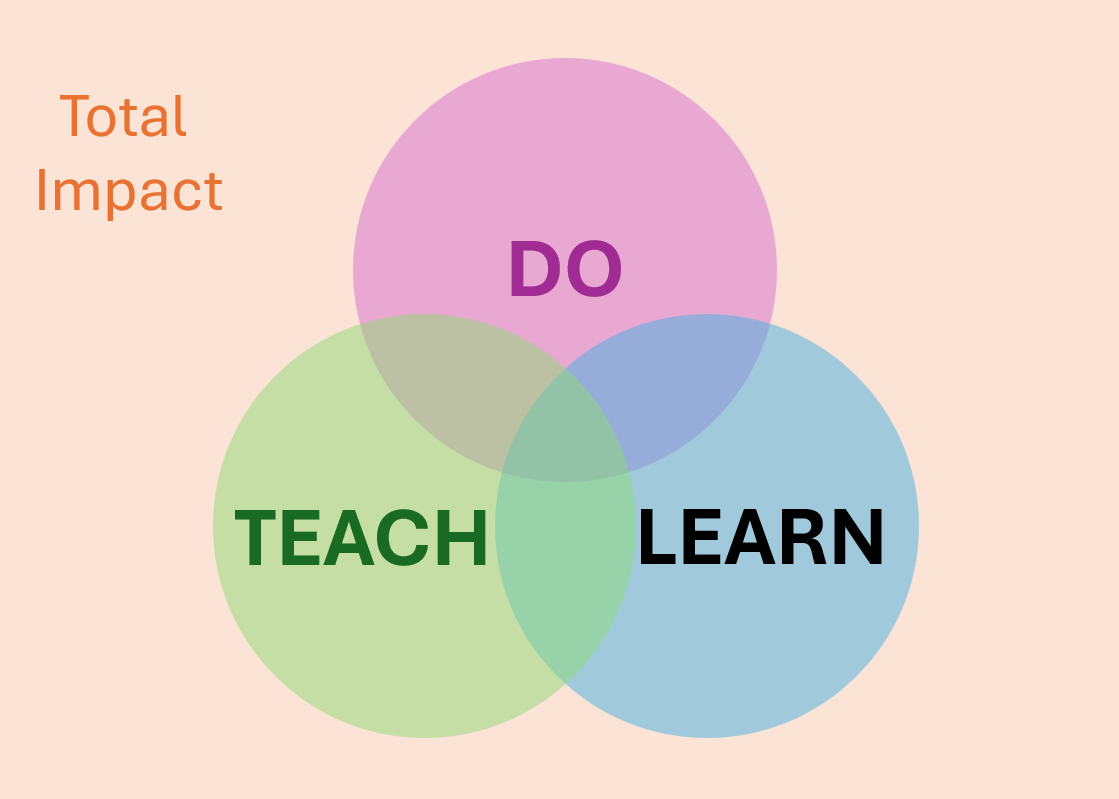
Now I want to zoom in on this diagram to talk about the magic that is unlocked in the four areas carved out by the intersections of these three facets.
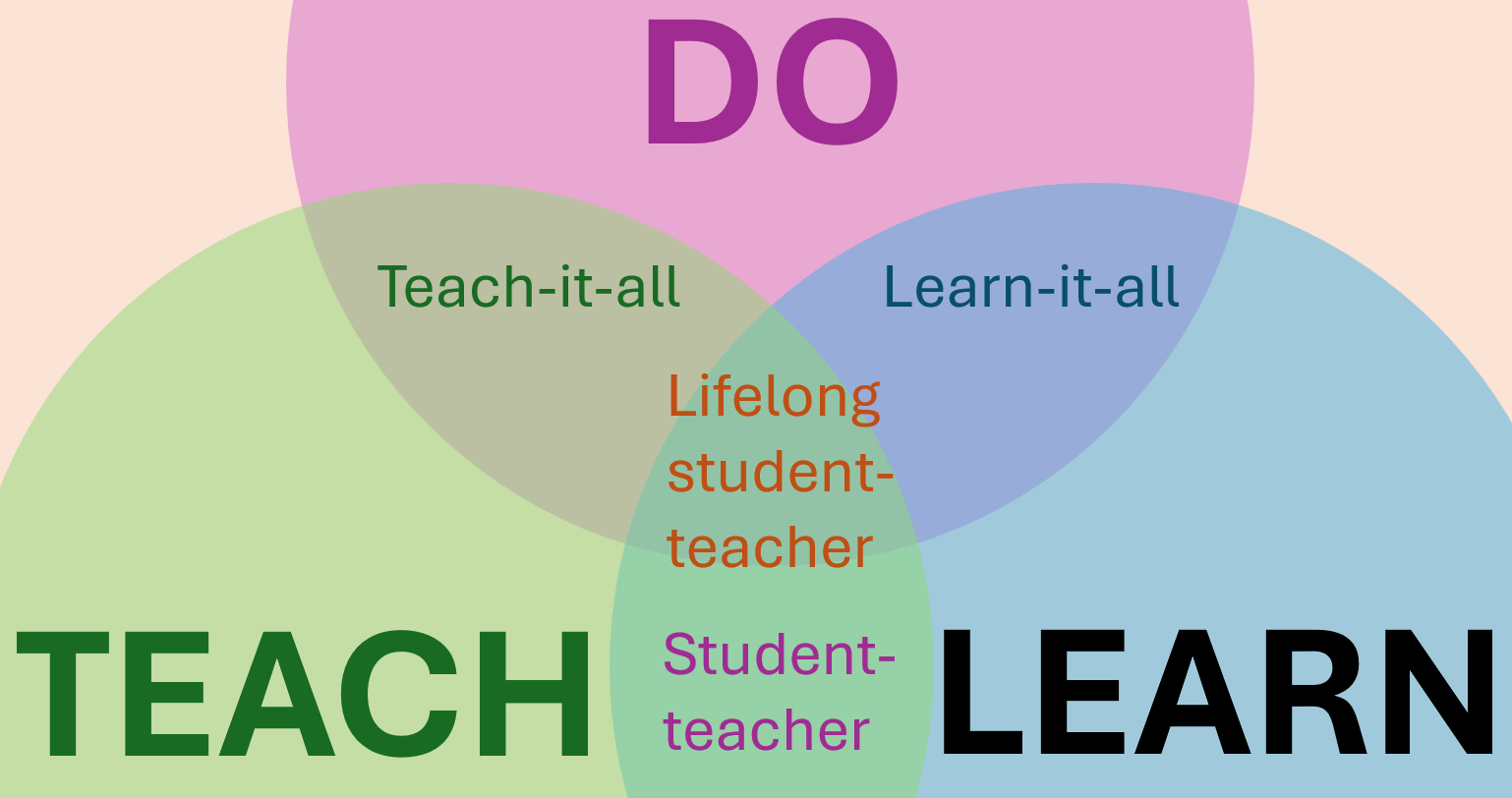
Do + Learn = Learn-it-all
Do + Teach = Teach-it-all
Teach + Learn = Student-teacher
Do + Learn + Teach = Lifelong student-teacher
Learn-it-all
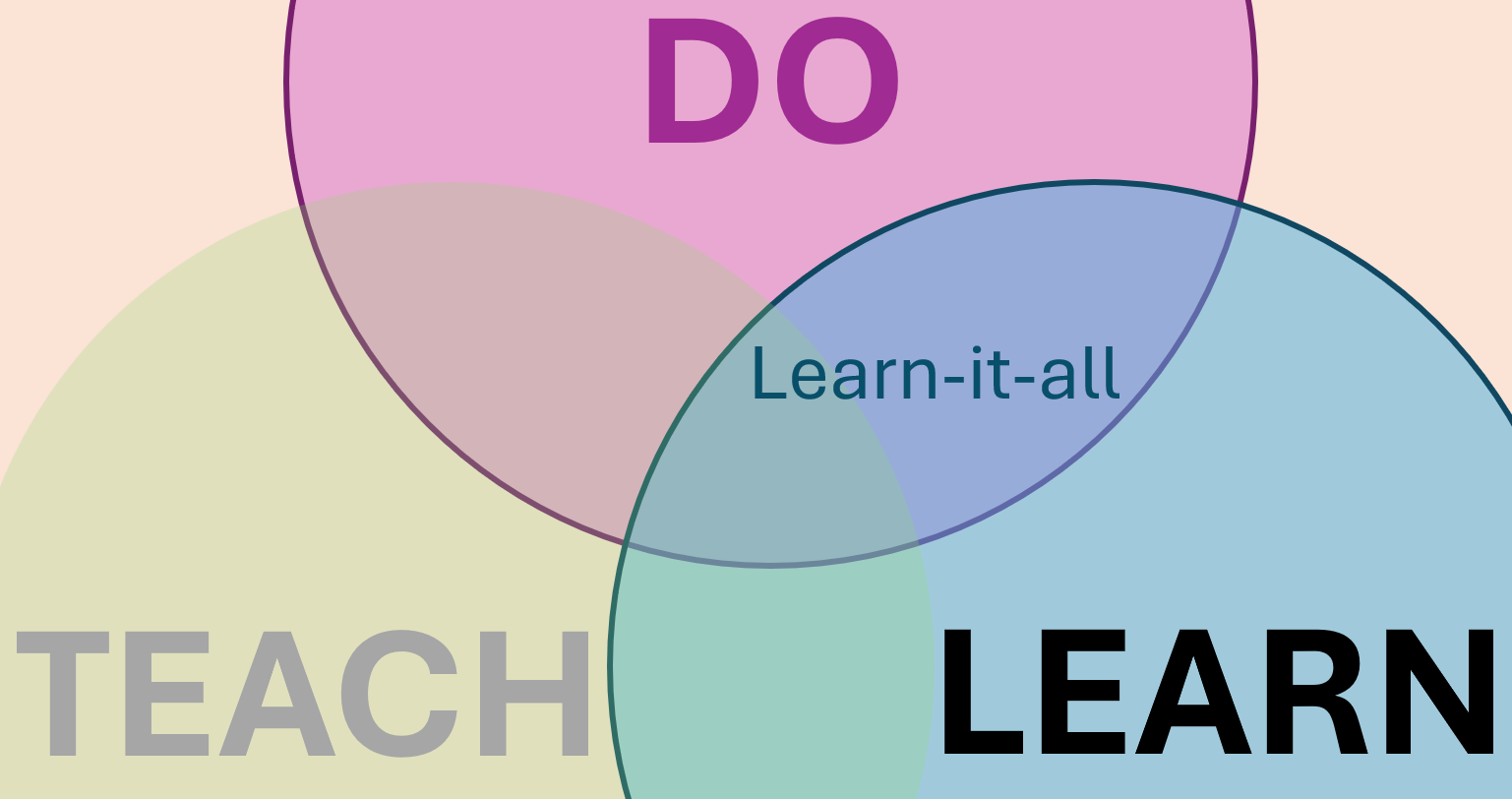
When Satya Nadella became CEO of Microsoft in 2014, he brought an intentional focus on culture. He said, “The C in CEO stands for Culture.”2 One of his earliest culture initiatives was, in his words, “We need to move from ‘know-it-alls’ to ‘learn-it-alls.’” Microsoft’s recruiting mindset had been more singularly focused on finding very smart people. That was great from a collective knowledge and know-how standpoint. But there were unintended consequences such as “loudest voice wins” and “not invented here.”3
Personalities and egos, unchecked, had more undesirable influence on direction and results. In areas of the company where such influence was highest, it evoked the know-it-all attitudes from the team. You better know what you’re talking about, or fake it if you don’t. Competence and confidence are fine, and should be encouraged. But moving beyond that, into assertiveness and overconfidence, led to bullying and shaming.
Learn-it-all was a mindset that could counter these side effects. It encouraged more humility and transparency, raising the likelihood of team members calling out where they themselves didn’t have all the answers and needed to learn more.
“Learn-it-all” was Satya’s own version of Growth Mindset, formalized by Carol Dweck in her book, Mindset.4 There was a terrific reinforcement of Growth Mindset that followed Satya’s “Learn-it-all” initiative. In the bottom corner of every whiteboard in every conference room in every Microsoft location, a small sticker was added to raise awareness5 of the benefit of bringing a Growth Mindset to the meeting.
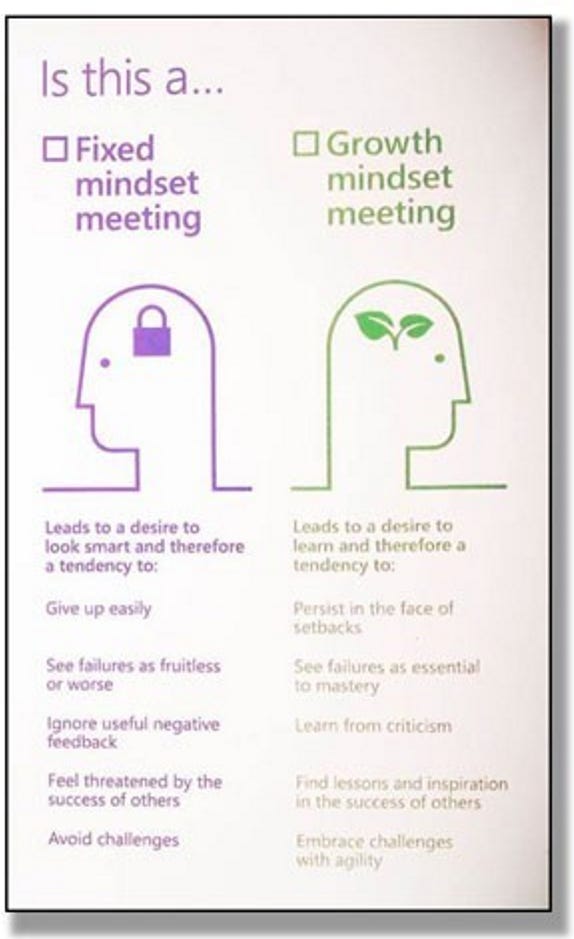
We sure do spend lots of time in meetings. Anything from shiproom where we’re checking the status of our product’s readiness, to design meetings, to strategy meetings, to triage meetings. And in all of these settings, a Fixed Mindset can undermine the potential of that meeting. Let’s pick the most menial of the above meeting types. Does a bug triage meeting really have potential? Certainly! It has potential for being efficient in how these bugs are handled. It also has potential for better understanding the customer’s needs, and not dismissing.
Fixed Mindset: “I know what this customer is saying. It’s nothing new. But we have enough counterpoints from other customers to stay the course.”
Growth Mindset: “Interesting. This bug report is questioning our decision. And we’ve seen other similar reports. Have we missed the mark? Do we need to rethink or at least hone our decision?”
Teach-it-all
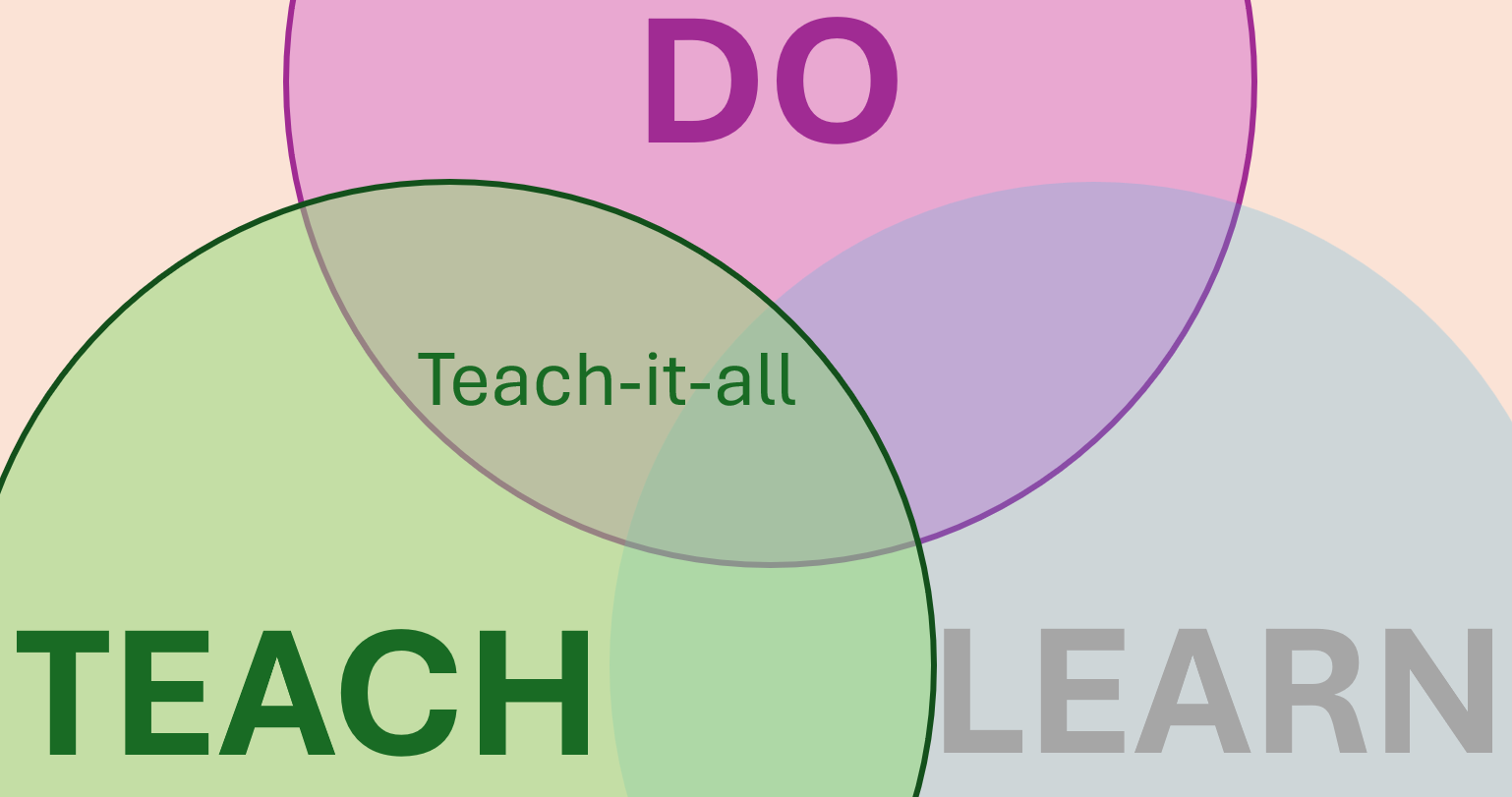
This “Learn-it-all” push was the necessary first step that opened the doors to much more investment in Microsoft’s culture. And once we had enough Learn-it-all momentum, I became an advocate for its complement, “Teach-it-all”. As Lao Tzu wrote, “When the student is ready, the teacher will appear.” Satya’s push to be better learners had worked, so now we had to get people to be better teachers as well. Here was how I pitched this to the team.
Every individual at this company is a Subject Matter Expert (SME) of something. And just as you have benefited from the teachings of others, you have to contribute a verse to the corpus of educational materials. As John Keating asks his students in Dead Poets Society: “What will your verse be?”
Not everyone is a presenter. Not everyone is a writer. Not everyone can see a clear structure of how they could linearly teach something. Don’t be intimidated by the prospect of having to teach. Start small. Start from your own comfort zone. Contribute a verse, in your own way, at your own scale.
I started with a corner of my whiteboard dedicated to “oft-uttered phrases.”6 Then came the OneNote that expanded on these phrases. And then, to help bring out the teacher in others, I married ONOIDH7 with a “scratch” space in our team’s OneNote where people could create a section for themselves and gather their own pro-tips there.8 After enough OneNote’ing, I recognized the value of expanding on my TotW (Thought of the Week) writings in my weekly team status mails to further organize my thoughts. All along the way, I’m evolving how I deliver my thoughts and the scale I deliver them at.
Think “Teach-it-all.” Think “teach them to fish.” Deliver more wisdom and insight in your code reviews and your doc reviews. Give more context on your line of thinking when you answer questions in email. Spot the specific topics where you are repeating yourself and see them as the indicators of your Subject Matter Expertise. Then start organizing your thoughts on that topic. Maybe it’s just a OneNote page. Maybe it’s a doc. Maybe it’s a deck. Maybe it’s a live presentation.
We’ve all successfully released our inner learner. Now it’s time to release your inner teacher.
Let me expand on a couple of points from this pitch.
Everyone is a Subject Matter Expert of Something
This is an intentional opening that was designed to immediately tackle imposter syndrome. At Microsoft, I used to say, “Every single person in the tech field feels like an imposter. From Satya down to the newest MS employee, everyone at this company feels like an imposter. So just get over it already.” And while that had some effect, it didn’t help all that much. So I began to use a more involved explanation of the good signal behind imposter syndrome.
Growth Mindset is intentionally moving from being know-it-alls to being learn-it-alls. This encourages us to be open, curious, inquisitive, hungry, eager, and adaptive. If we take too heavy of a single dose of learn-it-all, the side effect can be that we feel like a know-it-none. When we reach that point, we’re experiencing what has been termed “imposter syndrome”, or its earlier label of “inferiority complex.” The two main problems with these terms are that they are extreme and they make it sound like a disorder. I prefer the description used by Ruchika Tulshyan and Jodi-Ann Burey in the Harvard Business Review9: “healthy nervousness.” Learning is accompanied by a healthy doubt. And, as we all know from experience, that uncertainty is mitigated via the learning itself.
Between know-it-all and know-it-none, I’d prefer to feel the latter. Know-it-none, taken literally, will sow doubt. A little doubt is humbling. A lot of doubt is paralyzing. My goal mental state would be know-enough-to-activate-more-learning. Pretty much every time I am writing a post, the voice in my head is asking, “What makes me an authority?” or “What gives me the right?” When I catch myself asking these questions, I inject the question, “How do I uniquely add value?”
F. John Reh captures it perfectly. “Individuals designated as subject matter experts are typically sought out by others interested in leveraging their unique expertise to solve specific problems or help meet challenges.”10 “Unique expertise” is the key phrase. Sure, there are others that have more knowledge than you on a given subject. But once you combine that knowledge with your own lived experiences related to that topic, the synthesis11 of that into your own wisdom is a much more unique result.
Recognize your own expertise. List out the specific topics where you would consider yourself an SME. If you can’t readily spot these topics, think about all of the little pro-tips you’ve assembled and shared, and look for centers of mass amongst that collection. Whenever you are introduced to a new topic, and the healthy nervousness begins to grow inside of you, look back over your SME list and realize that you clearly have the capability to learn and to synthesize. That will keep your nervousness in check. Successful learning begets future success in your learning endeavors.
Find Your Own Approach
In my pitch, I went into pretty good detail on the importance of finding your own delivery as a teacher. But there is still plenty of encouragement to be added here. I’ll start with a replaying of a scribble I shared in an earlier post12:
Self Expression
We are all artists. We spend our lives searching for the medium that best allows us to express our thoughts and our dreams – a medium without boundaries. The lucky souls among us discover their medium.
That’s exactly what I’m encouraging here. Find the delivery model that is most natural for you. And if that model isn’t in use yet, create it so that you can. More importantly, as I described in the post, allow yourself and your approach to evolve. If you start out with something uncomfortable to you, chances are you won’t be teaching for long. Start with what’s easiest for you. Then, as you do it more, ask yourself what would make your teaching more effective. That’s what I was stressing with that ending statement: “All along the way, I’m evolving how I deliver my thoughts and the scale I deliver them at.”
Student-teacher
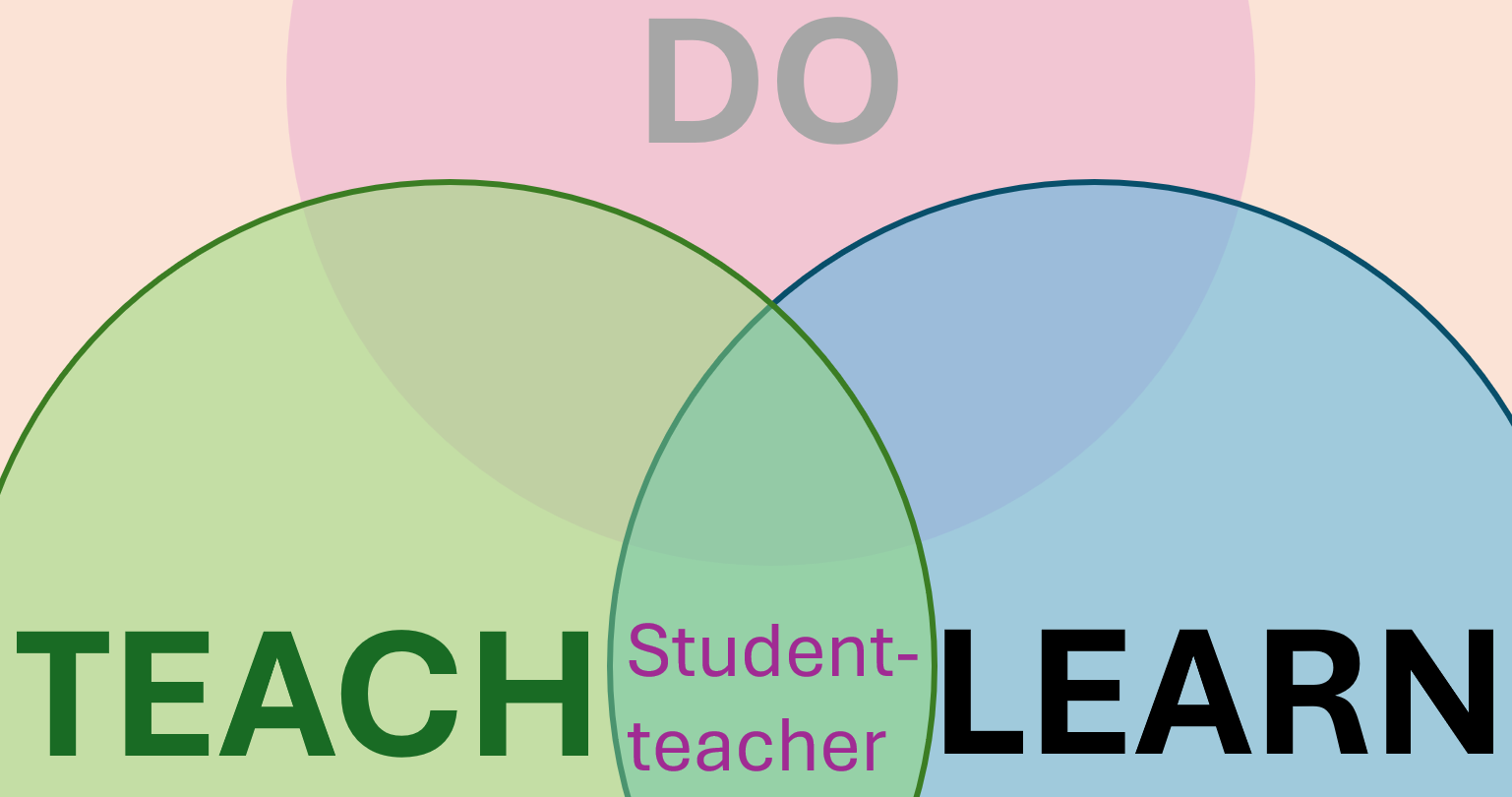
The best teachers are the ones that recognize the learning opportunity that is part of teaching. Teachers that simply share their knowledge are missing a huge upside. They will come across more as a disconnected sage speaking from a mountaintop, unaware of the listening audience. Contrast that with the teachers that demonstrate a willingness to learn during their teaching. The students are more engaged, the teacher is more respected, and all of the students -- the student-teacher included -- come away with new learnings.
To teach is to learn. Every teaching moment has the potential to be a learning moment. You’re not preaching incontrovertible truths from an ivory tower. You are sharing what wisdom you’ve gained, and listening to and observing the audience for opportunities to grow, deepen, and strengthen your own knowledge.
Microsoft’s Growth Mindset culture leverages the insights of Carol Dweck. There are many ideas that Carol shared in Mindset that you can find in Microsoft’s Culture. And that’s not just with regard to Learn-it-all. Dweck celebrates the student-teacher experience.
“[Teaching] is not entirely selfless. [Teachers] love to learn. And teaching is a wonderful way to learn. About people and how they tick. About what you teach. About yourself. And about life.”
“Seymour Sarason said, ‘There’s an assumption that schools are for students’ learning. Well, why aren’t they just as much for teachers’ learning?’”
“A good teacher is one who continues to learn along with the students.”
Scott Young, in Ultralearning13, calls out intuition’s role in deepening your understanding of a subject. And Scott references teaching as a measure of intuition: “Do I deeply understand the things I’m learning, or am I just memorizing? Could I teach the ideas and procedures I’m studying to someone else? Is it clear to me why what I’m learning is true, or does it all seem arbitrary and unrelated?”
In my list of top ten movies, Dead Poets Society tops the charts, and Finding Forrester also makes the list, coming in at #6. Both of these movies are about student and teacher, but the roles are not clearly divided. Michael Keating and William Forrester are the established teacher and mentor, but over the course of all their exchanges with their students, they celebrate a great amount of learning with and from their students. It’s not surprising that such movies would be high on my list, given another earlier scribble of mine, this one from 2003:
My career
I am here as a teacher
There are many others like me
My teaching style is one of leading by example
The curriculum draws from an always-growing sea of experience
Whose growth comes from me being student before teacher
Recognizing that I can always learn more
I have learned the value of seeing students as teachers
And for that reason will never regard myself as superior, as master
But, rather, forever as student-teacher.
Lifelong student-teacher
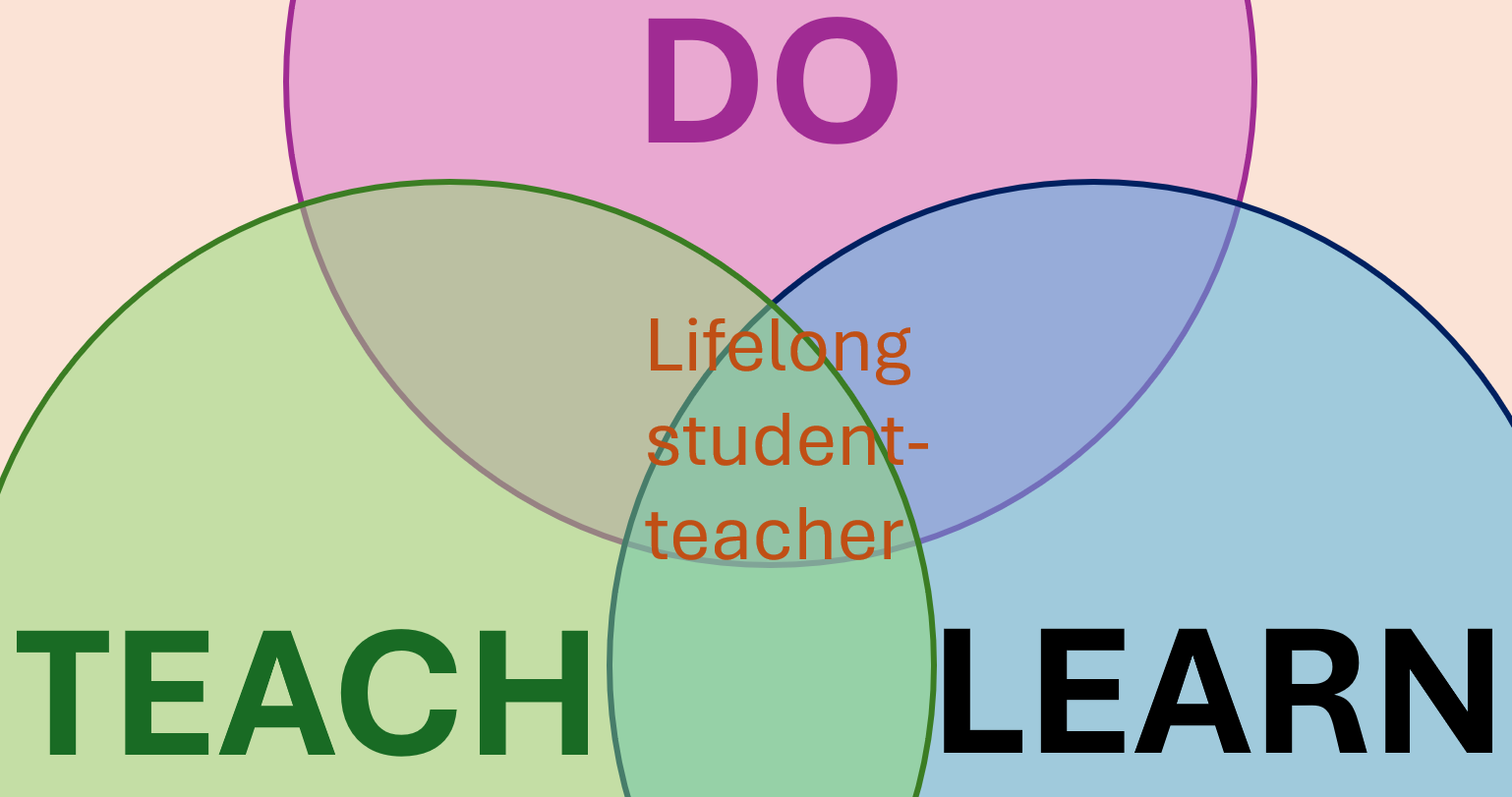
At the intersection of learn-it-all, teach-it-all, and student-teacher is the ultimate: the lifelong student-teacher. In the moment, you are simultaneously delivering success, teaching others, and learning from others. Lifelong student-teacher is the ultimate flow state for meaningful contributors. Stay in that state for a prolonged period of time, and you will be seen as a force multiplier for the team.
There are examples above that capture the real-time aspects of teaching and learning.
From learn-it-all, the Fixed/Growth Mindset whiteboard stickers are designed to catch you in the act. If you’re in the middle of a meeting and you notice a fixed mindset example from this sticker, you can create a moment of insight in the room by directing attention to this, and then you all can take corrective action.
From teach-it-all, I give two perfect examples of teaching in the moment: “Deliver more wisdom and insight in your code reviews and your doc reviews. Give more context on your line of thinking when you answer questions in email.”
From student-teacher, to successfully teach, you have to be observing the audience for reception, and learning better how to teach from it. So when you’re in student-teacher mode, you are already operating in the moment.
Be vigilant for opportunities to blend your Do, Learn, and Teach. They are more plentiful than you realize.
Footnotes
The “Three ‘Who’s” section of “So What?”
The “Important vs. Urgent” section of Play the (Really) Long Game
The “Leave a Paper Trail” section of Raising My Voice
Stop Telling Women They Have Imposter Syndrome, Tulshyan and Burey
Wow, a record number of footnotes here! 🙂 Plenty of potential for you to deep dive on. Enjoy!
Maybe my favorite post yet, given my passion for this space. Great summary. As I've immersed myself in this space one aspect of student-teacher that I find super compelling is the neuroscience behind what happens when you teach/share something that deepens your own learning on that topic. Such good stuff!