


In The Seven Habits of Highly Effective People1, Stephen Covey divides seven habits into two spheres: private victory and public victory2. The first three habits help move you from dependent to independent to become a more effective individual. This is your private victory. The next three habits help move you from independent to interdependent to become a more effective member of society. This is your public victory. The seventh habit is renewal, where you regularly revisit and hone the other six habits, iteratively raising your overall effectiveness.
In his introduction of the public victory habits, Stephen introduces the term “Emotional Bank Account”, which he defines as “the amount of trust that’s been built up in a relationship.” Relationships are complex and varied, making them very hard to assess. That’s not really a problem, because we spend less time evaluating relationships than we do experiencing relationships. Nonetheless, having tools to help measure both the health and value of a relationship can be helpful to periodically assess the give and take of a relationship.
With an Emotional Bank Account, you are making deposits when you invest in the relationship and build energy and trust, and you are making withdrawals when you sap that energy or betray that trust. Your strongest relationships have a high balance in their accounts, while your weakest relationships are the ones that are at risk of being overdrawn, or perhaps already are.
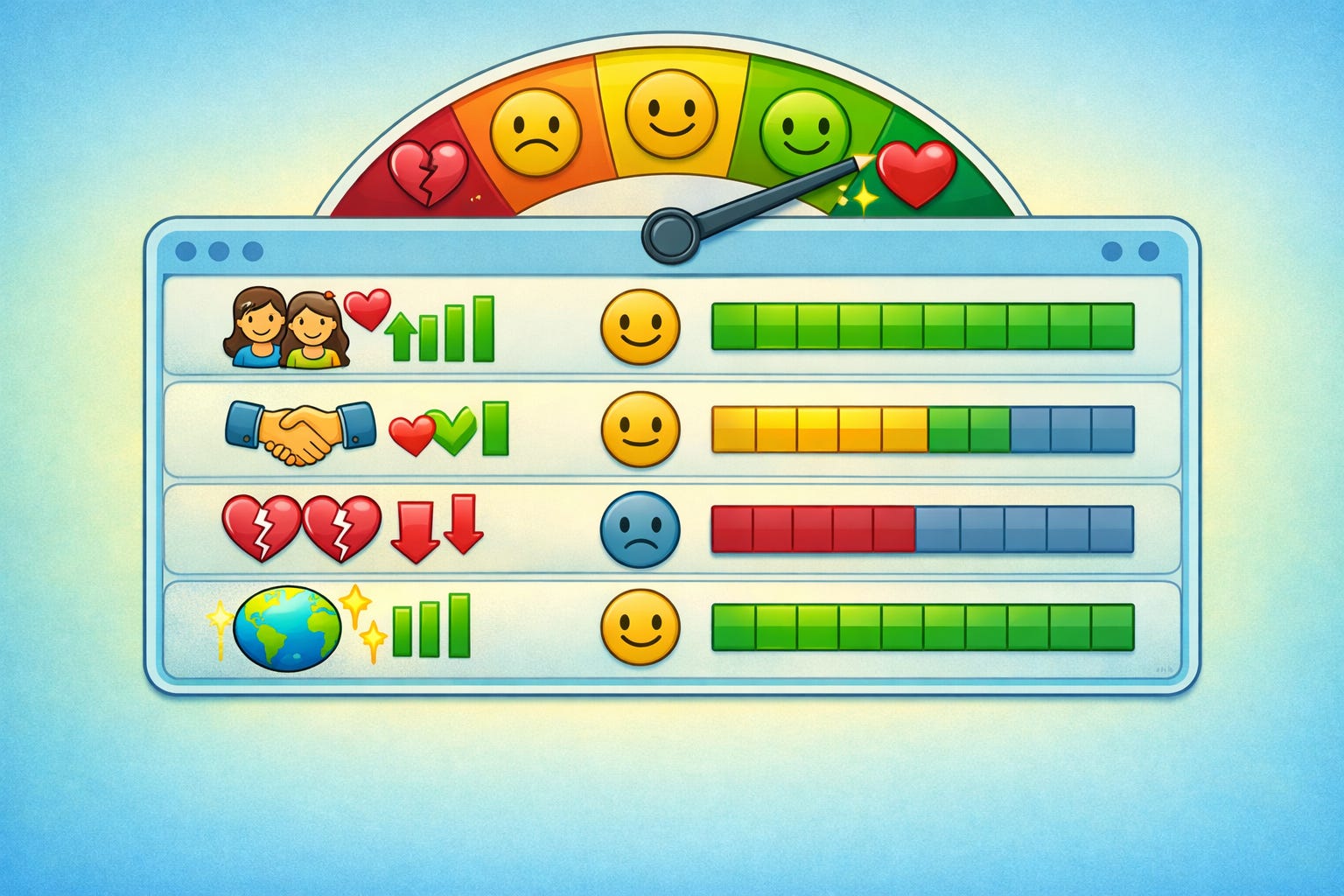
I like the metaphor of a bank account to represent the stockpiled energy and trust in a relationship, and I’d like to expand on this. Emotional Bank Accounts are very specific, with each account relating to a single relationship. A person can have a highly positive balance for one relationship while running negative for another relationship. Your public victory comes from intentionally managing all of your Emotional Bank Accounts … your overall Emotional Credit Rating.
This isn’t about keeping score, but about raising your own awareness3 on how you show up in your relationships. You can use these insights to invest strategically in your relationship portfolio, becoming a more effective individual and a more effective member of society.
Here’s how to measure and manage your own Emotional Credit Rating.
Computing your Emotional Credit Rating
In The Meaning of Your Life4, Arthur Brooks describes another approach to measuring a relationship: by depth. In Nicomachean Ethics, Aristotle defines three levels of depth in relationships:
Friendships of utility - Individuals are useful to each other for something they each want. Arthur describes such friendships as, “There’s nothing wrong with these friendships, but they don’t bring significance, because they aren’t about your being, only your doing.”
Friendships of pleasure - These are friendships based on the pleasure you bring to each other. Arthur says, “These are very nice relationships to have, but they can’t give you a sense of meaning because, once again, they are about doing, not being.”
Friendships of virtue - These relationships are based on mutual respect and admiration. Arthur calls these, “The relationships that bring true meaning—they define why your life matters … They love your being and you love theirs.”
This depth framing sets up an Arthur exercise. “Make a list of the ten people with whom you spend the most hours each week—colleagues, family members, acquaintances. This includes in person or virtually. Put them in order of time spent with each. After each name, write utility, pleasure, or virtue. Of course, some are more than just one. Write the highest level, not the lowest. But be honest with yourself. If your partner only likes you because you are physically beautiful, this is not a virtuous friendship.”
Once you’ve done this exercise, you just need to add one more step to get to your Emotional Credit Rating. For each relationship, write down the Emotional Bank Account balance for that relationship, a number in the range of -10 to 10. -10 means completely overdrawn, 0 means even, and 10 means couldn’t be any higher. Then add a short explanation for that number. Is the give and take even or one-sided? Is it more of an energy giver or an energy taker5?
Now you have a clearer picture of your current Emotional Credit Rating. Are you happy with the rating or do you want to take steps to improve it? Here are some options to consider.
Add a friendship. Do you feel like you have more to give … and more to get? This exercise may make you realize you’re not connecting with others enough. Put yourself out there more to discover new friendships. As your elementary school teachers told you, “A stranger is just a friend you haven’t met yet.” 😜Is there a running group you could connect with? Is there a volunteer opportunity that resonates with you? There are countless ways to create more connection opportunity. Just a word of caution: more time on social media won’t equate to more friendships.
Upgrade a friendship. Is there a friendship that you want to promote to a friendship of virtue? Or maybe you’re already there, but you don’t get enough time together. Recognize the potential of these stronger friendships and invest more in them. This just happened with me, when I was visiting a colleague at Microsoft last week. Earlier in our careers, we were part of a philosophy discussion group where we saw each other monthly. Now, we had only seen each other twice in the last year. At the end of our meeting last week, he said, “it’s conversations like this that have me wanting to do this more.” I agreed, and now we’re comparing calendars to find a monthly 1:1 slot.
Downgrade a friendship. Has a friendship run its course at the current depth? Should it be demoted to a pleasure friendship or a utility friendship? Be honest with yourself and ask if the friendship has run its course and should just be removed entirely. Entertaining this question is a good test, as it may reveal hidden value you hadn’t realized. But if it doesn’t, then let it go. Remember this: “I have an infinite capacity to love, but a finite time in which to demonstrate that love.”6 Choose wisely.
Change the energy. Relationships take work. It’s not just about happy times together. A friendship of pleasure may be a complete energy giver, but a friendship of virtue is going to come with some energy taking along with the energy giving. But check the overall energy balance. Has a relationship become too much of an energy taker? If that’s from your own side, then how can you be more of an energy giver to the friend? If that’s from the other side, can you bring that to their attention to see if they can make some intentional change? If not, then consider option #3 above.
Check your Emotional Energy Flywheel5. All things considered, are you feeling revved by the collective energy of all of these relationships? There are times when you may be putting yourself out there too much, to the point where you are threatening your own emotional well-being. “Remember to put your own mask on first before helping those around you.”7 You will be a better long-term friend to more people if you are keeping your own energy up.
Diversification
Just as your financial credit rating improves with more “active credit”, so does your Emotional Credit Rating. Don’t rely on one Emotional Bank Account for your entire credit rating.
My parents were of the generation where they liened on each other as needed, but kept others at arm’s length. They had friends, but in Aristotle’s terms, they were predominantly utility friends and pleasure friends. As Pop started to struggle both cognitively and physically, my Mom went into her own private hell cave. She remained hesitant to share the difficulties she was having even with her own children. We continually encouraged Mom to share the load with us, but old habits die hard.
This underscored the importance to me of having a diversity of deep friendships. Not only does it give me a larger pool of wisdom to draw from, but it also prevents me from burying one person in all of my liening. My Mom’s experience with my Dad changed how I viewed my own marriage, for the better. I love Charu, and it’s no surprise that our relationship tops my list in Arthur’s exercise above: I rated our Emotional Bank Account balance at the highest rating of 9 (I don’t give 10 because I believe there’s always room for improvement). But with other virtuous friendships in the mix, I don’t over-rely on Charu. We are interdependent, not codependent.
The “World” Account
In addition to the Emotional Bank Accounts you have for each of your friendships, there is also a general bank account that you should be more aware of: the account for your relationship with the world. Just as there are times when you can thank the individuals in your life for the help they’ve given you, there are those times when the world helps you out. You may call this karma. Or, for those who were part of the “Practice Random Acts of Kindness and Acts of Senseless Beauty” movement from the 80s, you may call it intentional randomness.
I grew up in Richmond, Virginia, where we had several tolled roads: Powhite Parkway, Downtown Expressway, I-95, and the Boulevard Bridge (nicknamed “the Nickel Bridge” … and then updated to “the Two-Nickel Bridge” when I was a kid). And for the younger readers, tolls back then went coins tossed in a basket (or given to the toll operator) to lift the gate. No fast pass electronic scanning.

When my family would go on a road trip, it often involved a small caravan of cars -- a family of 7 kids + 2 parents + relatives didn’t easily fit in one vehicle. When we’d reach the toll booth, dad would be in the lead car. He would tell the toll booth attendant that he was paying for the two cars behind him as well. Then he would stick his arm up for us to see, hold up two fingers, and then point forward, telling us he had paid for us already. We would then drive straight through, with the operator waving us by.
Shortly after I was driving age, and I found myself more commonly going through these toll booths, I was reminded of my dad doing this. Being someone who looked for opportunities to make a routine event more fun, I decided to start paying for the person behind me. It was an extra quarter (in most places), which was a cheap cost to feel good. And it did make me feel good. So I kept doing it. My friends asked me why I did it and I just answered, “I’m going to keep doing it until someone does it to me, because then I’ll know the idea has caught on.” And so I kept right on paying for the person behind me.
I did get several people tracking me down after the toll booth, racing up to catch me (no small task given my general driving speed) and honking or waving in thanks. But I never got my toll paid for me by a stranger. But 30-some years later, at a Starbucks drive thru in Wenatchee, Washington, I was given a withdrawal from my World Bank Account. We got to the window and the Starbucks employee handed me the tea, saying, “The person in front of you just paid for your tea.” I immediately asked, “Well can I pay for the person behind me to keep this going?” He responded, “They paid for them, too.” I said, “Sweet,” and drove off, with a very big smile on my face.
You do good for other people, and other people will do good for you.
Footnotes
The 7 Habits of Highly Effective People, Stephen Covey (Goodreads)
References to Public & Private victory in previous posts
No surprise that a mention of Trust gets my attention. Super interesting to think about not only the overall emotional credit score, but the specific investment area of Trust and how those rate in any given relationship.