


When I decided to take a week-long trip on my own, leaving my pregnant wife and 2-year-old son at home, it was not really received well by any of our family. Quite understandably, dropping the family and flying away on my own doesn't seem like a signal that things are going well. I called it a retreat, borrowing the term from my Catholic upbringing where retreats were the accepted way for individuals to separate from their family for several days of independent reflection. But regardless of what name I gave it, I had a hard time selling it.
All I knew at the time was that I needed to get away. It wasn't about my family, or my friends, or my work. It was really just about me, and something I had been wrestling with internally. My wife called it my early onset midlife crisis, and I think that's a reasonably good summary. I would expand on that a bit and say, looking back from the other side of it, I had been in auto-pilot on too many aspects of my life, and wanted to become more intentional. And this required a little bit of mental housecleaning.
Everything wasn't solved in that one week away. But what that retreat did do was initiate a nine month period of change, where I slowly but surely course-corrected to better align my actions and my principles. And in the decades that have followed, I am a better person because of this reset. With a clearer sense of purpose, I have been able to contribute more and have a deeper impact on the lives of those around me.
In The Seven Habits of Highly Effective People, Stephen Covey shares this gem: "Private victories precede public victories." That is exactly how I feel about the path I took, and I'm celebrating the public victories that continue to come. It feels exactly like what one of the corporate athletes (see the HBR article I shared earlier1) described, "I really do believe that when you learn to take care of yourself, you free up energy and enthusiasm to care more for others."
The Oxygen Mask Principle
If you've ever been on a plane in the United States, then you've heard this classic FAA line, "Remember to put your own mask on first before helping those around you." This line applies to far more than just airline travel. Let me break this line down to highlight all the wisdom packed into these 12 words.
"Remember …"
This line starts with a very important word, and it's not there randomly or just for politeness. This line is talking about a critical situation. In the rare event that you're actually required to heed these words, it's because an oxygen mask on an airplane has just appeared in front of you, signaling the high likelihood of imminent danger. This is a time when it's hard to think, and hard to remember. In stressful times, the more that you are able to slow down just enough to allow your normal brain functions to do their thing, the better the outcome. In this case, by letting your brain have a second, it can remember the FAA's wise statement and begin to take appropriate action.
"… put your own mask on first …"
First and foremost, you have to ensure that you are able to continue operating. If you asphyxiate, the story ends, and we don't need to worry much about what the rest of this line is instructing you to do. This phrase is meant to give you the green light on being selfish, in a world where selflessness is celebrated. Yes, it's selfish. But it's an okay selfish. It's warranted. It should be guilt-free. You have to take care of yourself first. This is not a new concept. Well before there was an FAA, there was still, "You have to love yourself before you can love another", and, "Clean up your own room before you clean up the world". Put first things first. And you being operational is first. Because that sets up the next part of this call to action.
"… helping …"
With your own oxygen mask in place, you're now in a better position to help. All of you on the plane are in a dangerous situation, and to have the best possible outcome everyone is going to have to help out. So get involved. Work the problem. Cooperate with your fellow strugglers. This isn't a time to sit back and let the handful of pilots and attendants do all the work. There's a great quote from the rafting company that took my family through the Grand Canyon: "Actively participate in your own self-rescue." Help the situation. Help the group. Help.
"… those around you."
Time is of the essence. You have to start helping somewhere, so why not the people immediately next to you. Then you can work yourself further out from there. But be careful … that oxygen mask you employed in step #2 can't reach everywhere on the plane. But that's okay, because other fellow passengers will have been following this guidance and be helping those around them. "It takes a village."
Now, of course, the chances of you being in a situation where you have to apply this guidance literally is very small. But that is just one extreme example of where this line is valuable. Apply this instead to your everyday operation. Where is there chaos, pain, even danger in your work or in your life? What can you do to get yourself to a better state, and then help your fellow strugglers? My retreat was my oxygen mask.
Reach. Throw. Row. Go.
Once you're in a position to help others, here's an approach that will allow you to maintain your own energy while racking up more public victories.
I took senior lifesaving in the summer of my 15th birthday. It was a prerequisite to getting a job as a lifeguard at our pool. Among all the incredible hands-on training that was taught, there was a phrase that stuck with me: Reach. Throw. Row. Go. This was the checklist you were supposed to go through whenever someone in the water was in need of rescue:
Reach - from the safety of land, can you reach out to the person, like with a pole?
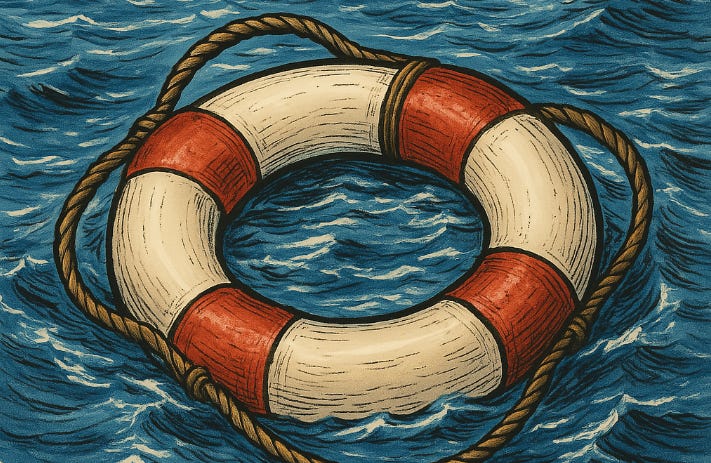
Throw - from the safety of land, can you throw something to the person, like a life preserver or a rope?
Row - is there a watercraft you can ride in to get to the person?
Go - after you've exhausted all other options, then it's time to get in the water yourself to help the person.
The reason for this order is because #4 is the riskiest way to help someone in trouble in the water. By being in the water with the struggling person, it puts you in harm's way. When someone is drowning, they're not thinking rationally or considerately. They're just thinking: "survive!" So once you're within their reach, they will use you to keep themselves afloat, even if that means you don't end up afloat in the process. This is why all the additional instruction provided with the "Go" stage is about the safest way to approach the person in distress. You tell them, "I'm coming. Before I get to you, you need to turn around so that I can properly tow you." When they comply you swim up to them from behind, fully prepared for them to reflexively spin around (in which case you would immediately go underwater so they don't find you as attractive to climb onto, then re-emerge and repeat the earlier phrase). Once they comply, from behind them, you reach your arm under their arm and across their chest, hooking them securely and ensuring that they stay facing that way. Then you pull them onto their back where they are the most buoyant and tug them back to shore by swimming under them.
Much like the earlier FAA line, this lifeguard checklist applies to more than just a literal lifesaving event. When you are helping a colleague out at work or at school, this checklist gives you a great framework for engaging.
Reach - Is there an obvious answer or a simple remedy? Share it.
Throw - Is the problem that they're facing solved with a tool that they may not be familiar with or haven't yet learned how to use effectively? Show them the tool and right way to use it.
Row - If it's a more challenging problem, then stand behind them, look over their shoulder, and ask them to walk you through the problem. The key here is to not take the pen or touch the keyboard. You are just observing. Many times just this clearer articulation of the problem can unblock them. Even if not, you're now have enough context to offer suggestions for them to try.
Go - You've now exhausted all other options, and now to help them, you're going to have to take the pen or touch the keyboard. Make sure they don't just sit back and let you do all the work. This is another great place to use the rafting guide's line, "actively participate in your own self-rescue."
Sustained Service
The "Go" stage, either literally in the water or metaphorically at work, demands far more of your energy and your time than the previous three stages. So, to sustainably serve, you have to make sure that you're making enough use of the earlier "Reach", "Throw", and "Go" stages. Going back to last post's Energy Flywheel1 topic, struggling people are energy takers, so you have to make sure to incorporate energy replenishment into your routine after assisting.
Self-sacrifice to help is commendable, but self-care that unlocks continuous help is next level.
Reflecting on your own energy management, what is one self-care investment that you can add into your routine to accelerate your energy flywheel, to set you up to be able to give more to those around you?
I love in your opening you call out INTENTIONALITY. I've seen this concept threading through several posts and I really believe one of the keys to all of this is to just be more intentional in what we do, and why we do it!