


Arnold Bennett wrote a self-help book. Obviously, there are thousands who have written self-help books. What stands out about Arnold is the year he wrote this book. "How To Live on 24 Hours A Day" was published in 1908, making him a pioneer of the self-help genre. His opening includes the line, "It is always the man who has tasted life who demands more of it. And it is always the man who never gets out of bed who is the most difficult to rouse." I love the way Arnold captures this. Any taste of awakeness makes you hungry for more. Whereas the sleeper merrily continues to sleep.
Here is another 2002 scribble of mine (I was doing a lot scribbling in 2002, but that's a story for another time):
The Crime
It is not a crime to be unaware that you are on a journey.
It is a crime to know of this journey yet do nothing to advance it.
Combining Arnold's quote with my scribble, this is a call to action for you: wake yourself up! This is my step-by-step process for building your own awareness muscle, to make sure you're part of the awake crowd and not the slumbering crowd.
Awake
Merriam-Webster defines "awake" as, "verb: to become conscious or aware of something; transitive verb: to stir up; adjective: fully conscious, alert, and aware." The words "conscious" and "aware" in here are the perfect lead-in to the introduction of the four stages of awareness:
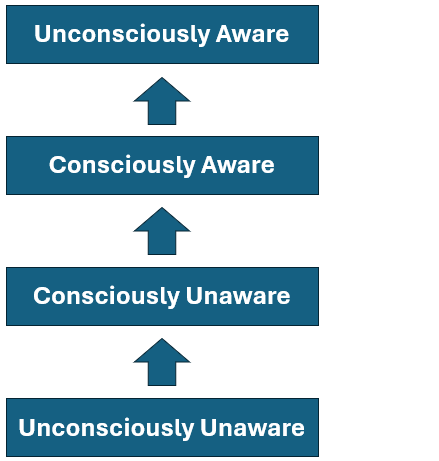
Unconsciously unaware -- ignorance is bliss. You don't know what you don't know.
Consciously unaware -- you realize that you lack awareness.
Consciously aware -- through active intentional effort, you increase your own awareness.
Unconsciously aware -- you've practiced awareness to the point that your awareness is now second nature, incorporated into your normal operation.
For any given topic or skill, these four stages are the arc you will go through as you develop your ability related to that topic or skill. Here is the action you take at each stage to advance you to the next stage:
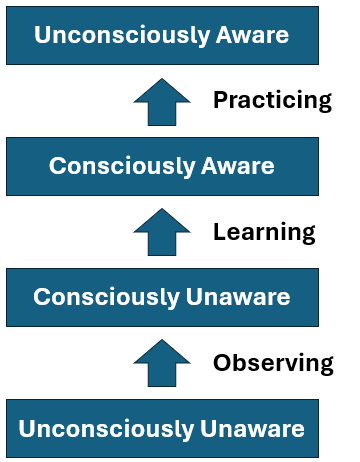
Observing moves you from unconsciously unaware to consciously unaware. You have discovered your own unawareness.
Learning moves you from consciously unaware to consciously aware. Intentionally (consciously), you are devoting energy to increase your awareness.
Practicing moves you from consciously aware to unconsciously aware. With more time devoted to your own awareness, you are making it more automatic. It's literally habit-forming.
Arnold Bennett is calling out the challenge of waking up, of moving from "unconsciously unaware" to "consciously unaware," of observing.
Awake is the state you reach after you've observed. You've noticed. You've realized. You've had an "a-ha moment" … a "moment of insight". So if we want to be more awake, we simply "observe more." How exactly do we do that? If you want to learn more, you know what to do. You gather learning materials, you build a plan, and you execute. If you want to practice more, you know what to do. You carve out the time and you "do the reps." But how do you observe more?
Arnold's point is that the best way to observe more is to start observing. A taste for observation, and all the downstream goodness that follows, will have you demanding more of it. Look at the above awareness arc and reflect back on examples of where this arc has best served you. Where has an observation resulted in you bettering yourself? The more observation wins you have, the hungrier you will be to observe more. That hunger will keep you more vigilant, increasing the likelihood that you will notice. Noticing begets more noticing.
Getting Better At Observing
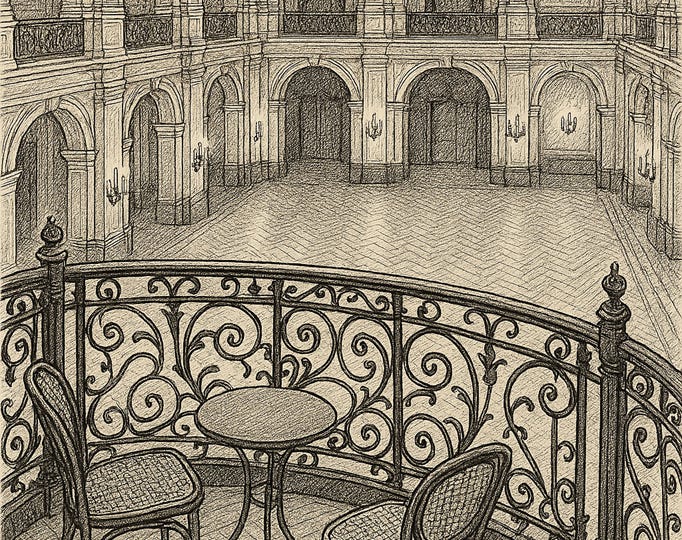
So how can you build your "noticing" muscle? Ronald Heifetz articulated it beautifully when he described a dual focus of "being on the dance floor and on the balcony at the same time." Everyone already has this happening. It's not uncommon to find yourself questioning your actions as you're doing them. The key is to raise awareness of this observer in you so that you can use them intentionally rather than accidentally. The more you leverage the observer, the more the observer will step it up. Provide structure to encourage the observer to come forth. The goal state is an ever-present observer that you can check in with as needed; your own personal advisor that's there 24/7/52.
Your observer is watching you … and the entire environment around you. So make sure the observer doesn't become a Me Monster1. If you're only utilizing them to check yourself, then you're missing out on the greatest power of the observer: to pick up on all the cues in the room, to read the room.
Here's how you can develop your own observer.
1) Crawl: The Daily Journal
Five minutes a day is all you need to get started. Don't force it longer. But as your observer starts to have more to say, don't limit it either. It doesn't matter so much what you capture here. What matters is giving the observer time and a venue for full freedom of expression.
The ideal time to do this is 30-45 minutes after the end of your work day. Give everything time to simmer. Your observer is using that time to process things. You may even hear impromptu thoughts from your observer as this is happening. If you have a work commute, make the daily journal time be when you arrive home after a commute. The second best time is right at the end of your work day. The third best time is at the very end of your day.
Set a timer for five minutes. Start off by asking yourself the question, "What did I notice today?" Keep the question general, and you'll elicit general responses. If you're too narrow about it, like "what did I notice today at work?" or "what did I notice today about where I helped others?", that will unnecessarily limit the scope of your responses. Once the question has been posed, just start capturing whatever comes to mind. When the timer goes off, you've captured enough. If you have more streaming in, feel free to stick around and capture more. Or call it a day, knowing you've accomplished the Crawl goal.
Your inner observer will celebrate this regular outlet. And the more regular you make it, the more your observer will reward you. Do this daily journal consistently for three weeks, and then put the day 1 journal entry next to day 21. Look at your growth in observation.
2) Walk: The More Often Journal
Think about the different modes that you operate in, at work or at home. Examples include Communications (email and chat), Architecture (document or specification), Team Driver (process management and status mails), and Culture Representative (event planning and presentation building). For each mode, select one time block in the week when you're in that mode. Then add 1 minute before and 4 minutes after each selected time block.
1 minute before: tell the observer to be on alert, because you're going to be checking in with them in an hour. Give yourself a brief moment of pause to reflect on the actor (dance floor) / observer (balcony) dual focus.
3 minutes after: open your journal, write the date and the mode, ask yourself, "What did I just notice?" and then start transcribing what the observer says.
1 minute after that: read the notes and see if you can identify one thing you would like to change about that experience.
At the end of the week, put 30 minutes on the calendar to read through these notes and determine what concrete change or changes you want to try to implement next week. Do this for four to six weeks, long enough for you to have been through enough weekly reviews of this to look for trends. Where has your observation most improved? The measure of success here is when you spot your observer coming forward outside of these pre-selected time blocks.
3) Run: In The Moment
By this point, your inner observer feels very loved. They feel recognized. They feel heard. Now you're at the stage where your inner observer simply won't shut up. This is great! You've reached the goal state of the ever-present observer. Now you just have to keep up. You have to give your observer attention in the moment.
Marty Seligman2 describes this fascinating "temporal pattern" that our brains demonstrate. "One very interesting property of the default circuit is there seems to be a temporal pattern all day long in which you listen to what I’m saying for about 90 seconds, and then you go inward … All day long our external circuits are turned on, those go for about 90 seconds. And then we … integrate what we’ve just heard in the last 90 seconds in the external world with what our current concerns are and what our future looks like." This explains how subconsciously you are already switching back and forth between acting and observing. At this rate, your inner observer clearly has a lot of material to work with.
To keep up with these incoming observations, your observer journal needs to be ready at a moment's notice, and you need to be able to "get in, get out, and get back to life."3. You can go simple and just carry a small notepad around with you that you can jot a word or two down on and be done. Or, you can go high tech and have an electronic notebook one keystroke or screen tap away. I am a OneNote guru and I have my full set of notebooks available to me on all of my devices. And if I don't know where the observation belongs, then I have a "Loose Scribbles" page just for that. Or if I have a post-it note handy, I will just use that.
Now that you're on-demand capturing your observers call outs, you'll want to give yourself a small (5-15 minute) timeslot every week to refer back to these notes and determine what actions you are going to take to instigate change. This is one component in my weekly review that I have on my schedule as my last action for the week, on a Friday afternoon.
Raising your own awareness is foundational to intentional development. So, as my parents used to always say to us in the morning, "rise and shine!"
Footnotes
Brian Regan's "Me Monster" comedy bit for the best description I've ever heard of this term.
A Deeper Understanding of Creativity at Work (hbr.org) @22:10
A great tagline from the Windows Phone "Really" Ad back in 2010. This remains one of my favorite Microsoft ads ever. And, as an aside, what do you think this ad would look like if it were made in 2025? Crazy how much more glued to our phones we are now, 15 years later.
Love this. Take TIME to NOTICE. And the Unconscious to Conscious to Unconscious model is one of my favorites. I use it with "incompetence" to "competence" vs awareness, but it has the same level of usefulness.
4:30 observation journal appointment series set!