


My family loves Lake Chelan. My wife grew up taking summer trips there, and she kept that tradition going when we had kids. Lake Chelan was our last trip of summer vacation with the boys, every year for probably 15 years. We love it out there so much that we now have a house out there, and for the last two years we’ve spent most of each summer out there.
Lake Chelan is full of happy memories … alongside of three terrifying memories. I have had three near-drowning experiences in my life, and all three of them happened in the middle of Lake Chelan. So when we got a house out there, I committed to replacing those terrifying memories with more victorious memories.
Growing up, I spent most of every summer in water. Earlier, my family lived at Virginia Beach, where I got comfortable with waves and current. Later, when my family moved inland, I spent most of my summer with siblings and friends at the neighborhood pool, where I did one summer of swim team and later took the senior lifesaving course1. I never had any brushes with drowning there. So what was different about Lake Chelan?
In all three Lake Chelan episodes, we were on a boat, diving into the middle of the lake away from any shore. I had no experience with that. In the ocean, we walked and bobbed more than we swam. And in the pool we swam from one side to the other. But here in the lake, there was no bottom, and there were no sides. You just swam around. What I came to realize was that, as a swimmer, I was always sprinting. There was no zone 2 movement. I was always revving. So, without a bottom and without sides, I was revving straight up to zone 5 and exhausting myself.
The good news is that that’s exactly how I started with cycling. So I have a good amount of experience at getting myself to slow my roll to extend my range.
Armed with a better understanding of what contributed to my bad experiences, I set my goal and built my plan. And six months later, I hit my goal: swimming a mile in Lake Chelan from Manson to my house without stopping!
I credit the Workout Mentality for my success. I took a big goal and I carved it into a progression of workouts that continued to stretch me, one workout at a time. I took each workout seriously, and just as seriously tracked my progress.
It’s obvious to apply a Workout Mentality to physical development. But it is equally applicable and rewarding to bring a Workout Mentality to your mental development as well. I gave a Productivity Workout series of classes at Microsoft, and those demonstrated how to bring a Workout Mentality to the development of your space, notifications, routine, communications, and work management muscles.
Think big. Act small.
You need a meaningful goal that inspires you. Aim high when setting your goal. You want to stretch yourself, and feel proud of yourself when you achieve that goal. Once you’ve set your goal, the easy part is done. Now comes the real work.
How will you achieve this goal? What are the skills/muscles you have to develop? They could be furthering skills that you’ve already developed, or they can be entirely new skills. Plan accordingly. Break the development up to give each increment its own specialized workout. Here were my 10 ten steps to achieving my one mile swim.
Swim with data. Get a swimming watch so I can measure my heart rate and pace.
2024.04.10 - pool 330yd - “I’m pining for the moon” | Swim | StravaSwim 1/3mi in the pool. Rule for all pool swims: I can turn and kick off the wall, but my hands can never touch the sides.
2022.05.16 - pool 600yd - 1/3 mile | Swim | StravaSwim 1/2mi in the pool.
2024.05.22 - pool 855yd - Distance Record | Swim | StravaSwim 1mi in the pool. Prove that I have the endurance to swim nonstop for one mile
2024.05.24 - pool 1,786yd - First Mile Swim ... With Obstacles | Swim | StravaSwim in lake and tread water. Swim out to the buoy line, tread water for two minutes, swim back.
2024.07.11 - lake 178yd - Swim and Tread Water | Swim | StravaSwim lateral to the shore. Swim out to the buoy line, swim to the next buoy, swim back to the dock.
2024.07.14 - lake 378yd - Swam The Buoy Line | Swim | StravaSwim 1/4mi in the lake. Swim out to the buoy line, swim 1/8 of a mile along the line, swim back to the dock … out and back makes it about a 1/4mi swim.
2024.07.23 - lake 805yd -Longest Lake Swim | Swim | StravaSwim with a swimmer’s buoy. Swim out to the buoy line, float with my swimmer’s buoy for 2 minutes, swim back
2024.08.16 - lake 582yd - First Safety Buoy Swim | Swim | StravaSwim 1/2mi in the lake. Swim 1/4 mile along the line … out and back makes it a 1/2mi swim.
2024.08.17 - lake 967yd - First Half Mile Open Water Swim | Swim | StravaSwim 1mi in the lake. Start in Manson Bay, swim to my dock.
2024.08.23 - lake 1,831yd - Mission Accomplished | Swim | Strava
The five critical attributes of a workout
Once the plan is in place, and it’s time to execute, the key is to take each individual workout seriously. Here are the five attributes of a successful workout:
Complete attention, “All in”, for a short amount of time. The goal is the future tense, but your workout is the present tense. This is not a time for multitasking, and this isn’t just about working until the timer goes off. You need to give this workout your complete attention. I gave several mantras in Timebox Everything2. My go to chant is almost always, “Take care of the minutes, and the hours will take care of themselves.”
Hyperaware of yourself and of your environment. By giving this workout your complete attention, you are raising your consciousness and you are in a state where you can be more observant of how your body and your surroundings are responding. How are you feeling? What exactly is fatiguing you most? Where is it going easier than you had imagined?
Focus on one specific aspect of development. Rome wasn’t built in a day, and you’re not going to reach your goal in one workout. Each workout isolates one skill for development. Each workout is a bite-sized dose of growth.
Push yourself. Each workout needs to stretch you. You should feel spent at the end of the workout, in an exhilarated way. Push yourself to discover your new upper limit … knowing full well that that accomplishment will be temporary, to be eclipsed by your next pushing.
Log your work. When you’re done, record your effort. This is the reason my first step was to get to watch to give me telemetry from the swim. I had never measured my heart rate while swimming. Beyond the data, record your observations (from #2) from during the workout.
Incremental progress; compounding results
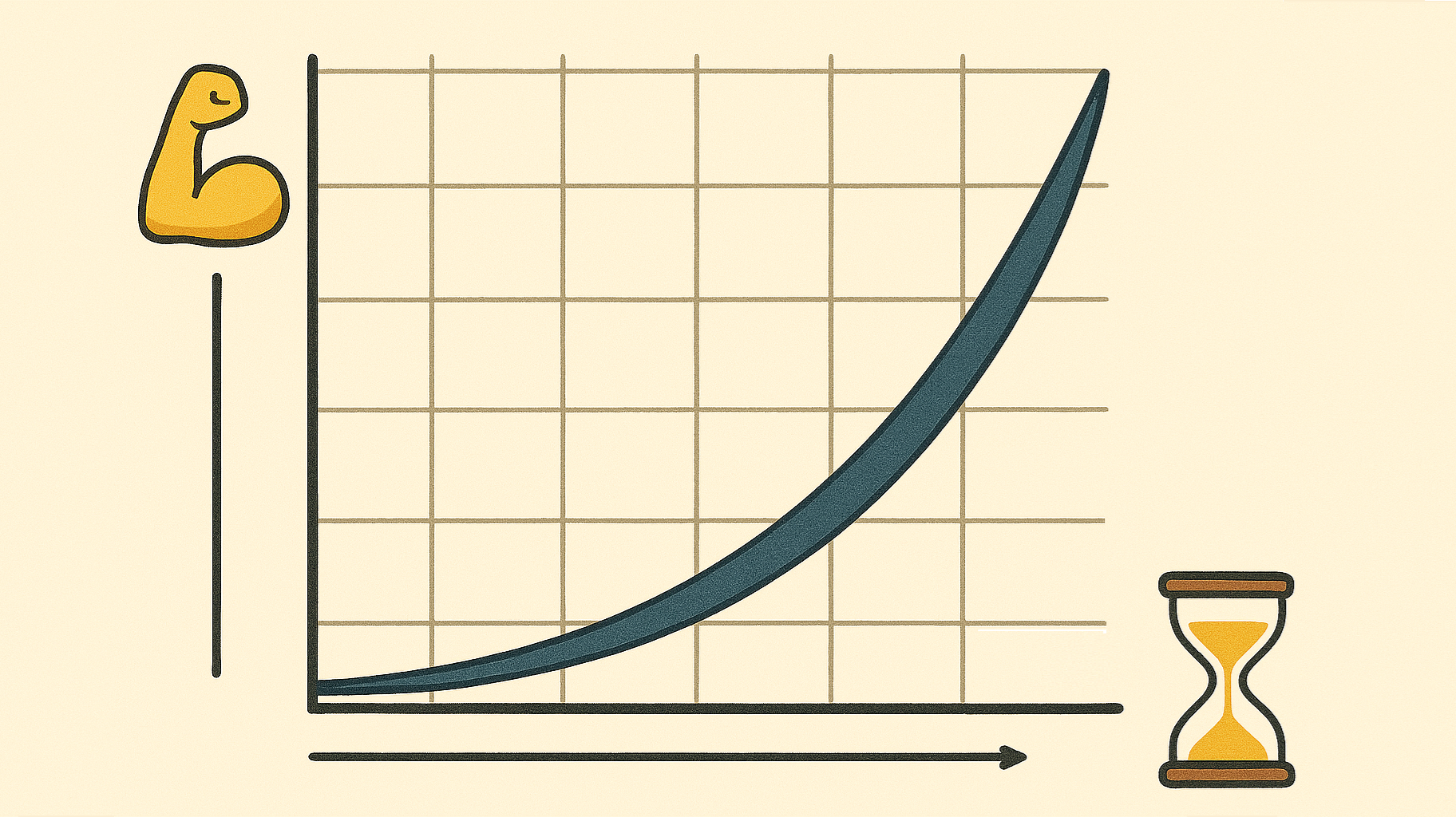
The Kaizen philosophy is continuous improvement. And that’s what the Workout Mentality exemplifies. James Clear said, “If you get one percent better each day for one year, you’ll end up thirty-seven times better by the time you’re done.”3 I follow James’ Atomic Habits approach and love his wisdom. But I have actually tempered his statement a bit. 1% sounds small, but it can start to get challenging to maintain day after day. If you say 0.1% better every day, you are 44% better at the end of the year. Yes, that’s far less than 37x, but it’s still a huge improvement over your baseline.
The 0.1% focus underscores two things. First, there is no improvement that’s too small to celebrate. Take the win. Second, it’s not about one improvement standing on its own, executed one time. It is about the compounding nature of that improvement helping you every day going forward.
Record your small wins for a month. Then sit back and read through all of these wins. You will see the additive nature in action, and realize how much long term impact small improvements make. This will energize you to keep looking for more small wins.4
I said in Work Year Wrapper5, “I don’t believe in New Year’s Resolutions, but I do believe in New Year’s Refinements.” Eight years ago, I made my final New Year’s Resolution. My Forever Resolution: incrementally improve, indefinitely.
The OG Workout Mentality
I recently read Ben Franklin’s Autobiography6. And when I encountered his detailing of his “13 Virtues”, I realized that Ben may be the original practitioner of the Workout Mentality. Here is the process he detailed.
First, he enumerated the 13 virtues that he aspired to uphold:
Temperance. Eat not to dullness; drink not to elevation.
Silence. Speak not but what may benefit others or yourself; avoid trifling conversation.
Order. Let all your things have their places; let each part of your business have its time.
Resolution. Resolve to perform what you ought; perform without fail what you resolve.
Frugality. Make no expense but to do good to others or yourself; i. e., waste nothing.
Industry. Lose no time; be always employ’d in something useful; cut off all unnecessary actions.
Sincerity. Use no hurtful deceit; think innocently and justly; and, if you speak, speak accordingly.
Justice. Wrong none by doing injuries, or omitting the benefits that are your duty.
Moderation. Avoid extreams; forbear resenting injuries so much as you think they deserve.
Cleanliness. Tolerate no uncleanliness in body, cloaths, or habitation.
Tranquillity. Be not disturbed at trifles, or at accidents common or unavoidable.
Chastity.
Humility. Imitate Jesus and Socrates.
Then he created a log with 13 pages, with each page capturing one week. Each time he violated one of his 13 virtues, he would be a dot in the appropriate box in the log.

The reason for having 13 pages is because each of these pages called out a different virtue at the top of the page. The above page was from his first week, when Temperance was his “virtue of focus” for the week.
Here it is best to turn to Ben’s own words, to see the incremental nature of his approach, the isolated focus each week, and the compounding nature of his efforts.
“My intention being to acquire the habitude of all these virtues, I judg’d it would be well not to distract my attention by attempting the whole at once, but to fix it on one of them at a time; and, when I should be master of that, then to proceed to another.”
“And like him who, having a garden to weed, does not attempt to eradicate all the bad herbs at once, which would exceed his reach and his strength, but works on one of the beds at a time, and, having accomplish’d the first, proceeds to a second, so I should have, I hoped, the encouraging pleasure of seeing on my pages the progress I made in virtue, by clearing successively my lines of their spots, till in the end, by a number of courses, I should be happy in viewing a clean book, after a thirteen weeks’ daily examination.”
The final step of Franklin’s approach was that this 13-week period became a repeating cycle. So after his first 13-week period where each virtue was taken in isolation, he would erase all the dots on the pages and go back through these 13 pages, only now he didn’t need to isolate each virtue. Having done that for the first pass, he was now observing the integrated pursuit of these 13 virtues.
This reminds me of Stephen Covey’s 7th Habit, “Sharpen the Saw”7. Stephen called this the “renewal habit”, and said after working through his 3 private victory habits followed by his 3 public victory habits, you were now supposed to continually revisit these 6 habits, refining indefinitely. It seems like both Ben and Stephen may have made the same Forever Resolution as me.
Break your growth down to well-designed workouts. And then give each and every workout your all. Record your progress to ensure that you can see just how these workouts have collectively improved you. And then just keep repeating that process.
Footnotes
The “Reach. Throw. Row. Go.” Section of Short Term Selfishness Enables Long Term Selflessness
The “Choose Your Mantra” section of Timebox Everything
How to Master the Art of Continuous Improvement, James Clear
The Autobiography of Ben Franklin, Benjamin Franklin (Goodreads)
The 7 Habits of Highly Effective People, Stephen Covey (Goodreads)