


An engineer on my team many years ago, Daryl, told the team a story about an airport deli with a very long line that he was in. The guy in line in front of Daryl was clearly getting agitated by how slow the line was moving, and was intently observing the one woman making the sandwiches, and the time she was taking with each sandwich, seemingly unaware of the length of the line. When that guy got to the counter, he commented to the woman that she could probably spend half as much time on each sandwich and still get the job done. The woman smiled and said, "I do one thing very well, and then I move on."
There is a constant debate over Time Management vs. Energy Management vs. Attention Management. Is one the most important? Are the others distractions? I think the reason it's debated so much is because they are actually necessarily intermingled. I do believe that Energy Management is at the top. You need to keep your Energy Flywheel1 spinning to operate at your best. And your Attention and Time Management contribute to your Energy Flywheel, so they are key components to this winning combo. The most sure fire way to add energy to your flywheel is with the deliberate direction of your attention to a single task for a fixed amount of time.
My previous post2 talked about the coping skills I've developed to mitigate the challenges of ADHD. My #1 coping skill is to timebox everything. I parcel out my attention clearly and strictly. And this yields a sense of accomplishment on an hourly basis that propels me forward in my day. I do one thing very well, and then I do another thing very well, and then another …
Choose your Mantra
The first step is to find the gem3 that most clearly captures the importance of expertly managing your attention and time. I have collected several winners over the years. I'll share my top five here to spark your thinking. If one of these speaks to you, use it. Otherwise, keep hunting to find your own (and then please do share it with me!).
"Take care of the minutes and the hours will take care of themselves." - Lord Chesterfield. There is a lot that you can get done in 15 minutes … when that 15 minutes is laser focused and devoid of all distraction.
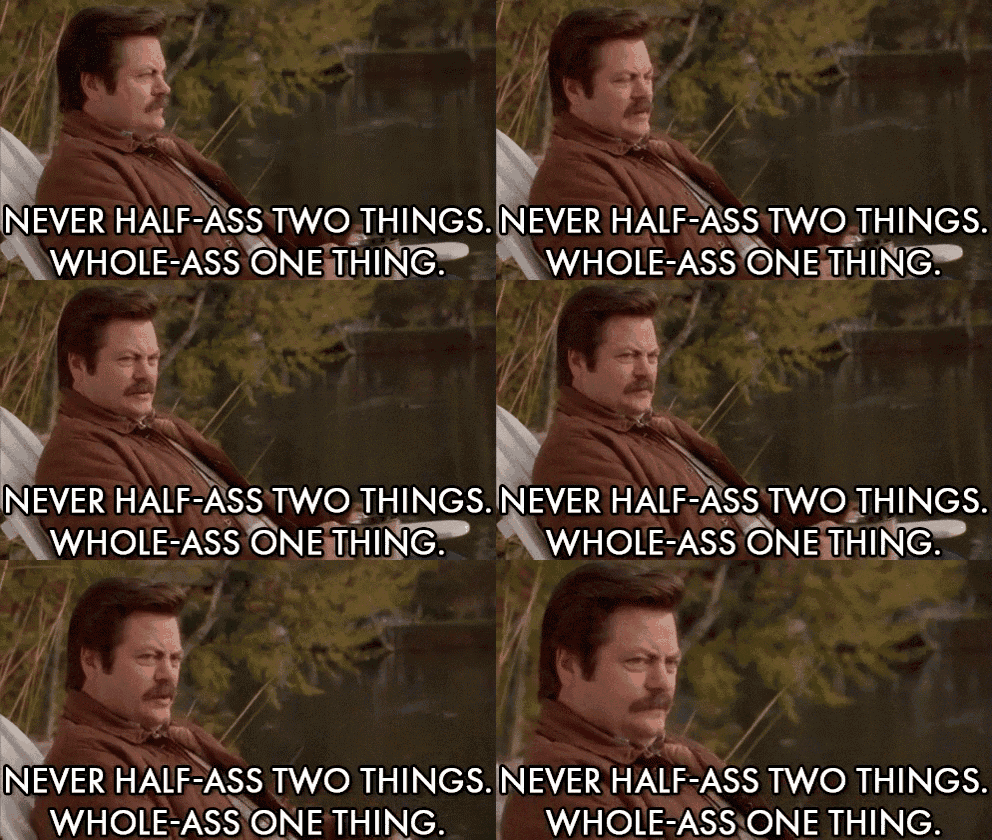
"Never half-ass two things. Whole-ass one thing." - Ron Swanson. I've used it in so many places, and it has real staying power. And my dad would have appreciated this one, as he always "tsked tsked" anytime he witnesses someone half-assing their work (aka "phoning it in").
"The bad news is time flies. The good news is you're the pilot." - Michael Altshuler. A great tip of the hat to intentionality. You are in the driver's seat. So instead of being a victim to the passage of time, be the architect of your time.
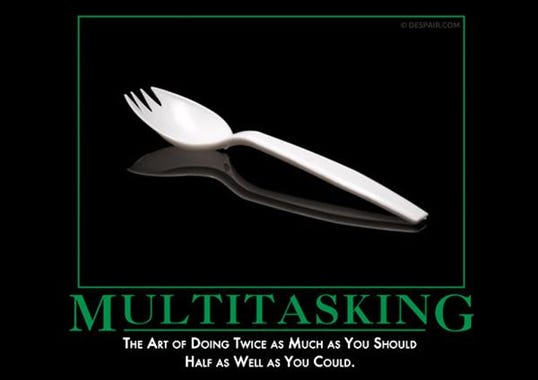
"Multitasking - The art of doing twice as much as you should half as well as you could." - despair.com. What I love most about Demotivational Posters is that on the surface they are jokes, but beneath the surface lies some biting truth.
Lord Chesterfield strikes again. Lord Chesterfield wrote many letters to his son in the 1740s, clearly demonstrating that he was taking good notes4. He tops my list already, but then shows up again in the #5 spot. This one is too longwinded to be a mantra, but this is too good of an articulation to not highlight. "There is time enough for everything in the course of the day, if you do but one thing at once, but there is not time enough in the year, if you will do two things at a time." To Chesterfield, singular focus was not merely a practical way to structure one’s time; it was a mark of intelligence. "This steady and undissipated attention to one object, is a sure mark of a superior genius; as hurry, bustle, and agitation, are the never-failing symptoms of a weak and frivolous mind."
Once you've found your winner, print it out and feature it prominently in your work space.
Choose your Timer
Now that you're in the right mindset, it's time to find your tool of choice: which timer app will work best for keeping you cognizant that you are working with finite time? Your proactive work is going to take place between meetings, classes, or other responsibilities that are fixed on your calendar. Using a timer during your free time is how you can freely commit completely to the work at hand. There is no nagging voice in your head creating dis-traction by incessantly asking, "is our next meeting about to start?" The timer will let you know.
Here are the features I require in the timer app.
Configurable length
Audible start
Audible end
Audible warning when it's time to start wrapping up
Large counter, preferably color coded based on how near the end I am
The app category that I found that satisfies all of these requirements is the "Interval Timer" category. These apps are designed for time-based workout routines. There are dozens of such apps in the app stores, and as far as I can tell, the feature sets are pretty common. The one I selected is Interval Timer - Apps on Google Play. I use this app probably 10 times a day for focus blocks as well as for habits such as reading, writing, and creation.
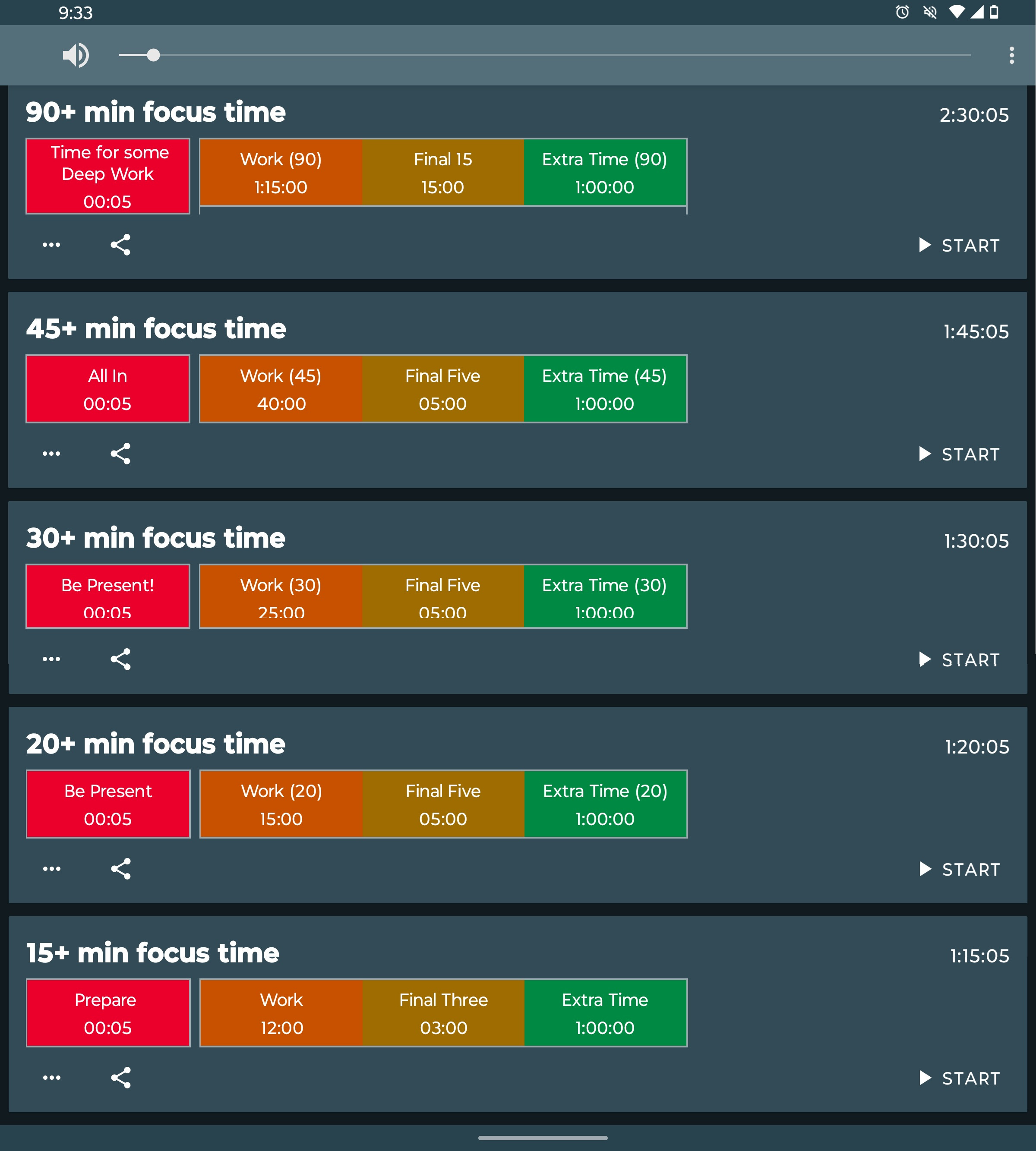
I have six preset timers: 15, 20, 30, 45, 60, and 90. They're all configured to have four intervals:
Prepare - 5 seconds.
Work - my main interval for working.
Final X - the warning period that gives me an opportunity to wrap up what I'm doing to cleanly exit when the time is up. For 15 and 20 minute intervals, it's "Final 2", for 30 and 45, it's "Final 5", for 60 it's "Final 10", and for 90 it's "Final 15".
Extra Time - there are times when I do have more time so I can work longer. And in those cases, I often want to know the total time spent (this is more for the habits scenario than the focus block scenario). So this interval allows the clock to keep running.
While the timer is running, the display is simply the color and name of the interval and the time:
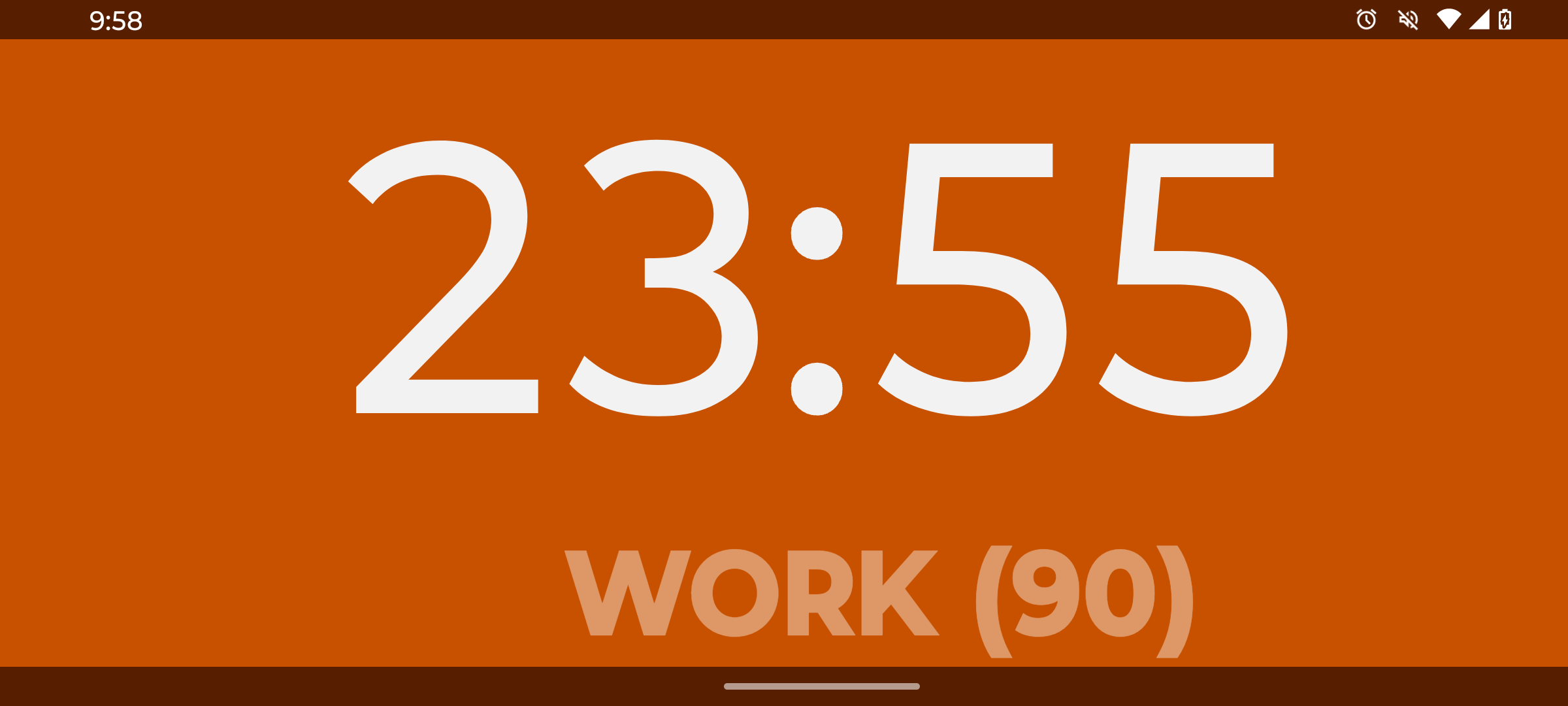
Each interval is announced by the app saying the interval name. And the transition between two intervals is announced with 3 beeps. So now I simply pick the appropriate timer, hit start, and set the phone down (outside of direct view, but just able to be seen in my periphery … so I can check the color if I end up forgetting where I'm at). I am never pulled out of my work flow to manually stop one timer and start another timer. The only time I need to touch the phone is when I'm done, to stop the timer. I am "audibly informed" when I enter the Final X and Extra Time stages … as I continue to crank away.
Don't Just Stare at the Timer
The timer is to make you aware that you're "on the clock". The timer has its job, freeing you up to do your job. When people see me working with a timer running next to me, a common comment is, "that looks stressful."
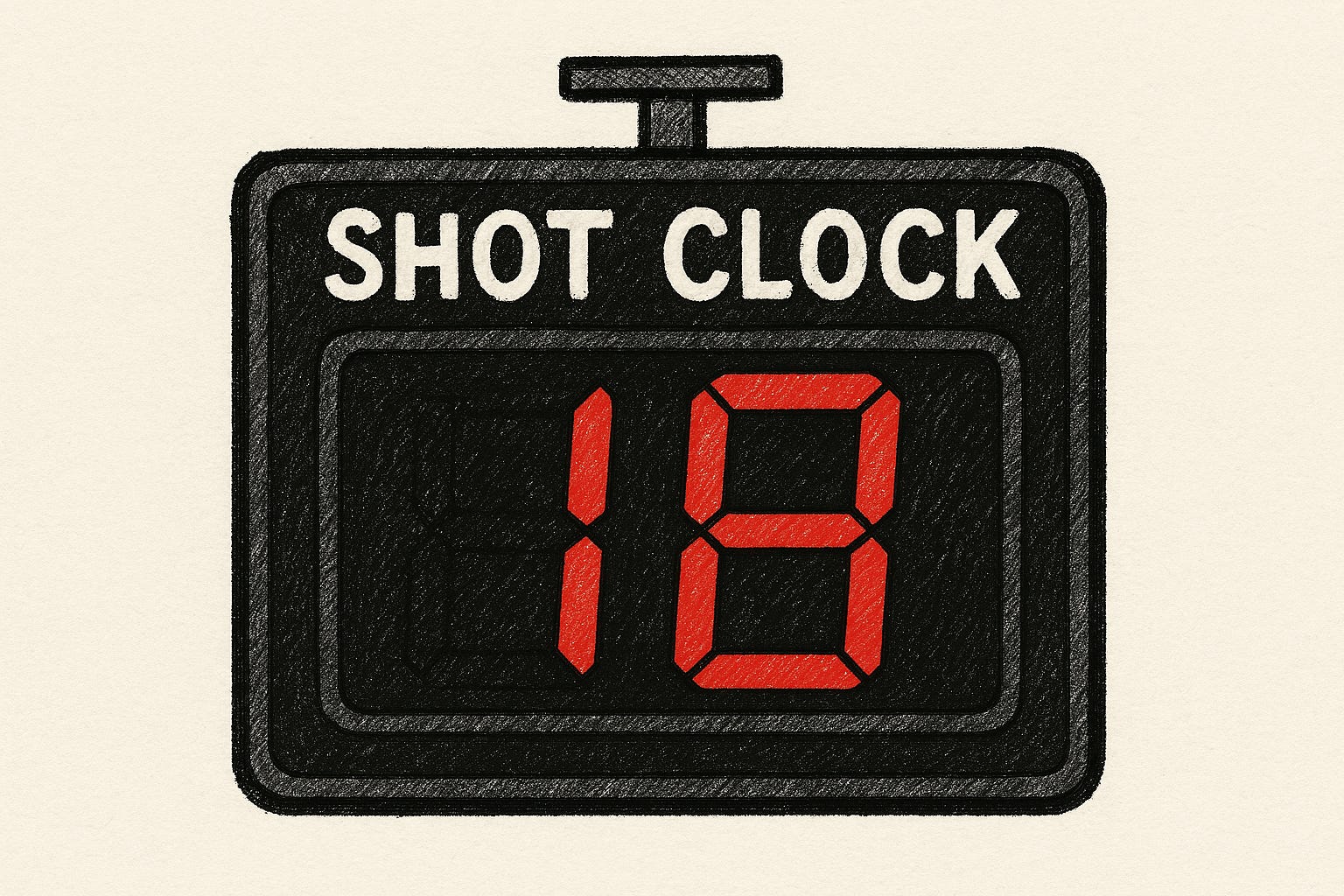
Basketball has a shot clock. Football has a play clock. And, much more recently, tennis got a serve clock. But do you see these athletes looking stressed out by the clock? There are times when they have to rush, but that's the exception and not the rule. They have a routine and a rhythm that was built with these clocks in mind. They train with these clocks and design their various routines to fit into these allotted windows. This brings a sense of urgency to their actions, but not a sense of stress. They are aware of these clocks, and yet these clocks will command very little of their attention when they are actually performing.
This is how I feel about the timers and alarms I keep. They are normal and predictable to me. They do not distract me. Quite the opposite, they allow me to give an activity my complete attention. I can dive deep into what I'm doing, knowing that I won't stay too long and risk missing or starving my other investments. With the clock there to pull me out, all that's left is to make sure I can effectively pause and resume.
Good Pavlov
Start using your timer. Get to the point of consistency where you're using it at least 2-3 times a day for three or more weeks. And then summon your Inner Observer5 to take note. What you will hopefully see is a magical Pavlovian effect with your timer app. With the same 5 second prepare interval placed at the beginning of each of your timers, you are being welcomed into all of your focus time blocks with the same beep, beep, beep, "Work". Experience this enough, and that sound will become associated with focused work. And, see for yourself, that you will start to enter a focused state more and more quickly. I started calling this "on-demand focus", and given the many years I spent on the "inconsistently-appearing focus" end of the spectrum, this has been satisfying beyond words. It reminds me of William Faulkner's classic line, "I only write when inspiration strikes. Fortunately it strikes at nine every morning."
My writing habit is how I start my day. I make a cup of coffee or tea, sit down in my "writing chair", turn on my timer, and start typing. At this point in the day, I'm usually already in a reflective mode that works for writing. So I've always entered the appropriate mental state for writing pretty easily. But for the other habit/focus blocks later in my day, the focus time I'm entering is a sharper contrast to the period that immediately preceded it. And historically this contrast has created transition resistance. I would start a focus block only to spend the first five minutes stopping myself from returning to the last topic. Now, with a simple beep, beep, beep, "Work", my brain commits.
I've never used a timer, but always been curious about them. I'm going to try one! Q: 5 seconds to "prepare" seems like no time at all, so I'm curious what happens in that 5 seconds and how that compares to opening docs/apps or other support you might need for that work block?