


I want to return to “Be the architect of your day”, which I introduced in Revving Your Energy Flywheel1. This has come up repeatedly in recent coaching sessions, so it bears a deeper dive.
Stephen Covey’s 3rd habit2 is “Put First Things First.” In his presentations, he had a “big rocks” demonstration that involved a volunteer from the audience, a large clear bucket, a large jar of pebbles labeled “small things”, and ten big rocks that are each labeled:
“planning and prevention”
“relationships & family”
“key employment issue”
“major project”
“big opportunity”
“sharpen the saw”
“service, community, and church”
“vacation”
“block of time just for yourself”
“mental”
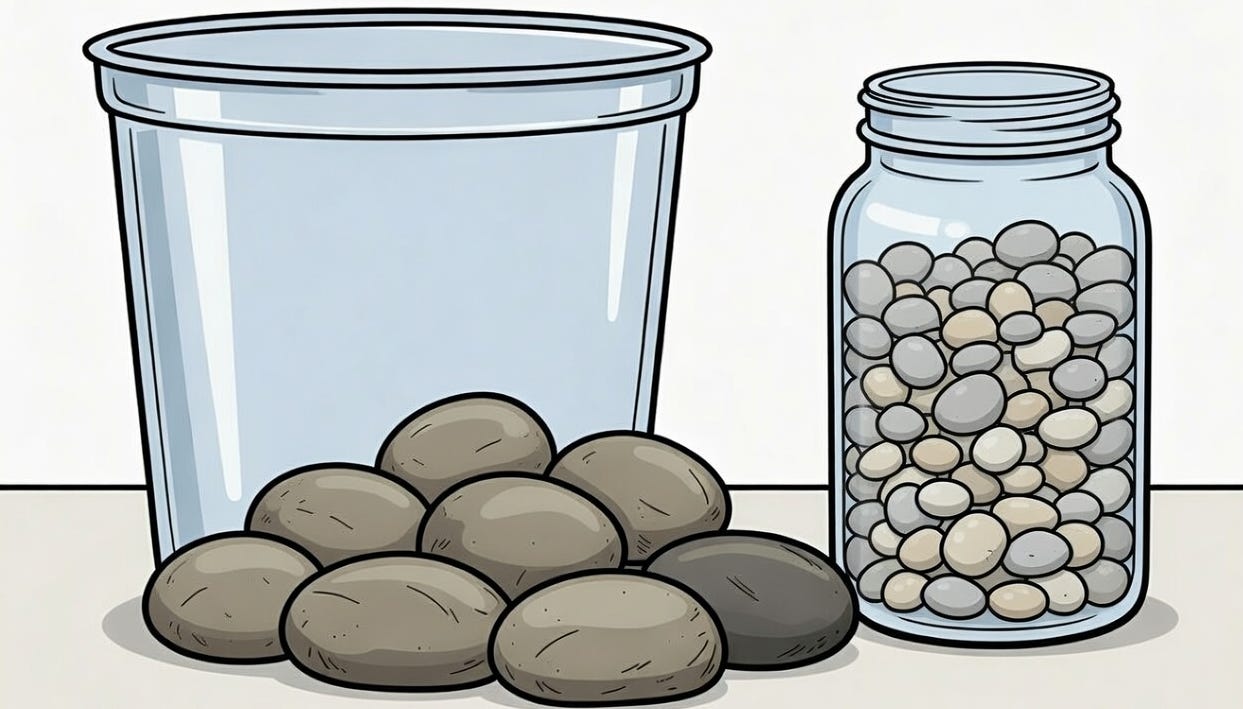
He begins by asking the somewhat rhetorical question, “Do you ever feel like you get bogged down in the thick of thin things?” Then he begins to pour the huge jar of pebbles into the clear bucket, “All these little, small things that tend to fill our lives, and little by little they just accumulate.” When the jar is empty, the pebbles almost entirely fill the bucket, with only a small space left at the top.
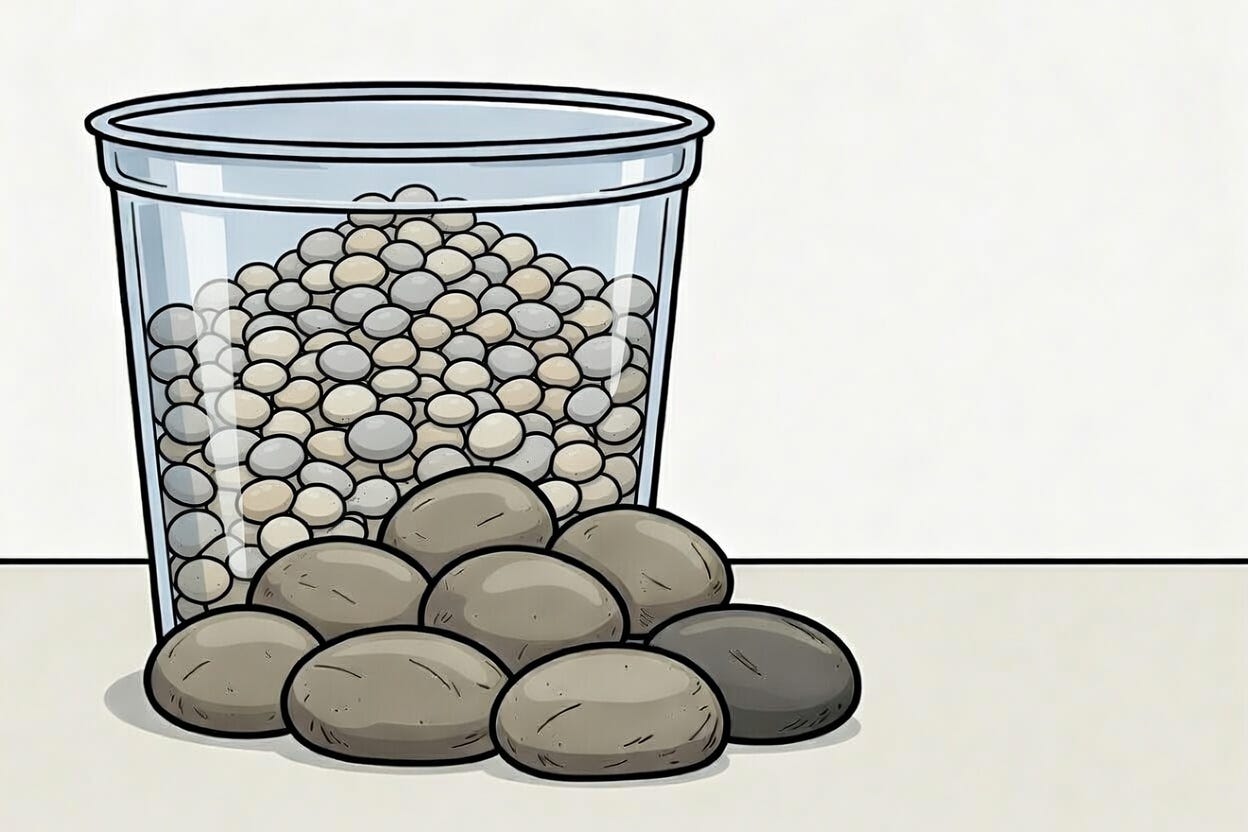
Stephen then asks the volunteer to try to fit all the big rocks in that bucket, without going over the top of the bucket. They can typically only fit four or five of the big rocks in.
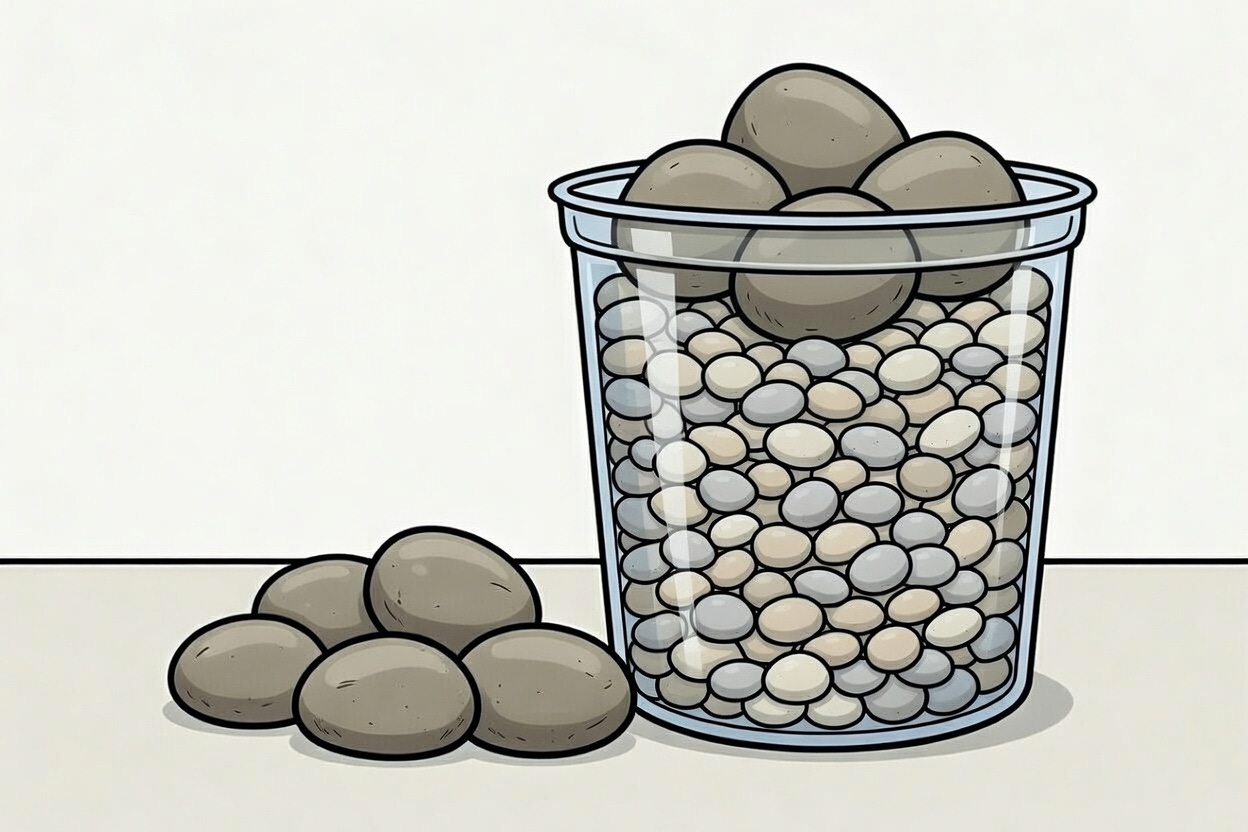
Stephen calls out some of the big rocks they’ve left behind, “You’ve given up your ‘vacation’, and you have no ‘special block of time just for yourself’.” Then he brings out a second clear bucket and tells the volunteer, “You could take a completely different approach. You could work out of a new paradigm.”
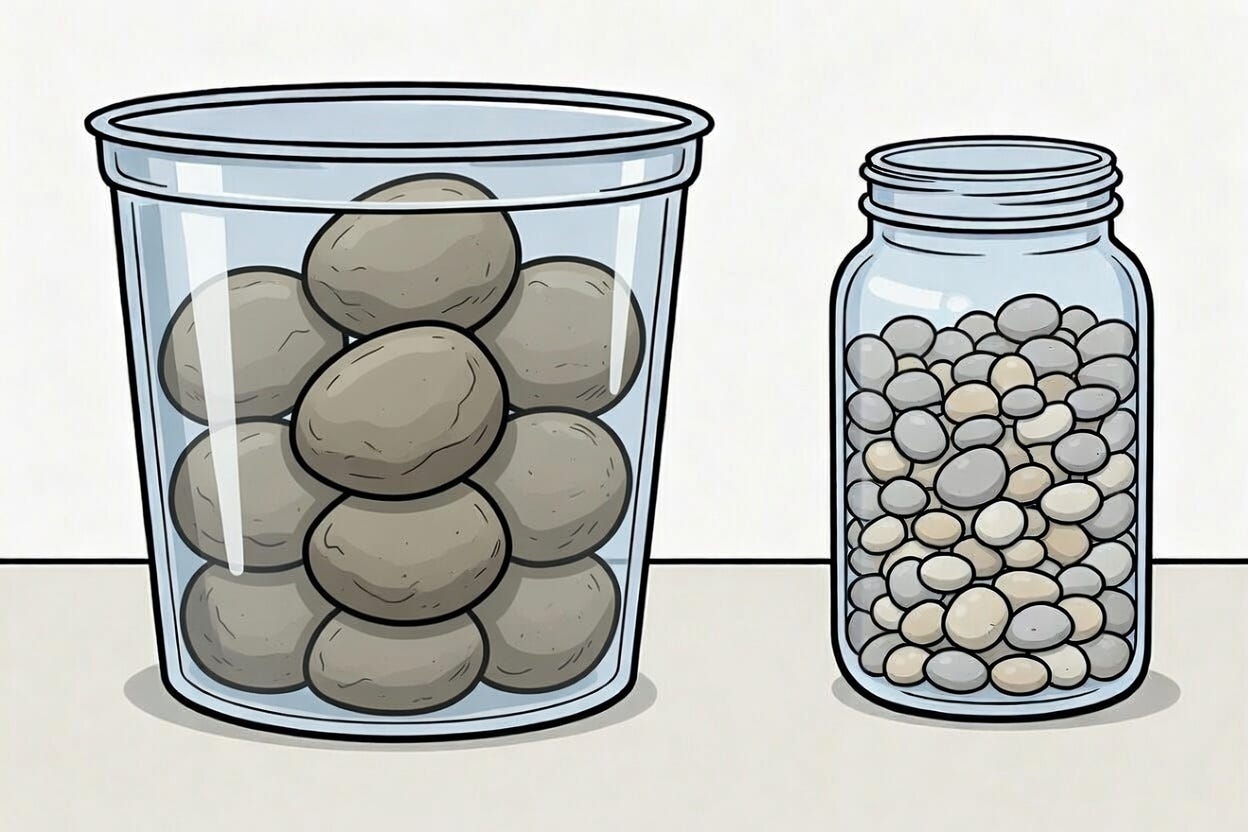
The epiphany that most people have at that moment is to put the big rocks in first. After placing all ten of the big rocks, the bucket looks full. But you can see there’s lots of room between the rocks. When they pour all the pebbles in, these “small things” freely slide in and around the big rocks. And when the pouring is complete, everything fits.
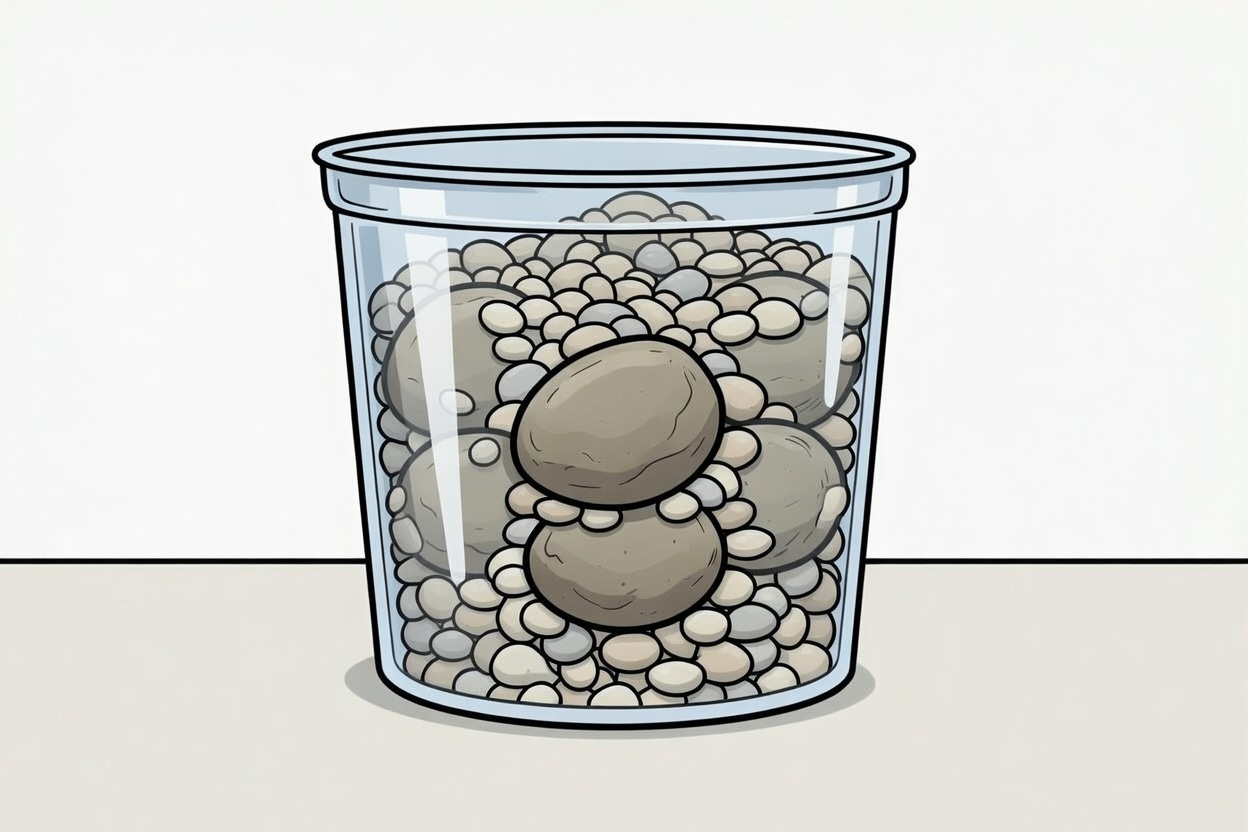
Stephen Covey’s “big rocks” demonstration from 1994
“Put the big rocks in first” is about prioritization. If you don’t intentionally do this, then all the pebbles will fill your day, your week, your month, … And you’ll starve the big rocks.
What are your big rocks? Step back from the “day to day grind” so that you can take in the big picture. What things are most important to you? What Stephen calls big rocks I call Inviolates, because you need to hold them sacred, and protect them at all costs. When it comes to any planning you are doing, you need to prioritize the Inviolates. They may seem skippable in the moment, but in the aggregate, you’re going nowhere without them.
In 7 Habits, Covey says, “The key is not to prioritize what’s on your schedule, but to schedule your priorities.”
Here’s how to identify, nurture, and protect your own Inviolates.
The architected calendar
This is what my weekly calendar looked like at the height of my Group Engineering Manager role.

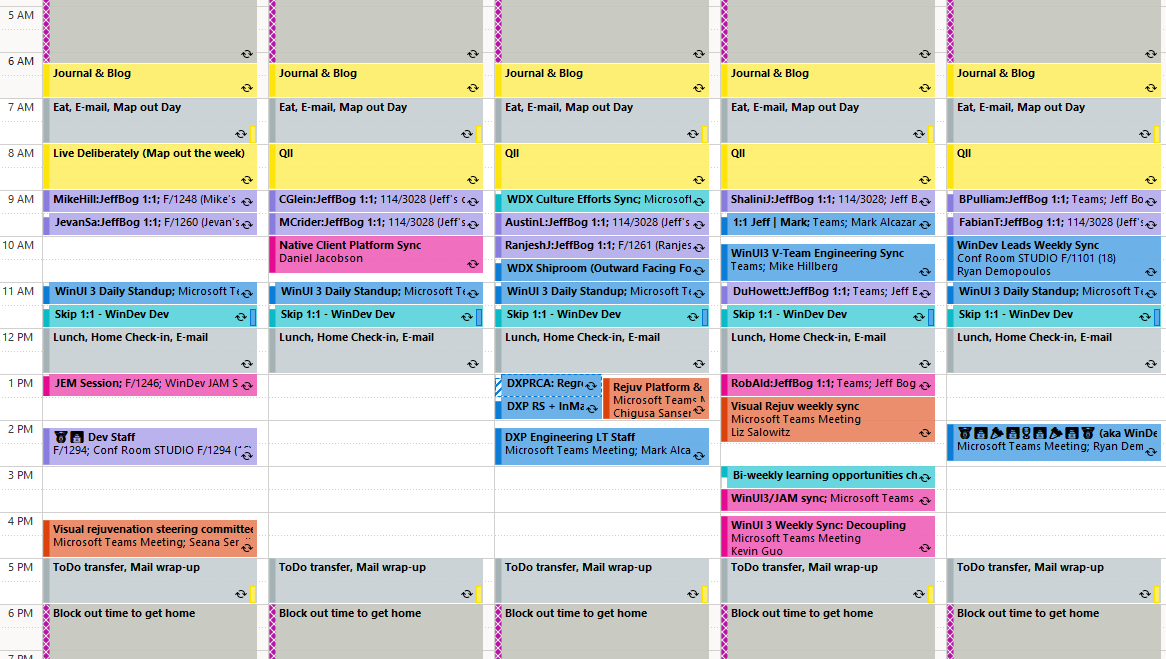
This was the starting point for each work week, as everything listed here are the recurring meetings on my schedule. So for other people to grab time with me, this is what we have to work around. If this seems stressful, you should’ve seen what it looked like before I architected my calendar.
Yes, I only have 9 hours of unscheduled time per week, but every single meeting here is an established touchpoint for the people and the projects that I oversee. So those 9 hours are for the surprises, not for normal operation. And, over the years, that has proven to be more than enough space.
This calendar of perfectly placed blocks was the result of many meeting negotiations4:
“Does the meeting need to happen?” What warrants in person discussion vs. what can happen over mail?
“Do I need to be there?” Check your FOMO; and think about effective delegation.
“Does the meeting need to be that often?” Could you get away with meeting every other week?
“Does it need to be as long as it is?” Could you get away with meeting for 25 minutes instead of 50?
“Does it need to be at that time?” Can you request a different time that would be more ideal for you?
And, from an Energy Flywheel standpoint, I have made sure that the energy givers and energy takers are properly interleaved to rev my flywheel and keep it humming all day and all week.
Put the Inviolates in first
Do you think that it just magically worked out that all of my Inviolates fit around this schedule? Of course not! My Inviolates are sacred, so I bend my schedule to fit around all of my Inviolates.
Establish a daily pattern. Mine was simple at the time of this snapshot, because my boys were all grown up so there wasn’t the varying home schedule for school drop off and pick-ups or for the various after school sports and activities they were involved in. Mark all home hours as unavailable. And respect that. I got to work at 6:10 every morning and left at 6. And work never followed me home.
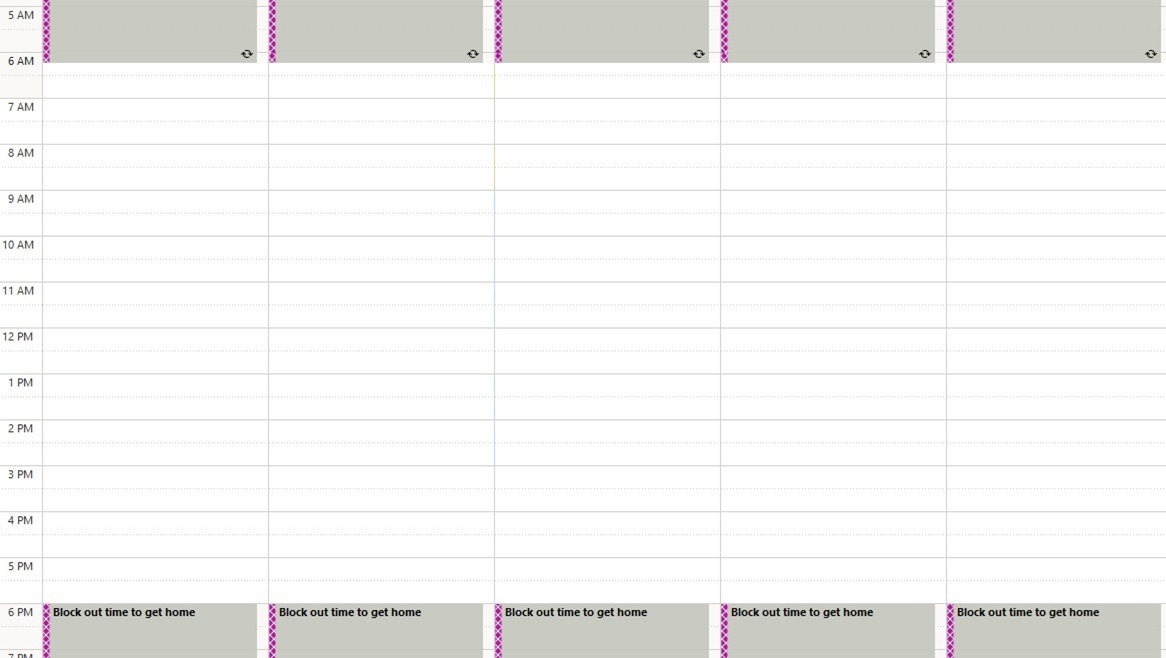
This creates the canvas that you can start your architecting inside of. Now you add the Inviolates.
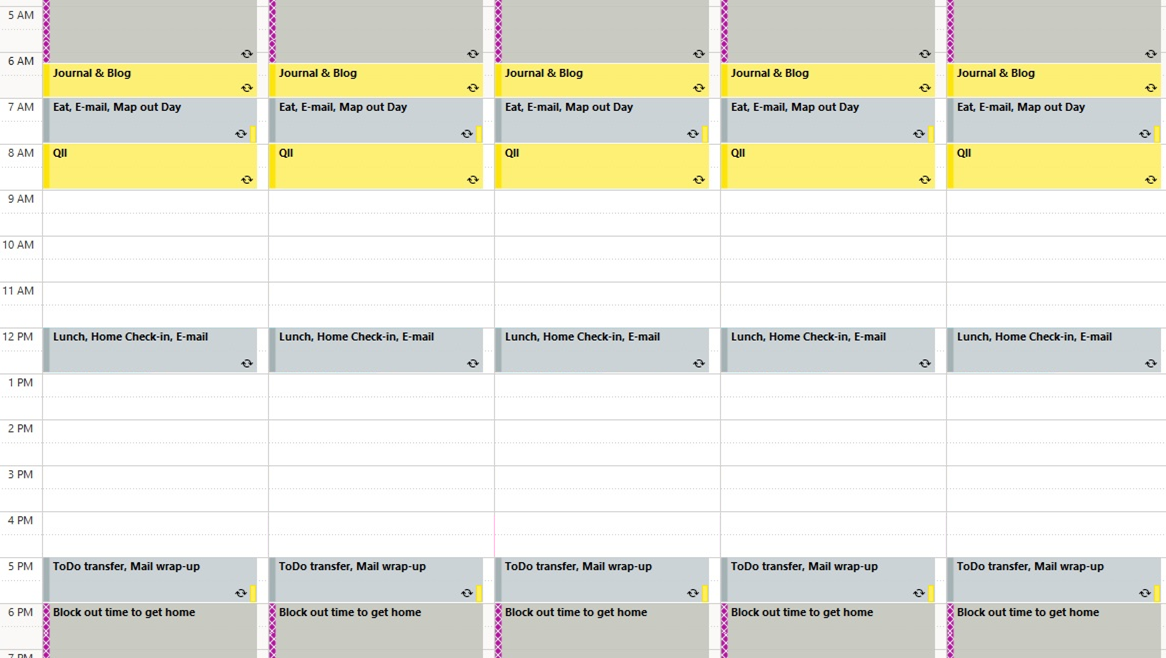
Journal & Blog - I start each day with writing. Sitting in a quiet office with no movement happening in the hallways yet, it is the perfect way to start my day. I still have this on my post-Microsoft calendar, it’s just 90 minutes now instead of 50.
Eat, E-mail, Map out Day - Grab something to eat while I Triage all my Comms4. Now I have all necessary context paged in and I’m ready to map out my day. What do I absolutely need to address today, and where can I place it on my calendar (moving meetings if necessary)?
QII - An hour every day dedicated to Quadrant II5 work. Never starve your proactive, planful mode.
Lunch, Home Check-in, E-mail - Grab something to eat, check phone for texts and email from family and friends to see if anything needs addressing, and then Triage all my Comms again.
ToDo transfer, Mail wrap-up - Make sure all of my newly noted ToDo’s find the right home in my External Brain6, do a final Comms Triage for the day, and then head home.
Identifying your own Inviolates
My calendar and my Inviolates are just examples. What you choose for your Inviolates and where you put them on your calendar is entirely up to you. Here are my pro-tips on how to identify your Inviolates and where to put them in your day.
Start small. I reached the point of three contiguous hours of Inviolates in my morning, but I didn’t start there. Keep Admiral McRaven’s words in mind as you embark on your Inviolates journey: “If you want to change the world, start off by making your bed.”7 The first step for me was a 30 minute “email & map out day” Inviolate. My days felt more in control and productive with just this small regular investment. As you add more to your Inviolates, you should notice your Energy Flywheel getting a predictable boost with each iteration.
Front load proactiveness. The further into the day you go, the more that the “small things” will begin to pile up and demand your attention. Embrace the quiet of the morning (both in your mind and in your office). The first Inviolate to add to your schedule should be at the start of your day.
Have proactive bookends to your day. After you’ve established a start-of-day Inviolate, it’s time to add an end-of-day Inviolate. Here you reflect on how the day played out for you, what went well, and what didn’t go so well. Then pick one item you want to try to improve the next day. This brings closure to your workday, and your reflections here are notes to your future self, to be read at your next start-of-day Inviolate.
Embrace a midday pause. The next level Inviolate is the proactive pause you use to split your day. As a Group Engineer Manager, my midday pause was an opportunity to catch my breath as well as course correct for the day. And, in divide and conquer fashion, it changed my calendar from one large chunk to two manageable chunks. This further revved my Energy Flywheel daily. When I pivoted to my Director of Learning and Development role, where I had far fewer meetings and far more deep work blocks (yay!), my midday break became a 50 minute bike ride around campus.8 It was my midday meditation on wheels.
Keep nurturing your Inviolates, and they may just take over your calendar, in the best kind of way.
Footnotes
The “Be the architect of your day” section of Revving Your Energy Flywheel
The 7 Habits of Highly Effective People, Stephen Covey (Goodreads)
The “Creating space on your calendar” section of Revving Your Energy Flywheel
The “Important vs. Urgent” section of Play the (Really) Long Game
Admiral McRaven’s commencement speech @4:44 - 6:12