



My model for sustainability is my progression in biking endurance.
Sprint: In college, I would ride 30 miles and return barely able to move. At Microsoft, riding with colleagues, I managed to get that distance up to 50 miles. But I was still killing myself on every ride. I was just sprinting.
Marathon: When the goal became a century (100 miles), there was a fundamental pivot where I embraced the phrase, "it's a marathon, not a sprint." I slowed my roll and learned to maintain my energy for 100 miles. When I finished my 100 miles, I felt spent, but not dead. This led to me testing longer distances, getting up to just over 200 miles in one day.
Ultramarathon: Given the limited number of hours in a day, I didn't see myself pushing much beyond 200, so then I switched my focus to how many days in a row I could ride. I did three century days. Then I did four. And now my annual retreat consists of five consecutive century+ days (this year I'm aiming to ride from Chelan, WA to Calgary, BC in 6 days). I'm now convinced that the number of days could grow indefinitely and I could manage.
Sustained Delivery
I cover a lot of ground on my bike not by going fast, but by going long. The same goes for my work. And in both cycling and in work, there's the long game (marathon), and then there's the really long game (ultramarathon). And I've spent decades of my career in the ultramarathon mindset. A common phrase over the last 20 years of my coaching is "Play the Long Game", which is simply about upleveling your approach to energy management.
Sprint
At school, your semesters are full of sprints, where you cram for a test or pull an all-nighter for your coding project. And at work, sprints show up in after-hours work to finish up a feature and the crunch time when your product is nearing the ship date. Sprints are short bursts of increased work for increased results. Sprints have their place, but there must be more to your growth than a connected stream of sprints.
Marathon
You also experience marathons at school, where you lay out a strategy for a semester and work to follow it. And as you experience more semesters, and notice the repeating cycle of a given semester starting calm and ending crazy, you further develop your strategy to evenly spread more of the load to lower the higher demands at the end. At work, the product release cycle is similar to the school semester, potentially longer but still having that calm to crazy arc. So you continue to evolve and execute your own planful strategy. Marathons are meaningful periods full of notable accomplishments and learnings. But don't stop there.
Ultramarathon
The ultramarathon doesn't have a set distance. There are 50km, 100km, and 100mile variants, and more. In cycling, they go crazy long, with perhaps the most epic being the Tour Divide1, a 2,745 mile ride from Banff to New Mexico. What all ultramarathons have in common is the mindset of be able to continue on, indefinitely. The ultramarathon demands expert management of your own Energy Flywheel, balancing all of your energy givers and energy takers to be able to continue to execute and to grow, indefinitely.
At work, the sprint is for an hour, a day, or a week. The marathon is for a product release. And the ultramarathon is for your career. There is a time and place for each, but it's the ultramarathon mindset that will make sure the sprints and the marathons are showing up where they are supposed to as part of your strategy for sustained delivery.
Set yourself up for long-term success. Play the really long game.
Important vs. Urgent
At Microsoft, most of my coaching involved 1:1s in my office. And as my coaching volume went up, I found myself dedicating a piece of my whiteboard to oft-uttered phrases from my coaching sessions (this is actually the initial seed of my "Leave a Paper Trail" mantra2). In sessions, I could then point to phrases and pictures on the board as we were talking. This gave the oft-uttered phrases more weight, and also served to spur related conversations with other visitors (outside of coaching) who caught sight of my column of phrases written on the side of the whiteboard.
After every office move, my first action on entering my new office was to recreate this column on the side of one of my new whiteboards. This oft-uttered phrases column was regularly updated, but what always remained at the top of that column was Stephen Covey's Time Management Matrix, complete with my "Sustained Delivery" header.
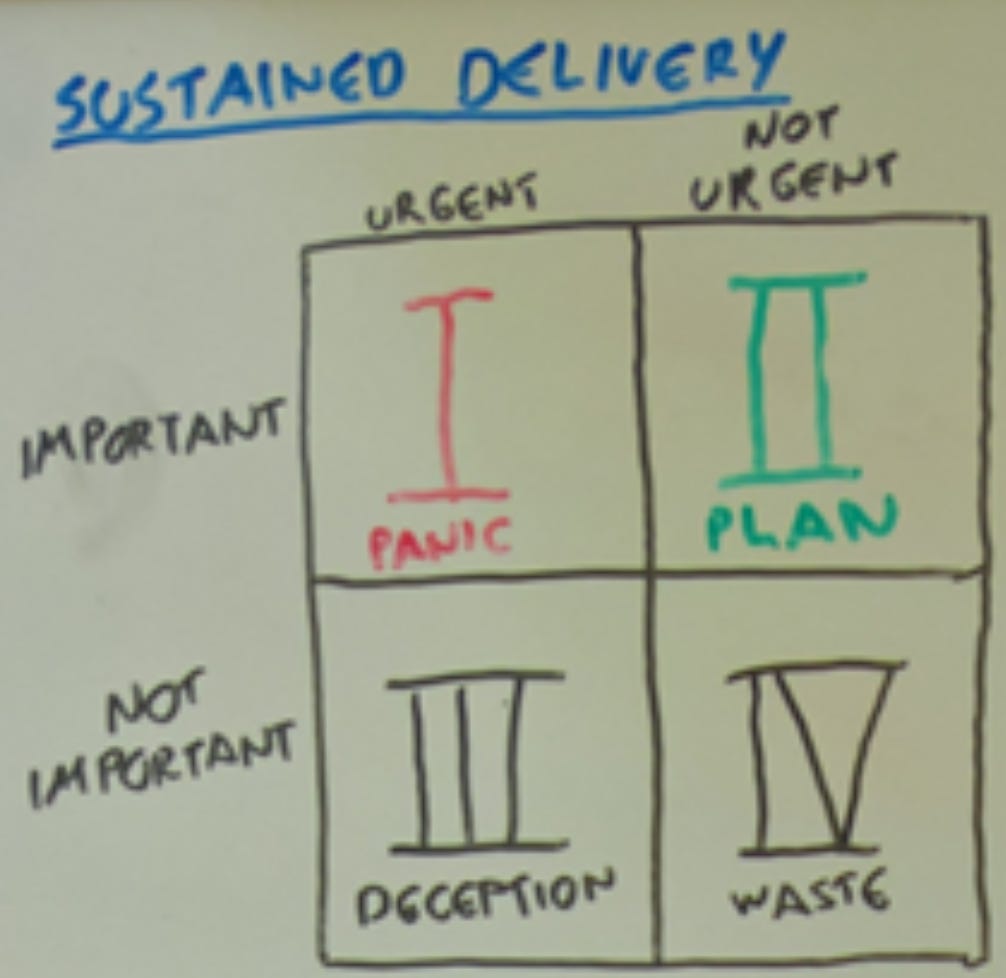
Quadrant I: urgent and important - the quadrant of panic
Quadrant II: important but not urgent - the quadrant of planning
Quadrant III: urgent but not important - the quadrant of deception
Quadrant IV: neither urgent nor important - the quadrant of waste
Quadrant I, urgent and important, is intentionally written in red. Work in that quadrant is done in a panic. Your hair is on fire. People are breathing down your neck. You have to react. You have to drop everything else. You hang the Do Not Disturb sign on your door. The emotional toll of the added stress of being in Quadrant I is working to deplete your energy stores.
Quadrant II, important but not urgent, is intentionally written in green. Work in that quadrant is done in a calmer environment. You are on top of your work. You are ahead of the deadline. You saw this work coming and you had a plan for how and when you were going to get it done. You are operating proactively and methodically. This work is increasing your energy stores, if for no other reason than the relief associated with completing work without any "red" involved.
The ultramarathon "be able to continue on, indefinitely" mantra can be rephrased in this matrix's terms as "maximize time in Quadrant II". Quadrant I happens (which you should view as synonymous with "shit happens"). And you can tolerate it, to a point. But extended time in Quadrant I will drain all of your energy. When you're in Quadrant I, you are doing everything you can to get out of Quadrant I. And when you're out of Quadrant I, you should be doing everything you can to avoid getting into Quadrant I. Avoiding Quadrant I is the motto of Quadrant II: being on the ball and planful so that you are proactively addressing your work before it turns into a fire drill. You're tackling important work in a measured and methodical manner. Quadrant II is all about sustainability.
Quadrant III and IV are covered merely as a footnote. They are listed on this matrix for completeness. If you ever identify work as being Quadrant III or IV, congratulations, you've just discovered work that you don't actually have to do. I do love the name of Quadrant III, the quadrant of deception. When work is urgent, that urgency can sometimes command all of your attention, so that you don't ask yourself the necessary starting question: "is this work actually important?"
IFF Quadrant I
IFF is a throwback to logic classes in college. It means "If and Only If". The larger the piece of work you're doing, the more likely that there are subparts of that work that belong to different Quadrants. As part of "relentless prioritization", you need to order the different subparts in Quadrant order. This will reduce stress level because the result is that the Quadrant I work will be a subset of the large piece of work. That means less time in Quadrant I.
This will also provide an energy boost because you turned one opportunity for a sense of accomplishment into several opportunities for a sense of accomplishment. You don't just mentally celebrate at the end of the larger work item. You now have several clear milestones to celebrate, with the completion of each subpart. You can propel yourself forward with the thinking: "I'm not done with everything ... but i am done with the most important thing."
Chip and Dan Heath, in "The Power of Moments", wrote "We're not stuck with just one finish line. By multiplying milestones, we transform a long, amorphous race into one with many intermediate finish lines. As we push through each one, we experience a burst of pride as well as a jolt of energy to charge toward the next one."
Hold a retrospective
When you're in Quadrant I, that's the wrong time to be asking how you got there. In Black Hawk Down, Hoot is an experienced soldier giving advice to a greener soldier before a battle: "Once that first bullet goes past your head politics and all that shit just goes right out the window … Just watch your corner and get all your men back here alive."3 When you're in it, focus on getting through it. This keeps it simple, and gets you through the Quadrant I faster.
But when you're done with that Quadrant I activity, there is another Actor/Observer4 opportunity. Create space to reflect back on that situation. How did it end up in Quadrant I? What could you and/or your team have done differently to have caught it in Quadrant II? In general, we don't spend enough time, individually or collectively, optimizing our processes. So any insight that your reflection brings would be valuable to share with your team.
When you first attempt such retrospectives, it may seem insurmountable. You may not have any idea how to do it any better. Don't feel defeated here. Just keep doing these retrospectives after each visit to Quadrant I. You should eventually start to spot trends.
Indeed, "Quadrant I happens." But we should all aim to make Quadrant I happen less.
Uplevel U
Homework time! Is Covey's Important/Urgent matrix new to you? Have you looked at your work through the lens of this matrix before? There's a great three part exercise you can do with his Time Management Matrix.
At the end of your day, set aside 5 minutes to answer the question: how much of your day was spent in each of the four quadrants? Use rough estimates to keep this timeboxed to 5 minutes. Do this for a week to set up parts 2 and 3.
After you have a week's worth of data, set aside 10 minutes to analyze this data. Can you identify one Quadrant III item and one Quadrant IV item that you can eliminate for next week?
With the goal of maximizing time in Quadrant II, set aside another 15 minutes to answer these two questions: how much of last week's Quadrant I work could've been eliminated? What adjustments to your routine and processes would reduce the likelihood of the largest Quadrant I item happening again?
Footnotes
Leave a Paper Trail section of Raising My Voice, and a deeper dive into that in Raising Your Own Awareness and Life's a Journey; Take Good Notes
Black Hawk Down: Politics and War
The "Getting Better At Observing" section of Raising Your Own Awareness
I love Chip and Dan Heath. As you know their book "Switch" was profoundly impactful on my approach to studying positive outliers or "Bright Spots".