


“What impact did I have in this review period?” This is the fundamental question to ask yourself at the start of your performance evaluation. The longstanding challenge in evaluating performance is the need to focus on impact over activity. You may first think, “I worked 80-hour weeks to get this project done.” But that’s just the activity. You need to the uplevel your reflection. What did those 80-hour weeks allow you to accomplish? This line of thinking will help you get to a more impact-centric response. “I delivered feature X which allowed our partner teams to deliver features Y and Z to their customers.” Now you’re on the right track.
Overindexing on activity is far from a new problem. Andy Grove’s gem from the 70s is proof of how long we’ve been dealing with it: “There are so many people working so hard and achieving so little.”1 (bolding mine) The easiest way to move you out of an activity focus is to employ the question, “So what?” … repeatedly.
In my coaching on the topic of impact, I got many miles out of a Venn diagram that Microsoft HR provided. Here’s my own recreation of that HR gem.
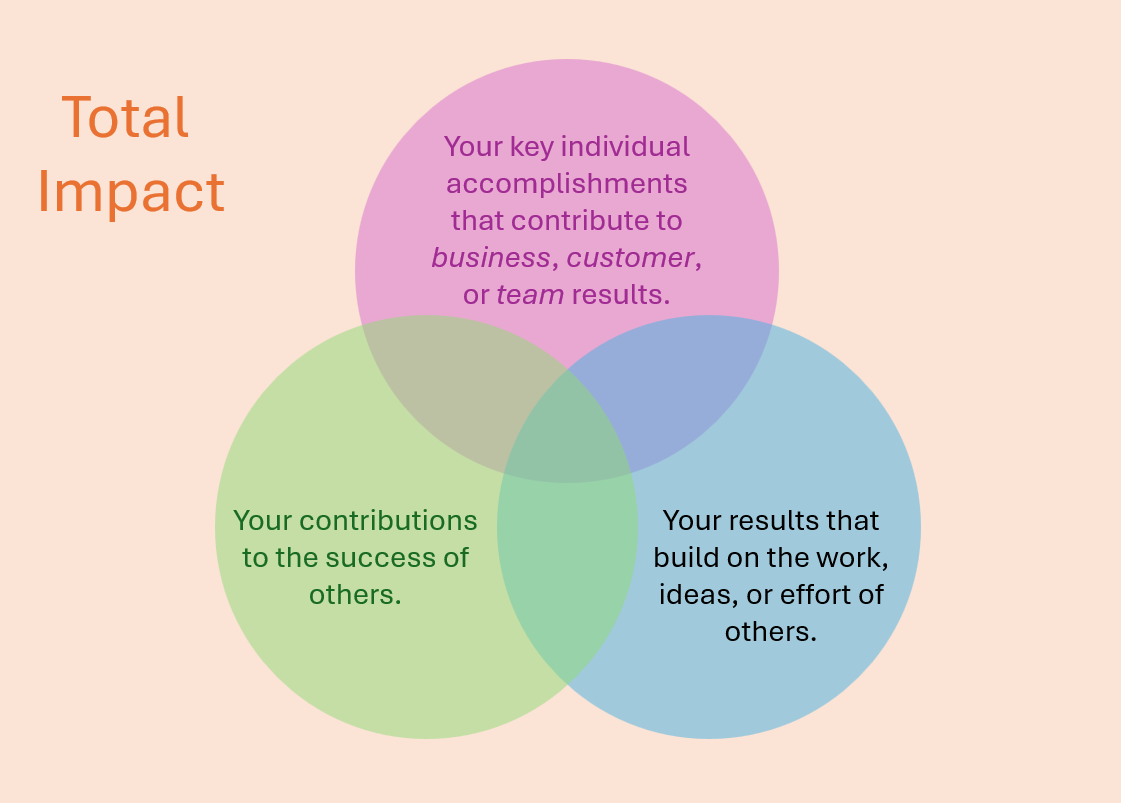
This Venn diagram can be found at the top of every Microsoft evaluation form (called “Connects”) since 2014. (aside: I take partial credit for it still being featured in Connects because I was a reviewer for HR’s revamping of this Connect form in 2023, and my first piece of feedback was, “woah, you forgot the Impact Venn diagram.” HR corrected that and the diagram lives on.)
Your total impact is the combination of three things:
Your key individual accomplishments that contribute to business, customer, or team results.
Your results that build on the work, ideas, or effort of others.
Your contributions to the success of others.
Let’s break this diagram down.
The Three “Who”s
Calling out business, customer, and team results brings great clarity to what impact matters. In order, these three dimensions progress from direct to indirect.
Business - I have worked in organizations that talk about “bottom line” and ultimately fixate on business results. This is understandable, as business results are the most tangible, and are both obvious and important. Day-in, day-out, business impact is being tracked and recognized in the team’s processes and execution.
Customer - Extrapolating from the direct business, how do your accomplishments ultimately benefit the customer? You move to this layer to make sure your work is actually making a difference.
Team - Extrapolating further, how did you help the team’s execution, and their future potential. This is another example of the P/PC balance2, where Business and Customer impact are about the shorter-term production and Team is about the longer-term production capability.
Here is an example of how repeatedly asking “So what?” will move you up through the three “Who”s:
“I worked 80-hour weeks to get this project done.” Activity
“So what?”
“I delivered feature X to our partner teams.” Business and Customer (internal)
“So what?”
“That allowed our partner teams to deliver features Y and Z to their customers.” Customer (external)
“So what?”
“That earned our team the trust from these partner teams to request more work from us.” Team
The Three “How”s
Now that we know the different “who”s that we can target for impact, let’s turn our attention to the three “how”s that we can utilize to accomplish that impact.
Your key individual accomplishments that contribute to business, customer, or team results.
This sits at the top of the diagram because it is the most obvious one. This is you doing, producing. When this diagram was introduced, I saw this “how” as a good counterforce against the established Microsoft culture of focusing too much on the direct product impact and not enough on the indirect customer and team impact.
This diagram didn’t change the culture overnight. But it established a clear top-down3 direction for our performance evaluation efforts. Reflecting back on the 10 years of rewards conversations that I was involved in since the introduction of this diagram, I definitely have seen teams moving steadily in this espoused direction.
Your results that build on the work, ideas, or effort of others.
This “how” is a great counterforce to the Not Invented Here (NIH) mindset from Microsoft’s established culture. NIH basically means everything I do is awesome and everything you do is lesser. Not Invented Here was a popular line of thinking in the type-A personalities of Microsoft (and, let’s face it, well beyond Microsoft). NIH comes from a focus on the first “individual accomplishments” how. Having this “how” in the picture gave people permission to consider other people’s ideas. You’ll get credit for leveraging the work, ideas, or effort of others.
Your contributions to the success of others.
This last “how” in the diagram is the collaborative counterpart to the second “how”. Building on the work of others is you learning. Contributing to the success of others is you teaching.
Managers contribute to the success of their team when they grow their employees and when they drive collaboration across their team. Mentors and coaches contribute to the success of their mentees as they guide them and pass on wisdom. Team members contribute to the success of their teammates when they share things they’ve learned to accelerate the ramp-up or growing expertise of others.
Lifelong student-teacher
There is a simplification of this impact Venn Diagram that I hinted at in the above articulation of the three “how”s.
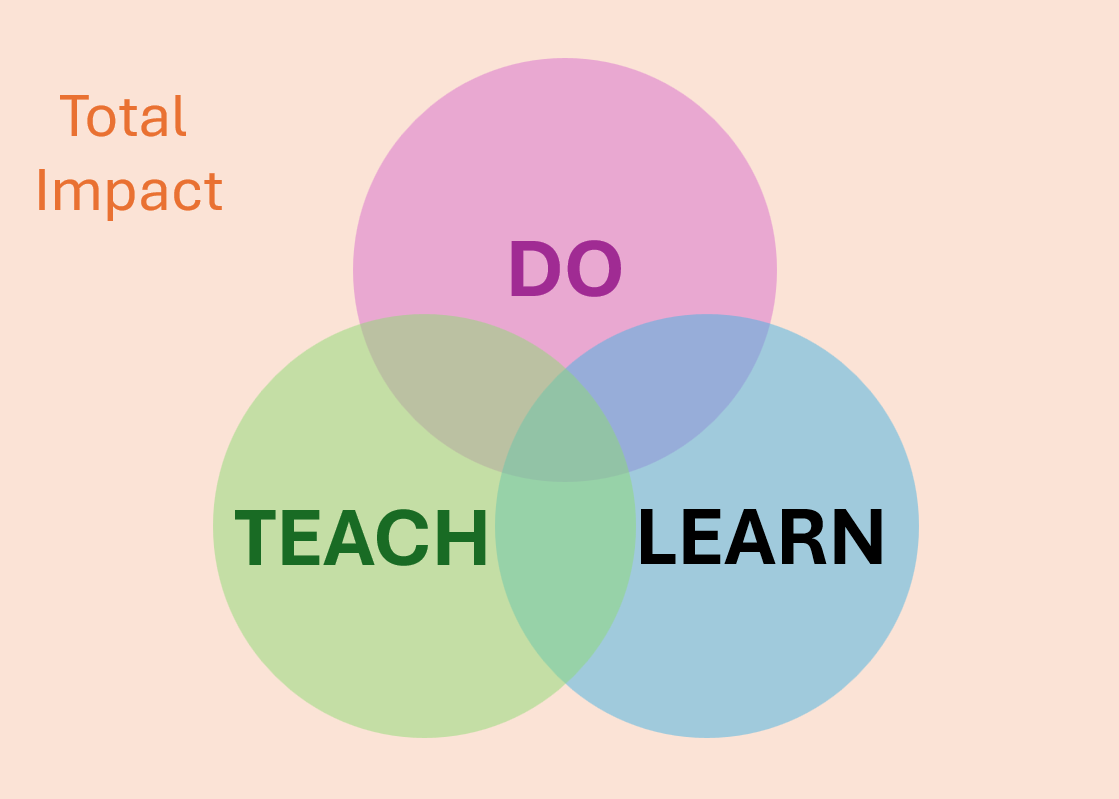
Your total impact is a combination of what you do, what you learn, and what you teach. The default focus is on the do. This diagram encourages you to devote more energy to the learn and the teach.
You can fully integrate teaching and learning into your work by adopting a “lifelong student-teacher” mindset. This is yet another example of the P/PC balance2. Doing is producing. Teaching and learning are building your production capability. You are always growing, and you should always be looking for opportunities to contribute to the growth of those around you.
As you plan out your next review period, ask yourself what proportion of doing, teaching, and learning you want to have. This intentionality will keep you from falling into the “just doing“ default mode.
Footnotes
“The Father of OKRs” (Chapter 2) of Measure What Matters, John Doerr (Goodreads)
The introductory section of Maximize Smiles per Dollar
I love the three circles. I hadn't ever seen the LEARN and TEACH concepts directly applied, but it makes perfect sense - I *LOVE* it!