


When I reached the 30 year mark of my software engineering career at Microsoft, I decided that was long enough to devote to software development. I made a pitch to upper management and our HR partners that there was a need for more attention to be paid to people development. They approved my pitch, and the Windows Director of Learning and Development (L&D) role was created. That was my last role at the company, and overall my most satisfying role. It brought together every muscle I had developed and made me a high functioning team-wide resource.
The corporate functions of Microsoft provide all of the standard Microsoft-wide training around culture, business conduct, security, etc. But technical training is provided by the engineering teams themselves. These teams, amidst all of their product development, have to find time to create training. This tradeoff is not unique to Microsoft, or even unique to the tech industry. Stephen Covey1 called this ubiquitous challenge “the P/PC Balance,” the balanced investment in both production (P) and production capability (PC). An engineering organization needs to develop the products in its portfolio, and at the same time it needs to develop the people that are developing those products.
In our Windows organization, I had observed our P/PC balance was off, and that a lack of structure and coordination was undermining our learning resource efforts. My pitch emphasized the importance of one dedicated resource to activate and organize all of these side hustles. Here is the opening of my L&D pitch (bolding added here to set up the equation that follows):
There is no shortage of learning programs and pilots across this company, and the metrics for each of these efforts shows appreciation, impact, and progress. But the majority of these efforts are currently happening in silos and are working inefficiently due to a lack of awareness and alignment, resulting in an inability to leverage related programs. There is inconsistency in the learning and growth experience.
The vital missing step in the growth of our learning and development experience is coordination. The multitude of learning programs are typically run by people as a part-time investment. With the time constraint and the established local needs that launched each program, it is predominantly outside of the owners’ time and scope to invest in coordination and alignment. We need to support the investments of these passionate proactive individuals, showing them how their contributions advance the overall learning experience.
Marrying this bottom-up organic energy with top-down coordination2 will bring consistency and sustainability to all our learning and development efforts. Proper organization and structure will maximize the scaling potential of successful grass roots investments and maximize the adoption potential of established top-down initiatives.
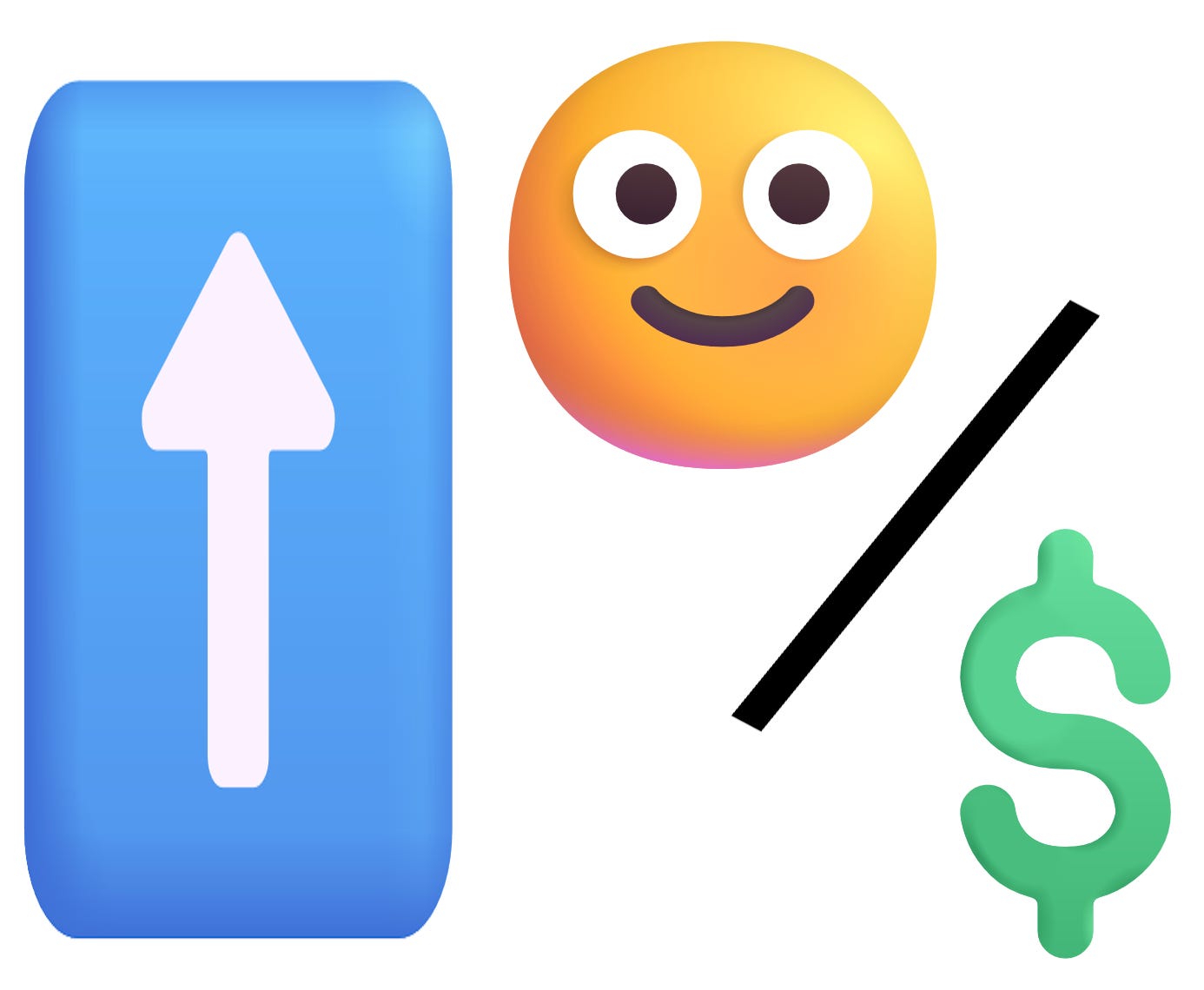
I originally summarized my Director of L&D role as, “Ensuring my team members have maximal impact for every hour they spend creating learning resources.” Over time this was abbreviated to, “Maximize smiles per dollar,” where “dollar” referred to the forever constrained time3 and money spent on the development of learning resources, and “smiles” referred to the positive impact to the team members consuming these learning resources. I’m a big fan of emojis (I’ll dive into that love in a later post), so eventually I created an emoji shorthand for this expression: ⬆️🙂/💲.
Armed with that expression, here is how I executed on my mission.
Breaking down the equation
Smiles is the numerator in this expression. So if we’re trying to maximize this expression, customer smiles is the number we want to get bigger. Dollars is the denominator in this expression, so it’s the number we want to get smaller, in order to maximize this expression. Dollars represents the work. Our time is finite3, and any investment of our time is us spending time on the problem. Time is money. I could have said “smiles per minute”, but that sounds like our goal is for everyone to smile more of the time. This is slightly different. Not knowing what the current smile volume is, the point here is that for any minute invested, it should increase smiles as much as possible. This captures the scalability of the work.
Putting it all together, ⬆️🙂/💲 is where customer-focused meets scalability. This expression is meant to shine a light on what work we’re doing and how we’re doing it. Is this work high ROI (Return On Investment)? Are we approaching the work in the most efficient way, thinking long term? The phrases, “Do more with less,” and, “Work smarter, not harder,” are also stressing the importance of being mindful of ROI. But unfortunately, over years of use, these phrases have picked up connotations of, “Nose to the grindstone.” ⬆️🙂/💲 is all positive. It has an up arrow and a smiley face, so certainly bad connotations won’t develop for this expression! 😆
I had a dual focus to accomplish ⬆️🙂/💲: (1) minimizing wasted effort and (2) maximizing potential audience. The order here is important. You have to start being conscious of the spend. You have to be frugal. Make sure the denominator never outsizes the numerator. Small target audience means small investment. As you grow your target audience, you have more latitude to spend more. But always at a slower rate, so as to maximize the expression.
Organizing the development lobe of our Team’s External Brain
I had called out my role as coordination in my pitch. The 2,000-person Windows org had a good volume of investments in learning and development, but they were scattered around and had no real uniformity. So I began by creating the internal WinUniversity site with the slogan, “Continuing education for the whole employee4.” I wanted to define a clear “lobe” in our Team’s External Brain5 that could be the Windows team’s one-stop shopping for all things learning and development. So I added the link to this site to my email signature as step one in my advertising campaign. Then, in all communications with the team, I regularly provided relevant links to resources from this site.
WinUniversity was made up of three pillars: Curriculum, Calendar, and Community.
Calendar - Our team was a merging of two different teams, that each had their own designs for when and how learning sessions were offered to the team. The Calendar pillar established our combined team’s unified “rhythm of learning”, a cohesive progression of weekly hour-long learning blocks, monthly day-long learning blocks, and semesterly week-long learning blocks. Now the creators of learning resources had clear dates to target for their offerings, and consumers had blocks on their calendar to make space for learning.

Curriculum - Over the course of five years, across the variety of learning sessions Windows had previously provided, our team had generated around 200 learning presentations. These were predominantly technical in nature, but there was also a growing number of resources that focused on “whole person”6 topics such as leadership, goal-setting, and communication. There was no real organization of these learning resources, just a simple flat list of resources you could search through to hopefully find an appropriate resource for your needs. The Curriculum pillar provided initial structure by categorizing these learning resources to make it easier to find relevant resources. From that point forward, each new learning resource we created was categorized and added to WinUniversity. As time went on, the Curriculum pillar became the home for learning paths that offered linear tracks of more comprehensive learning.
Community - The Windows team had created some cohorts to help team members at certain career transitions, such as “Early in Career”, “New Managers”, and “Principal ICs (Individual Contributors)”. These cohorts were common originators of learning resources, designed to help their own cohort. The Community pillar filled in the gaps to create cohorts for every career stage and role. This gave every team member a set of peers that they could meet with to discuss needs and challenges for that group. And the common framework that all cohorts participated in explicitly created synergizing opportunities across cohorts.
The WinUniversity site increased the “🙂” numerator of the ⬆️🙂/💲equation by making it easier to find out about the learning resources available to the team. And it decreased the “💲” denominator because bringing all learning-related content into one place raised people’s awareness of what materials were already available, before redundant resources were built.
Inviting everyone to “contribute a verse”
WinUniversity quickly became the team’s rally point for learning and development. Consumers came here to help them learn. And people that had built learning presentations added their contributions here. But there were far more people who could “contribute a verse” if we lowered the barrier to entry (read: lower the 💲). Team members saw WinUniversity as a polished entity, which established a higher bar in their heads for adding to the site. It was common to hear people describe their potential contributions as “work in progress,” “just a start,” or “not ready for prime time.”
The solution to this resistance was to create a playground space for the team to play with their ideas. I created a “WinUniversity BTS (Behind The Scenes)” OneNote notebook. The entire Windows team used OneNote regularly enough that they saw it as a very approachable workspace, without any of the polished or established connotations that the WinUniversity site had. WinUniversity BTS became a space of open sharing and brainstorming. To further encourage contributions, I seeded the BTS notebook with a hierarchy of pages and subpages that provided an initial structure of 31 categories and topics:
Organizing our Curriculum
Curate First, Create Last
-------------------------------------------
Core/Common
Bootcamp
Meet Your Team
Career/Professional
Technical
Culture
Tangential
Discipline-specific
SWE
Bootcamp: SWE
100-level
PM
100-level Course Catalog
How We Work
DAS
Design
Band-specific
I/II
Org-specific
Manager path
Lead (M1) in Training
Lead (M1)
GEM/GPM (M2) in Training
GEM/GPM (M2)
Geo
India Training
Africa Training
Japan Training
Learning Mindset - HR
It was both intentional and important that my initial framing was woefully simplistic. I wanted to make it clear to people that they had carte blanche to modify this notebook as they saw fit. The team needed to make it their own. The more complete it looked initially, the more people may be tempted to say, “Looks good enough,” and not invest any more effort. My hope was that anyone giving this even five minutes of scrutiny would say, “What about ____?” The first “Organizing our Curriculum” page in this hierarchy included this encouragement.
The WinUniversity site represents our established learning resources. The WinUniversity BTS notebook represents our collective work in progress. It is all the ideas we have for where and how to grow our knowledge base.
This is a crowdsourcing effort. We’re going to get to the finish line by everybody bringing all of the knowledge they have, all of the references they know of, and combining them into something that is comprehensive.
What I have in this section now is the material that already existed in various places across our org. I am consolidating it here. Everything this organization does related to learning should happen here.
Think of this notebook as the dumping ground. I have built a starting structure, but that is just to plant a seed.
I could see this easily exploding to five times this size. I could see things being removed or replaced. We’re going to iterate on this.
For any relevant content you already have or know about, add links here. And even if you don’t have training content ready, just give a description and list of what you think the team needs to have. Write out a summary of the ideal, and people in the org can iterate together on fleshing that out.
As people came up with new learning ideas, I would give my standard ONOIDH6 response and point them to the BTS page that would be a good home for their idea. Two years later, WinUniversity BTS had exploded into this much richer hierarchy of 100 nodes (bolded new nodes):
Organizing our Curriculum
Curate First, Create Last
Video Guidance Pro-Tips
ChatGPT-assisted curation
-------------------------------------------
SoT (Source of Truth)
Adding Sessions to WinUniversity
Front Page of Curriculum
-------------------------------------------
Core/Common
Bootcamp
Setting a baseline
Curriculum Timeline
Meet Your Team
WWE: Meet Your Leaders
Learning Mindset
Career/Professional
OKRs
Skill Building Flow Chart
Feedback from office hours
Building a Learning Plan
Interviewing
Interviewing SWE
Interviewing PM
Effective Meetings Reboot
Mission
V-team members
What success looks like
Effective Meetings Curriculum
Effective Presentations
Personal Effectiveness (PE)
PE - Triage Shield
Technical
Culture
Doing Remote Well
Making Coffee
Financial
Tangential
Admin
Creating a learning path on Sharepoint
Discipline: SWE (Software Engineer)
Windows Bootcamp
Code to Bits
Start RNW
Asking Good Questions
Module: Welcome (Asking Good Questions)
Module: Deploy the Start Menu
Module: Intro to Docked Development
Module: ReSearch
The Path to Feature Complete
XAML
SWE Culture
100-Level
200-Level
Technologies
Accessibility
AI
C++
React
React Native
UWP
Discipline: PM
Existing PM Learning in Windows
100-level Course Catalog
PM School Notes
Windows PM Learning
Meeting Notes
Speaker Calendar
Scratch
Discipline: Data (Data Science)
Resources
Hard Skills
Soft Skills
Curriculum Organization
Discipline: Design
Band-specific
I/II
Principal
Org-specific
ADEPT
DASH
SigX
FUN
SPACE
CARE
Manager Path
Lead (M1) in Training
Lead (M1)
GEM/GPM (M2) in Training
Running Great People Discussions
GEM/GPM (M2)
Signals
Geo
India Training (general)
India Training Trip - July 2022
New hire SWE Curriculum
Senior and EM training
Africa Training
Japan Training
Org: Devices
Discipline: EE
Discipline: ME
The BTS notebook became the center of gravity for team members to capture, share, and grow their ideas. A very small “💲” denominator here. Other team members could then readily add their own thoughts to that topic, building momentum and depth for that topic. The “🙂” numerator kept growing as more team members came together on any given topic.
Organic in nature
Let’s drill in on the Interviewing nodes in the above page hierarchy to show how organically these topics evolved. I had a few pro-tips I had learned over the years on interviewing SWE (Software Engineer) candidates. I looked in the BTS notebook but couldn’t find any existing page for this topic, so I created a page titled “Interviewing SWE” and added my pro-tips there. Later I get a message from a colleague saying, “I found your page on Interviewing SWE. Thanks for starting that. I have some thoughts of my own that I’ve added there.”
I went and read them, which sparked more recall for me, and I added some more to this page. Then I replied to this person telling them about my additions. This went on for a bit until I said, “I think we have enough material here for a learning session.”
My colleague organized those points into a 15 minute lightning presentation and scheduled it on an upcoming Day of Learning. A PM (Program Manager) heard about the session and wanted to create something similar for their discipline. So they created an Interviewing PM page and sent it out to some of their PM colleagues to start a brainstorming session. One of the PMs pointed out that some of these interviewing points were PM specific, but others were general to all interviewing. They then connected with my colleague and I who had built the Interviewing SWE page, and we all discussed a structural refinement, with an Interviewing parent page and child pages for each discipline.
In this scenario, my job as Director of L&D was to further the ⬆️🙂/💲. I was interacting with learning teams across the company to ensure that I was aware of and up-to-date on what learning resources HR was offering centrally and what peer teams, or parent organizations, were providing. I added links to these outside-of-Windows resources throughout the BTS notebook, and wherever possible, I would introduce these Windows teachers to interviewing teachers elsewhere in the company. Together, they could figure out the right interleaving and ordering of their respective resources, yielding a tiered Interviewing Learning Path that started with HR’s global guidance, shared the mechanics of your division’s hiring process, and then gave you discipline-specific material on how to effectively assess, say, a SWEs abilities.
Minimal barrier to entry, with a pay as you go progression to refine content. The more you invest, the broader your potential impact. Creation efforts began in the BTS notebook. And then, as learning resources were built and delivered, they would be published to the WinUniversity site.
As I would read through additions to WinUniversity BTS, I was always encouraging people to recognize the potential scale of their efforts. “Chances are, anything you’re doing around learning applies more broadly than you think it does.”