


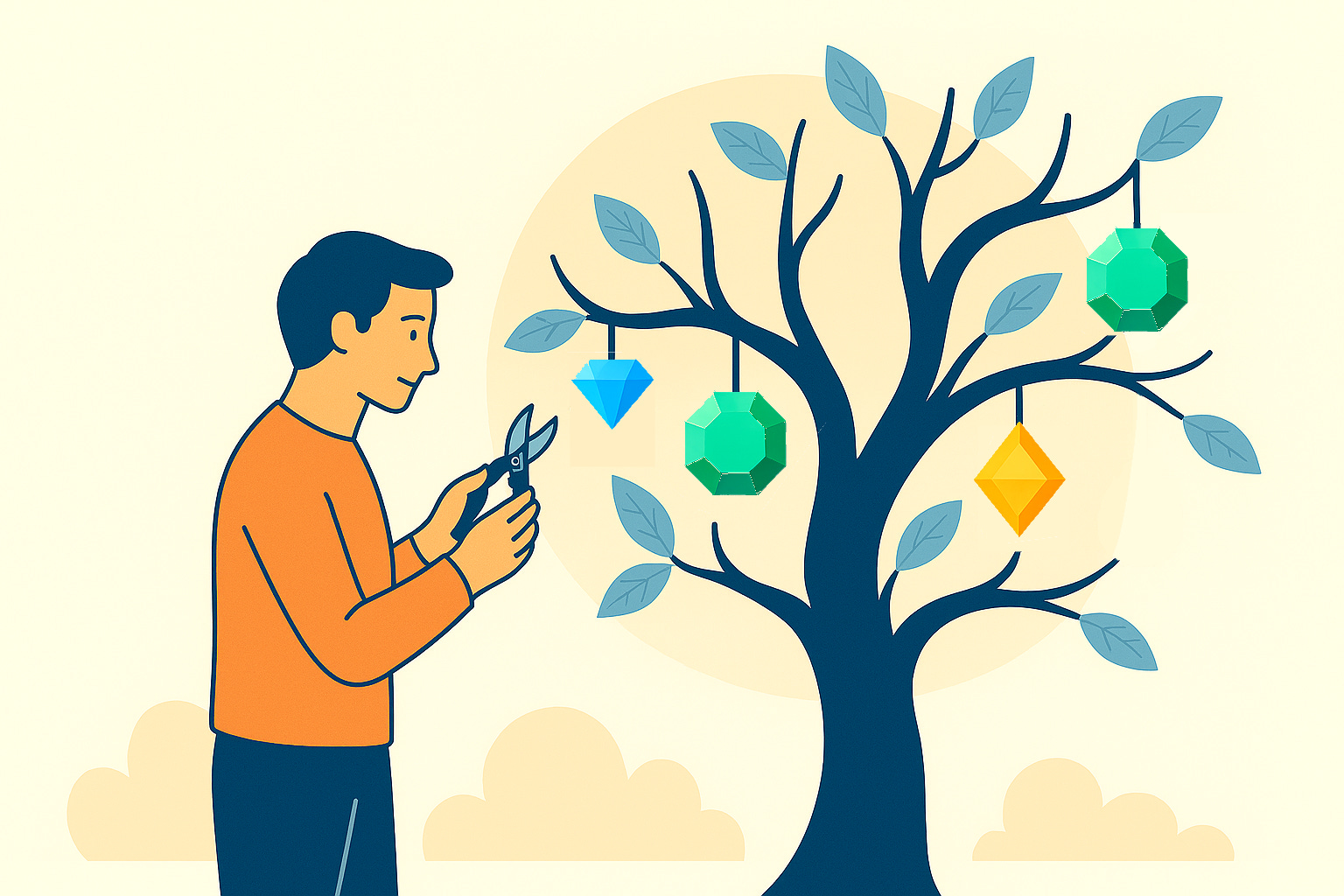
My family and I went to my niece Caroline’s wedding last weekend. This is the third of my 16 nieces and nephews to get married. It was a beautiful time. A beautiful venue. A beautiful couple. Beautiful vows, officiant speeches, and reception speeches. But one word showed up in the ceremony that was so out of place that it really caught my attention. Caroline’s sister Grace was the officiant. As Grace was speaking and sharing stories of her sister, she referred to a recent Substack post Caroline had written called, “Against Optimization”. Why were we talking about optimization at a wedding? I made a note to look up that article and then returned my focus to the moment.
I enjoyed the rest of the weekend with my siblings and all our kids, and then on the flight home I looked up her post. Then I understood why it got a mention in the ceremony. Amidst the insane amount of wedding planning, Caroline experienced an optimization overdose. It was certainly relatable, and I have seen several similar articles in the last couple of months that are encouraging a little less optimization, for your own wellbeing.
I think there’s a lens to look at this optimization through that all of these articles are missing. And so, I would like to provide a different perspective … in defense of optimization.
Falling in love with optimization
I have loved to optimize things. From a very early age, the idea of optimization turned every activity into a puzzle. As I cut lawns, I was always thinking about the most optimal cutting route, planning for emptying the clippings and refilling the gas tank. As a bagboy at the local supermarket, every cart of groceries was a challenge for optimal packing, with all the colds together, no bags overloaded, and the customer never waiting. I didn’t know this was called “optimization”. I just saw it as a gamification of the work to make it more fun.
College is when I learned the term “optimize” technically. In computer science, when writing computer algorithms, we were taught to ask, “What am I optimizing this algorithm for?” In the programming space, the three most common optimization options were (1) programming time, (2) execution speed, or (3) execution storage. The key to this question was that you were picking one of these to optimize for. You couldn’t pick all three. You had to pick a winner. Given my years of programming with this question being regularly asked of anything we were writing, this question has become part of my default analysis.
“What am I optimizing for?” is an even more impactful question outside of software development. And I can’t emphasize that final “for” enough. “What am I optimizing for?” Bold. Italics. I’d add underline, change the color, and make it flash if Substack’s editor allowed for that. Having an optimization bias is a great thing, in my opinion. But if you are just optimizing for optimization’s sake, then that’s wasted energy.
You can’t have everything. You have to pick what is motivating your optimization, so that you can optimize in the right way. Much later in my career, with decades of professional optimization under my belt, I created the mantra, “Optimize Life, to Maximize Moments that Matter”. I lead with “optimize”, as I’m clearly a fan. And I call out “life” to mean that optimization can be effectively applied to all aspects of your life. And then I say what I’m optimizing for: “moments that matter”. As many of them as I can experience, as deeply as I can experience them. I have a Thoreau kind of greed, “Live deep and suck out all the marrow of life.”
This wedding as an example
It is without doubt that there was a ton of planning that went into Caroline’s beautiful wedding. Amidst all of this planning, there must have been so much optimizing going on that it led to her optimization overload. I don’t know if the “What am I optimizing for?” question was explicitly asked during all of this, so there may certainly have been extraneous optimizing happening. But from the standpoint of a wedding attendee, I participated in a very well-put-together wedding experience. It came shining through that what they had been optimizing for was a beautiful experience for everyone who came to this country inn to be together that evening.
The first official words illustrated this intent: “The couple has asked you to put your phones away for the ceremony. We have some awesome professional photographers, so they’ll handle the photos.” It was a great call to action to put those distraction machines away and just be present1.
I knew this weekend would be a “moment that matters”. Getting all of our family together that is now spread across five states doesn’t happen often. I was optimizing for quality family time. This is the reason we flew there Thursday evening and flew back Sunday evening. We were not rushing to or through any of the events with the family. My wife, sons, and I got into town and got settled in, and then were fully adjusted to the time zone and the town by the time the first pre-event started. And after the wedding night, we had a leisurely bagel brunch with all the family before we made our way up to the airport. We had so much time that we were even able to vector off course a bit and meet my nephew Jake’s first kid, Grant.
My sister Sue has some medical challenges that all of the siblings are helping her get through. So when it came to this wedding, there was extra work required to safely transport her to and from the venue, and stay within reach of her in case anything happened. We also knew that she was going to have to leave the wedding reception early. The siblings talked ahead of time to make a plan that optimized for maximizing Sue’s time at the wedding and minimizing our time in transit.
I was on transport duty, and I got Sue there and all settled in early so that once the ceremony started, we could give it our complete attention. I slowly took in the fall colors on the rolling hills that were the background of this wedding. We smiled at all the beaming faces coming down the aisle. And we laughed at the flower men who escorted Caroline’s dog down the aisle while tossing flowers around in a “heavy on the attitude” way.
Just after we finished our salads at dinner, Sue gave me the signal that she needed to exit. I had already pulled the car up the front walkway before we came in for dinner, so my brother John and I wheeled her out to the car and I was off. I optimized this drive back and return trip to miss as little of the action as possible. They covered my dinner to keep it warm, and Charu used her phone to capture the speeches I missed so I could watch them later. So it was like I never left.
In short, the wedding experience was not optimized. But everything that fed into creating that experience and that timeline was. The event was optimized, so that the experience could be maximized.
“Be the architect of moments that matter”
Chip and Dan Heath, in “The Power of Moments”, encourage you to, “Be the architect of moments that matter.” Don’t just leave important moments to chance. Be aware2 of the opportunity, and seize it. If it’s important to you, design it. And if it’s a detail that goes into the design, then optimize it so that it doesn’t pre-occupy your mind.
Optimization is all about putting overhead in its place. It’s keeping the administrative details from dominating the conversation to the point that you lose sight of why you’re doing it. This is much like my point in Managing Email3 about an overflowing inbox (overhead) weighing on you and distracting you from your actual work (purpose).
David Allen perfectly captures the alarming trend in the overhead winning out. In the introduction of “Getting Things Done” David says, “People are not paying appropriate attention to their kids’ school plays, sports games, or going-to-bed questions about life, or they’re simply not able to be here now, anywhere, anytime. An ambient angst pervades our society -- there’s a sense that somehow there’s probably something we should be doing that we’re not, which creates a tension for which there is no resolution and from where there is no rest.”
What are you optimizing for?
Nicely done! As I read more of your posts, it is clear why you write.
Thank you for sharing your earned wisdom.
Thanks, Erik. You and I were part of the "Learn-It-All" culture shift at Microsoft. What I've concluded from that shift is that "Learn-It-All" is the necessary first step, but it needs to be followed shortly by "Teach-It-All". That's the two sides of the "lifelong student-teacher" coin.