


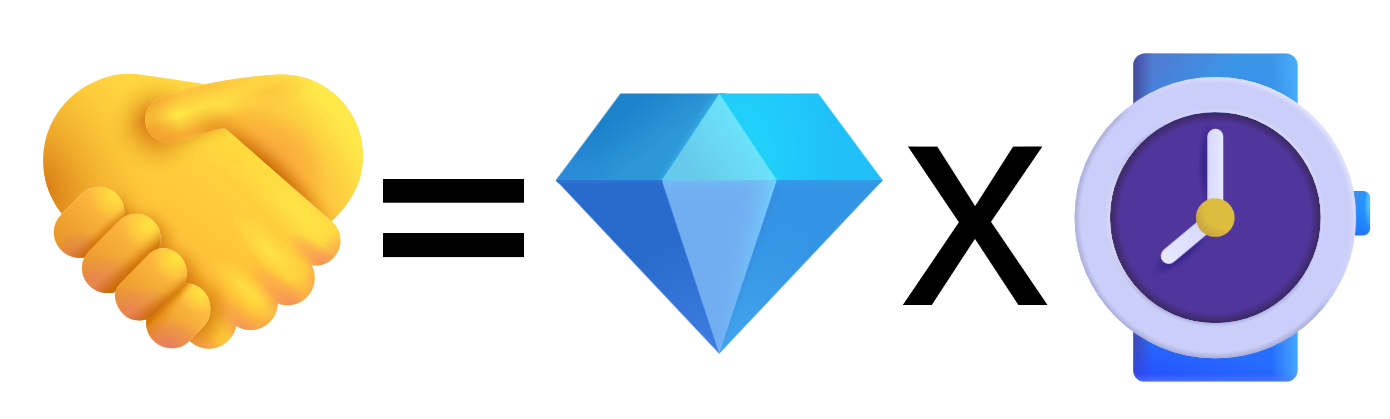
In “Hit Refresh”1, Satya Nadella defines the trust equation as “trust = consistency x time“. The longer that consistently deliver, the more trust that is placed on you. The most universal indicator of earned trust is your level. The more senior your level at a company, the more trust the company is putting in you.
When you’re a junior level developer (Microsoft calls this SDE I), you’re still figuring a lot out about the company and, likewise, the company is still figuring you out. This is why the junior level feels more constrained. You’re going to be working on individual features and related bugs. You can feel more like a cog in a vast machine than like a human.
When you reach a staff level developer (Microsoft calls this SDE II), you have learned enough about how the product cycle works that now you can be trusted with more aspects of the design and execution. You’re now going to be seeing features the entire way through their arc from conception to delivery. Your work will feel a bit more well-rounded than your SDE I work, but you may still feel like you’re in a box.
When you achieve a senior level developer position (Microsoft calls this Senior SDE), you’re recognized as more of a leader for your team. Now, in addition to your feature work, you are tasked with the more ambiguous responsibility of elevating the team. Your technical skills continue to be leveraged, but now you’re tapping more into your human side. This is most likely where you’ll hear the term “EQ” (Emotional Intelligence) being used. It is typical to feel a bit stretched here initially, but when you gain comfort, you will realize how much broader your scope of influence is. This is the beginning of the force multiplier feeling, where you are doing your own individual work while also helping others around you. You’re less aware of anything fencing you in at this point. It’s a pretty wide open field.
Progressing further to a principal level developer position (Microsoft calls this Principal SDE), you have now been exposed to the culture and philosophy of the company to a point where you have now internalized “the company way”. This creates a fundamental inflection point. Up until now, the company has told you what you’re going to do. Now, you’re going to be telling the company what you are going to do. The company trusts that you will be able to operate autonomously in a manner that aligns to the company’s mission. This brings incredible freedom, but with it comes incredible pressure. You are now one of the individuals that is architecting the overall direction for your team.
There are many levels of progression beyond this. At Microsoft, this includes Partner, Distinguished Engineer, and Technical Fellow. Other companies will create similar or different stages. But I only needed to detail this up to the principal level for the purposes of the topic of trust.
If you don’t like the constraints of your current role, the way out is through growth. The way to grow is by earning trust. And the way to earn trust is by following Satya’s equation. Here’s how.
Mastery
You are promoted to the next level when you consistently go above and beyond the current level. How do you “go above and beyond” your current level? Through mastery.
For any responsibility you take on, your approach should evolve over time from (a) ramping up to (b) performing to (c) mastery. Each stage is marked by less time demand than the previous stage. The ramping up stage is when you devote the most time to your new duty, to learn the ins-and-outs and to formulate your plan for how you’re going to manage this responsibility. The performing stage is when you have established a workable rhythm and are executing on your duty. And the mastery stage is when your understanding of the role has expanded to the point where surprises are rare and the time needed to perform this duty is minimal.
The more responsibilities that you master, the more space you create to either uplevel your given responsibilities or take on more responsibilities. This is a game plan for growth. If you think this sounds more like a vicious cycle, remember that you choose your pace and scope of growth. It’s the amount of stretching that’s comfortable to you.
Upleveling your responsibility
Once you’ve mastered a duty, you may decide to uplevel that responsibility. The goal of upleveling is to “make it suck less for the next person.”
We’ve all encountered inefficient systems, experiences, and processes at work. Actually, it’s probably more accurate to say that we’re surrounded by them. And this prevalence can easily lead to acceptance, because the problem is too big to fix entirely. “It’s just the way things are.”
While it’s true that the company will never get it 100% right, it’s easy to get 1% better … repeatedly. It comes down to an exercise in pain assessment and effective extrapolation. When something you work with or work through was painful to you, ask yourself two questions:
“How painful was that?”
“How many other people are going to have to experience that?”
The greater the combined quantity of your answers to #1 and #2, the greater your motivation should be to make it suck less for the next person.
Here’s the progression to uplevel any duty:
More clearly document the duty. What aspects of this duty are more ambiguous? Make it all clear cut. Just the act of clearly articulating every step will streamline all future executions of this duty. Additionally, this sets up more improvement, per John Dewey’s line, “A problem well stated is a problem half solved.”
Cut and optimize. Now that you have a clearly stated process, you have a heightened awareness2 of all the work involved. The first question to ask is, “What steps, if any, are unnecessary?” Then cut them. The second question is more iterative in nature, which goes back to the 1% better statement above. “What step is the most painful, and what optimization could reduce that pain?”
Capture opportunities. After you’ve completed the rounds of optimization that you could in the time you had, capture all other optimization opportunities you didn’t get to. With #1 & #2, you’ve made it suck less for the next person. With this step, you’re helping the next person make it suck even less for the person after them.
The Side Hustle
Once you’ve created enough space through mastery, you may opt to take on additional responsibilities. Among the available options to you, ask yourself, “What scratches an itch that my current role doesn’t?” Side hustles work best when they serve as either a pressure relief valve or they allow you to explore a new dimension.
Pressure relief valve - a junior engineer feels overly constrained in their current role because they don’t get to do as much UX design. Their company provides known outlets (e.g. hackathon, innovation sprint, or gig assignment) that this engineer can participate in as a pressure relief valve. This is a valuable outlet that allows the engineer to have the continuity and progress of their current role while also getting to bring more of themselves to their work3. The satisfaction that this engineer feels in their side hustle will undoubtedly bring more energy to their day job4. Win-win.
Explore a new dimension - After three years in their role, an engineer wonders if a different aspect of product development would be more of a fit for their strengths, perhaps as a product manager. Through their network, they can find peers in product management to have pro/con discussions with. Additionally, there are resources the company provides that explain the differences between the different roles and migration paths for those interested. And, much like in example #1, there are short term opportunities to try out this role.
The most important thing to remember with side hustles is relative priority. You can take on as many side hustles as you want, and dive into them as deep as you can go, provided they never beat out your core responsibilities. As long as you are continuing to make your engineering deliverables, then any side hustle work will be applauded. If not, the side hustle will be deemed a distraction, and a negative.
There are no shortcuts
Trust = consistency x time. Execute. Consistently. Over time, you will earn the trust that grows your scope.
You may witness people cheating this equation, and temporarily leapfrogging their level of earned trust. Temporarily is the key word. If your position of responsibility is not based on sufficient trust, it is not going to end well.
Follow this equation, continue to build trust, and CEO’s the limit.
Trust, as you know, is THE core focus of WiLD Leaders. While I appreciate Satya's definition of trust, I think much of the important nuance is lost with such a simple/short definition. I really appreciate the richness of this definition: Trust is your belief in my integrity (I *will* do what you need me to do), my ability (I *can* do it, I have the skills and knowledge, and have your best interest at heart), my reliability (I will do it *consistently* and deliver it on time), my strength (I will do it *well*), and that I will tell you the truth when any of those things are lacking.
While I am 0% surprised that you would have a better definition for _trust_, I am 100% surprised that I didn't consult you before writing this post. 🤦