



Andy Weir tells a good story. After Drew and Charu read his first novel, The Martian1, they got the four of us to go see the movie when it came out. When Project Hail Mary2 came out, Drew, Charu, and I read it and loved it. So last week, we got the family back together to go watch Project Hail Mary. It was very well done. Highly recommend!
No spoilers here. I just want to share the premise of each of these two stories. In The Martian, they’re trying to figure out how to get Mark Watney, a stranded astronaut, off of Mars and back to Earth. In Project Hail Mary, an isolated Ryland Grace is trying to figure out how to research black matter in a distant galaxy and send his findings home to save Earth from this same black matter.
Both of these stories center around intense and extended problem solving. Both Mark and Ryland have their pity party moments, but in Finite Bitching3 fashion, they are quick to turn their attention to the task at hand and begin to Work the Problem. Once Mark groks the gravity (no pun intended) of his situation, he says, “In the face of overwhelming odds, I’m left with only one option: I’m gonna have to science the shit out of this.” Well said. Little problems require a little science. Big problems require a shit ton of science. Work the shit out of the problem.
“Work the Problem” is a phrase perhaps most famously used by Gene Kranz, lead flight director for NASA’s Apollo 13 mission. 55 hours and 55 minutes into the Apollo 13 mission, there was a major failure on the spacecraft. At the same time that commander Jim Lovell radioed, “Houston, we’ve had a problem,” mission control was already reacting to a whole bunch of simultaneous alerts flashing on screens around the room.
The panic was building, so Gene Kranz worked to settle people down, “Let’s work the problem, people. Let’s not make things worse by guessing.” Gene went on to highlight how to keep focused on the problem. “Okay, now let’s everybody keep cool. We got the LM [Lunar Module] still attached. The LM spacecraft’s good, so if we need, to get back home we’ve got a LM to do a good portion of it with.”4
For the next 87 hours, mission control and the astronauts worked together to solve the problem. Gene later described the flow as, “Everybody seemed to be moving in the right direction without being directed.” Lovell celebrated the victory of “Initiative to think outside of the box. When things go wrong, how do we repair them?” These are articulations of Work the Problem at its finest.
Space is probably the most unforgiving environment, so the Martian and Apollo examples are extreme, but the Work the Problem lessons here are broadly applicable. You can probably even put yourself at ease when you encounter any problem by telling yourself, “This can’t be as hard as Watney’s or Kranz’s problem, so I’m sure I can figure it out.”
You have a problem in front of you, and you have time working against you. Focus on the problem at hand, and get to work.
Divide and conquer
In the movie Unstrung Heroes5, John Turturro plays Sid Lidz, a father who prides himself on his love of science. He is constantly exploring, and enthusiastically involving his family in the running of his experiments. When Sid’s son Steven faces a challenge (running for class president), Sid jumps at the opportunity to walk Steven through his own approach to Working the Problem. “Now the first thing we have to do is make two lists, see. One list you call ‘Possible ideas.’ The other list, ‘Available materials.’”
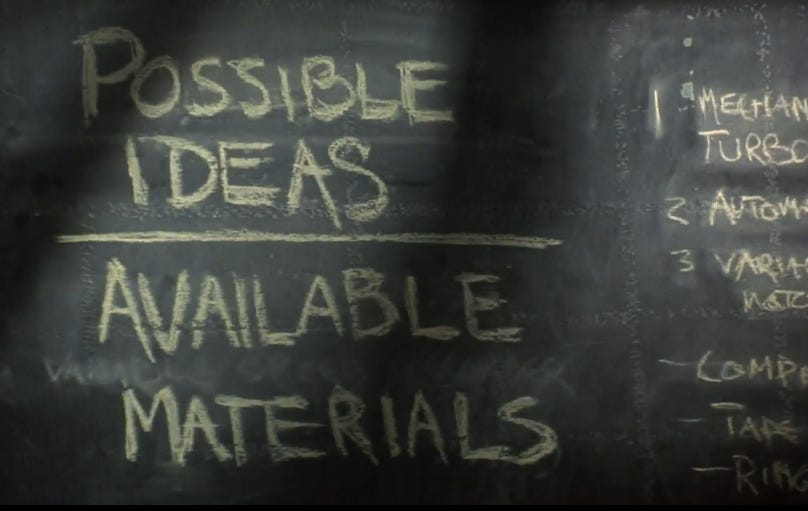
This is a great way to approach the problem. What do you have to work with, and how can you creatively leverage those materials to solve the problem? By answering these questions, you’re beginning to break your large and scary problem down into manageable chunks.
At the end of The Martian, Watney captures the incremental nature of Work the Problem. “This is space. It does not cooperate. At some point, everything is going to go South on you. Everything is going to go South and you’re going to say, ‘This is it. This is how I end.’ Now you can either accept that, or you can get to work. That’s all it is. You just begin. You do the math. You solve one problem, then you solve the next one, and then the next. And if you solve enough problems, you get to come home.”
Build your problem solving muscle
My dad didn’t use the same terms as Sid Lidz, but he was a master problem solver. I saw him fix our cars and fix our house. Regardless of the problem, he would resolve it. He wasn’t born with that. His problem solving proficiency came over years of learning. Problem solving is a muscle you build. I have aspired to be as well-versed at working the problem as Pop was.
When you encounter a problem at a scale that is daunting to you, lean into the experience. Break the problem down, work through the possible ideas and available materials, and solve it. The more success you have at large scale problems, the more confidence you have that you can fix even larger problems.
The goal state is the belief that you can fix any problem you set your mind to. This isn’t about arrogance or about self-delusion. This is about having a level of confidence that comes from your battle-tested approach to problem solving.
My measure of success for the building of my own problem solving muscle was to get as excited as my dad would get at the opportunity to solve a problem. I realized I had achieved that during a Crucial Conversations training I took several years ago. The instructor said, “It’s five o’clock on a Friday and you’re just about to walk out the door when a colleague steps into your office and says, ‘You and I have a problem. Can we talk?’ What’s your first reaction?”
People began giving what I imagine are the more expected responses: “Oh no.” “Here it comes.” “Yikes.” My response was, “YES !!!” and it wasn’t a joke. The Work the Problem mindset is all about optimism: visualizing a better future and then taking steps to get there. So while the timing of this colleague’s visit is unfortunate, the opportunity for us to be better on the other side of it has me excited to engage.
A slight tweak of Teddy Roosevelt’s gem is perfect for this. “Far and away the best prize that life has to offer is the chance to work hard at problems worth solving.“ Choose your problems, and then get to work on fixing them.
Don’t get married to your solutions
There is a phrase made popular by Uri Levine: “Fall in love with the problem, not the solution.” I think a more precise phrase would be “Fall in love with the solving, not the solution.” When I’m presented with a problem, my excitement doesn’t come from the problem itself, but from my belief that I can solve it. And when I do solve it, I don’t find myself missing the problem, longing for its return. So, I wouldn’t say that I love the problem. I love the problem solving itself.
That clarification aside, the second part of this phrase is key: don’t fall in love with the solution. You have to be dynamic and flexible. Your solution might look right at first, but then not hold up under scrutiny or testing. If you’re married to that solution, then there’s heartache when you discover it won’t work. But if you’re instead married to solving the problem, you can quickly discard this failure and go back to the solving.
The longer your solution has been working for, the harder it may be to discard it. This is human nature to hang on to it, from some combination of proof points and laziness. Remember the goal: a better future. Do you want this failing solution in place another year from now, or do you want a better solution to be in place?
People problems
Before publishing novels, Andy Weir spent twenty five years as a software engineer. The software engineering industry runs on the Work the Problem mindset. Code is very unforgiving. There is the need for precision. And when problems arise, the only way through is by doing the hard work of debugging.
This background gave Andy a drive to focus on the non-human challenges we face. “In my stories, I tend to like person-versus-nature plots, where there is no bad guy. In The Martian, it’s just all of humanity or a group of people working together to try to solve a problem, but there’s no antagonist other than Mars.”6
When the environment is the antagonist, then it’s more straightforward to work the problem. But when the problem you’re working is a people problem, added challenges are introduced. The solution there is to make it the least personal that you can. I turn again to Demotivational Posters7 for help.
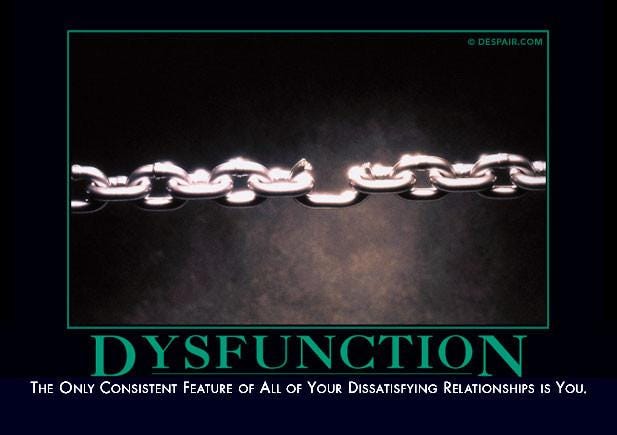
“Dysfunction: The only consistent feature of all of your dissatisfying relationships is you.”
This poster reminds me that if I’m pointing the finger at someone else, there are three fingers pointing back at me. So if I want to blame the person for the problem, then I’m the problem.
Instead, get more precise. The problem is the result of a clash in the perspectives of you two. Identify the relevant differences between you two, and now the two of you can work together to solve the problem, without having to get personal. Chris Voss, professional hostage negotiator, says it best: “The person across the table is never the problem. The unsolved issue is. So focus on the issue.”8
Footnotes
The “Choose your Mantra” section of Timebox Everything, and www.despair.com
Never Split the Difference: Negotiating as if Your Life Depended on It by Chris Voss | Goodreads