


I’m going to attempt to reference a political movie without making this a political post. Wish me luck. While the connections from this movie and the current Middle East events are obvious, I assure you that is not the motivation behind this post.
In Charlie Wilson’s War1, Gust Avrakotos is a CIA agent who partners with Charlie Wilson, a US Congressman representing Texas. The movie details how a small group of individuals in various circles join forces and leverage their influence to fund rebels who are fighting the Soviet army in Afghanistan in the early 80s. The final scene in the movie is at a party celebrating the rebels’ success in driving the Soviets out of their land. The movie closes with a private exchange between Charlie and Gust out on the balcony.
Gust: “Do you know the story about the Zen master and the little boy? …
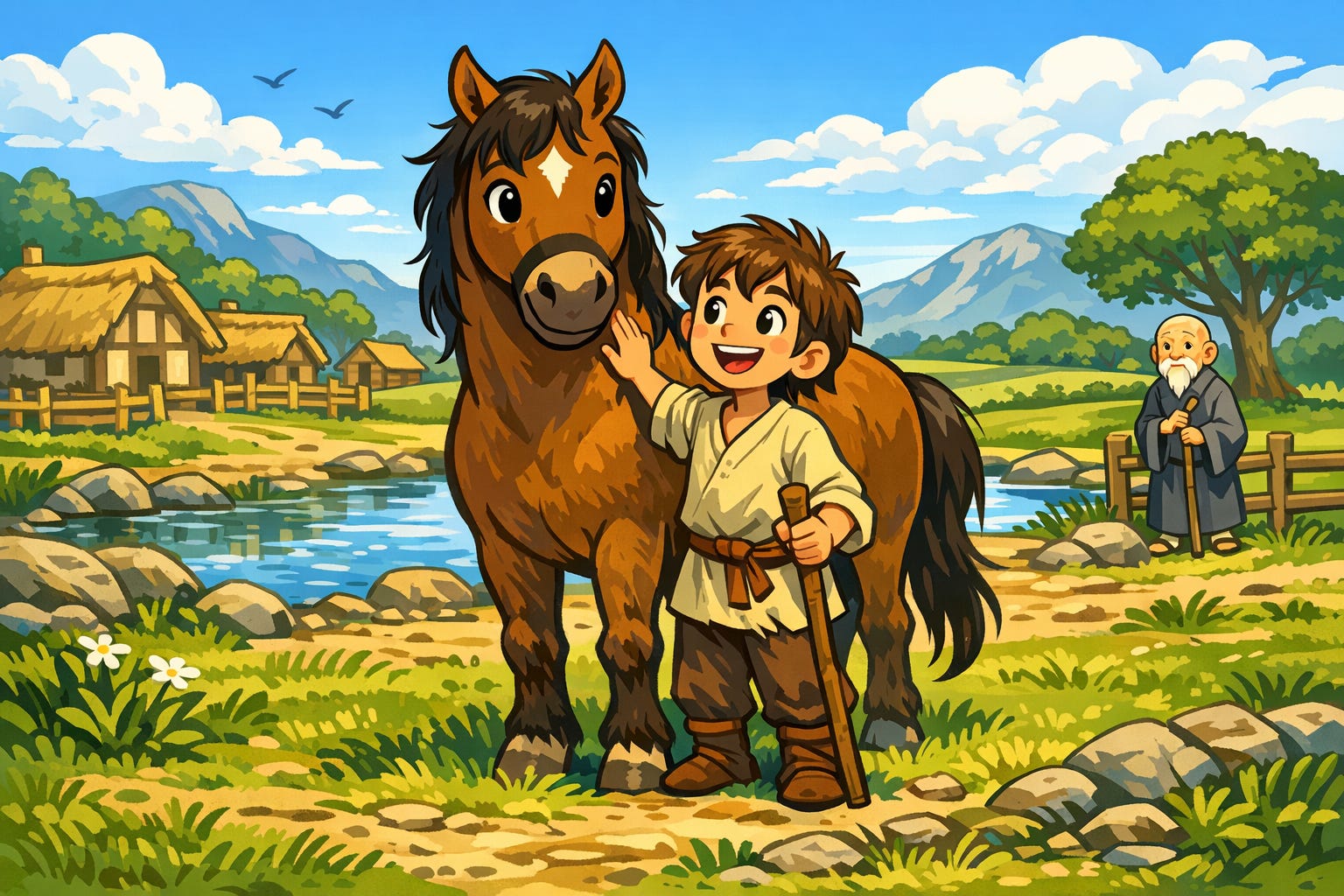
There’s a little boy, and on his 14th birthday he gets a horse, and everyone in the village says, ‘How wonderful, the boy got a horse.’
And the Zen master says, ‘We’ll see.’
Two years later the boy falls off the horse and breaks his leg, and everyone in the village says, ‘How terrible.’
Then the Zen master says, ‘We’ll see.’
Then a war breaks out and all the young men have to go off to fight but the boy can’t because his leg’s all messed up, and everyone in the village says, ‘How wonderful.’”
Charlie: “Then the Zen master says, ‘We’ll see.’”
Gust: “So you get it.”
Charlie: “No … ‘cuz I’m stupid.”
Gust: “You’re not stupid, you’re just in Congress.”
Charlie: “Send ‘em money?”
Gust: “You’re gonna start with the roads, move on to the schools, factories. Restock the sheep herds, give ‘em jobs. Give ‘em hope.”
Charlie: “I’m trying.”
Gust: “Yeah well try harder.”
Charlie: “I’m fightin’ for every dollar. I took you from 5 million to a billion. I got a Democratic Congress in lock step behind a Republican president.”
Gust: “Well that’s not good enough, because I’m gonna hand you a covert classified NIA right now and it’s gonna tell you that the crazies have started rolling into Kandahar like it’s a f*cking bathtub drain.”
Charlie: “Jesus Gust, you could depress a bride on her wedding day.”
Gust: “Hey, listen to what I’m telling you.”
Charlie: “You did a hell of a job for the son of a soda pop maker.”
Gust: “We’ll see … Said the Zen master.”
This is great story about the importance of playing the long game2. Gust has been steadily raising Charlie’s awareness3 on the situation in Afghanistan. And at a moment when it seems that their work is done, Gust tries to create yet another moment of insight by telling the Zen master story.
You have certainly experienced your own Charlie moment, where you think your work is done, only to find that, as Gust says, it’s not good enough. The more complex the mission, the more likely you’re going to encounter this phase, perhaps even repeatedly, during the execution. This is the benefit of the iterative planning approach, where you keep yourself open to the suprises to come.
Let’s explore the components to a successful extended mission.
Define long-term success
Establish an initial best guess plan
Follow-up: Course correct regularly
Follow-through: Keep your eye on the prize and drive success
Define long-term success
Any manager can manager a team. A leader will grow that team, evolve that team, transform that team. Leadership is about making meaningful change. And that doesn’t come easy. It’s far simpler and straightforward to give a man a fish. Teaching that man to fish takes work. As a leader, embrace this investment.
When you identify a change worth making, your next step is to define what long-term success looks like. Good: Reduce team’s issue triaging time by 25%. Better: Customer satisfaction is up by 25%. The ultimate goal is improved customer satisfaction. One implementation (of several possible) is improved triage time. That customer-focused success metric creates an openness to many potential implementations.
Having the right success metrics will help with everything downstream of them: the initial plan and all the iterations during execution.
Establish an initial best guess plan
With clear focus on your idea of success, now it’s time to construct a plan. This will be your pitch4. It doesn’t have to be complete. It just has to account for all that is known: the “known knowns” and the “known unknowns”5. And then, to plant the right seed in your mindset, recognize the potential for “unknown unknowns”. You don’t know what to do about them, because you don’t know them at the time of planning. Accept that … and be open to that. This will serve you well in the later stages of execution.
Follow-up: Course correct regularly
Once you’ve gotten buy off on your plan, you’re ready to establish your execution plan. The key here is regular checkpoints. The Scrum methodology includes repeated “sprints” of regular intervals, with each sprint ending with a “retrospective.” The retrospective is a chance to assess how you’ve done in the last sprint and what you want to change going forward.
This is where any “unknown unknowns” that become “known unknowns” are revealed. By baking checkpoints into the plan, you are intentionally opening yourself up to the possibility of change. This is when you can capitalize on that openness and embrace the challenge. You are far less likely to dismiss this new information as scope creep or “not my problem”.
Assign a “threat level” to each discovery:
High: It blows your original plan out of the water, and you need to fundamentally rethink your approach.
Mid: The original plan is still solid, but there may be changes needed in resources or funding.
Low: a tweak to the plan will address it.
You had already set expectations that some surprises were inevitable. That makes them far less surprising. Stay logical. Stay practical. Work the problem6. Call out these discoveries, along with your adjustments to the plan to account for them. You now have something concrete to present the stakeholders to explain the need for change.
Follow-through: keep your eye on the prize and drive success
With your plan, and with your course corrections, now all you have to do is follow-through. As Henry David Thoreau said, “Advance confidently in the direction of your dreams with no concept of failure.”
There are any number of inputs trying to distract you from your goal. Follow-through is not automatic. This is why Gust demands, “Hey, listen to what I’m telling you.”
In the tech industry, we talk about “bright shiny object syndrome”, where some new cool thing comes along that demands attention. Certainly it can be a bad idea to fully dismiss the new object: “Not now AI, I’m busy.” We need to remain vigilant, but of equal importance is maintaining perspective. One of the most commonly occurring failures of leadership is over-indexing on the bright shiny object and sucking momentum from meaningful investments. Fight for yours.
Teachers note
Returning to my movie reference from the start of this post, there’s another scene much earlier in this movie that is worth calling out for all the student-teachers7 in the audience. The first time Gust and Charlie meet in the movie, Gust tries to tell Charlie the Zen master story. But they keep getting interrupted, and eventually Gust stops trying to tell it.
Gust completely makes the right call by stopping. He recognizes two things in that moment. First, more than not having Charlie’s attention, Gust doesn’t have Charlie’s earned trust8 yet, which makes it far more likely that this story will quickly be forgotten by Charlie. Second, the timing of the story is important. This story is meant for when more of the “unknown unknowns” are revealed, which can only happen after Charlie reaches a certain checkpoint in the operation. Charlie had far more basic things to learn before the Zen master story would fit in.
Teach the right lessons. And time your lessons well.