


My good friend Barney was the first person that I connected with after being laid off (two years ago yesterday), meeting with him for coffee the Wednesday after my last day at Microsoft. I was deliberate about starting with Barney, as he is a fresh start SME, having intentionally constructed a career of serially working himself out of a job. The key line from our meeting was him saying, “Don’t just jump in the next thing that looks comfortable or familiar. Instead, enjoy this in between time. And just stay open … to anything.” A few weeks after our meeting, Barney sent me a link to an episode of the Good Life Project podcast called, “How To Love Midlife: 12 Ways Life Gets Better with Age“1, which featured Chip Conley.
The podcast episode began with some statistics clearly designed to elicit a key moment of insight2: 50 years old is actually the middle of your life. So when you’re in the retirement age range of 55-65, there are actually far more years ahead than you realize. The central topic of the episode was The Modern Elder Academy (MEA). The mission of MEA is, “We believe midlife isn’t a crisis – it’s a calling. Thanks to advancements in health and quality of life, midlife now lasts decades longer than it did a century ago. Our mission is to disrupt societal beliefs around aging and help people in the second half of their lives create the exciting, fulfilling, purpose-driven lives they crave.” Chip sums it up perfectly as, “Midlife isn’t a crisis, it’s a chrysalis.” Midlife is the transition between the caterpillar that consumes and the butterfly that pollinates. MEA recognizes that a meaningful role for people in the latter half of their life is spreading wisdom.
Two months after my Barney meeting, my sister Ann sent me a book as a gift: Arthur C. Brooks’ “From Strength to Strength”3. This book also stressed how long we have, and detailed the two important phases of life: the first phase of fluid intelligence, and the second phase of crystallized intelligence. Fluid intelligence is all about you learning, and organizing and reorganizing your knowledge. Crystallized intelligence is when you reach the point of having enough depth and structure to your knowledge that you have wisdom to share. And in the final chapter of that book, Arthur also calls out the Modern Elder Academy.
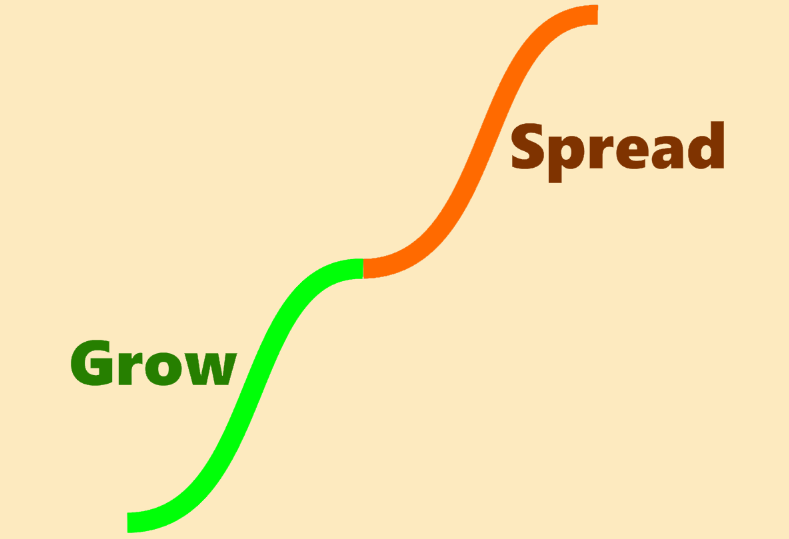
Two completely separate resources that led to the exact same conclusion: recognize and celebrate the transition from chiefly growing to chiefly sharing. In your first career, your focus is on the growing. Then, for your second career, or as Arthur calls it your second curve, your focus is on sharing. This was the right frame of mind to get into after my exit from Microsoft. That set in motion a very deliberate two year journey, that brings us to today, the start of my third year of my second curve. Here’s a look back at the last two years, and then a look forward at the year ahead.
Looking back
Year One: Play the Pause
Year Two: Establish my Second Curve
Looking ahead
Year Three: Uplevel my sharing
Year One: Play the Pause
In my early Play the Pause4 post, I detailed most of how I invested my time in the first year of my second curve. It was a year devoted to organizing my thoughts into a book. I fell short of my goal of publishing that book, but the biggest success of that year was convincing me of what my second curve should be.
Well before Barney and Ann had shared their Chip Conley and Arthur C. Brooks references with me, I had already detailed my second curve. It was part of my learning and development role pitch from 20215. That pitch detailed a five year plan for a broadening scope of my role.
Year 1: start with Windows org (2,500 people)
Year 2: move up one level in the hierarchy to the Windows & Devices org (10,000 people)
Year 3: move up one more level to the Experiences & Devices org (40,000 people)
Year 4: move up one last level to company-wide (200,000 people) (this is where bottom-up and top-down met6.)
Having reached my goal company-wide scope in year 4, this set up my last year in this role as a pivot. Here is how I detailed this year in my pitch:
Year 5: Establish Microsoft Coaching Program
This is the year when I will invest in the creation of a Microsoft Coaching program. I see a purpose for me (and many others) at Microsoft beyond my Software Engineering Manager role. Microsoft Coaching, not outsourced, but insourced. A sustainable cycle of veterans transitioning from engineering roles to coaching roles, to ensure that Microsoft Values, Culture, and Leadership evolve to their maximum potential of influence and impact.The standard model for retirement at Microsoft is to run at 100mph right up to the finish line, and then drop to 0mph. There is a much more natural transition that we should create, and would provide a win-win experience where the veteran is able to dial back hours gradually and the org benefits from having the veteran around for consulting, coaching, and guidance. This is already being done on a one-off basis throughout the company. I want to organize and normalize this model.
The initial coaching gig will be the coach supporting their successor in their engineering role. Once their replacement is ramped-up, then the coach’s role will transition into a broader consulting role for the org.
Along the way, the coach should make time to add content to our knowledge base to further training. This will result in a more rewarding exit strategy to their Microsoft career, where the coach leaves the company with a great deal of closure, seeing the fullness of their wisdom captured and passed on to the next generation of employees.
I didn’t use Chip’s or Arthur’s words, but what I was pitching was exactly a caterpillar to butterfly pivot, a shift from fluid intelligence to crystallized intelligence. It was clear to me what my second curve should be.
Year Two: Establish my Second Curve
I summarize my second curve as Coaching, Advising, and Educating. Over the last year, here’s how I’ve put that into motion.
Coaching
Individual - I started with coaching, as this was a natural continuation of what I was doing at Microsoft. Of the many people I coached inside of Microsoft, some maintained this relationship after I left, and that started me on my coaching path. I have since picked up additional clients through other pipelines (including this substack).
At scale - In my intro uplevel pro post7, I described this substack as being the “at scale” component of my coaching. This is the same model I had inside of Microsoft, where the individual coaching drove the topic list for my posts, and the posts would instigate individual coaching conversations. That virtuous cycle is in place now as well, with uplevel pro now seven months old, with 58 posts. I’m just shy of 100,000 words.
Advising - As I detailed in an earlier post8, I have joined the advisory board for Computer Science (CS) department at Virginia Tech, my alma mater. There are some excellent challenges this board is partnering with the CS department to tackle, the most significant being the need to evolve the CS curriculum to be AI-relevant and able to keep up with the very dynamic nature of the tech industry that’s been juiced up by AI.
Educating - When I joined the advisory board, I put a celebratory post on LinkedIn9: “I’m excited at the opportunity to work more closely with my alma mater, Virginia Tech. Joining the Computer Science Advisory Board is level 4 of my 7-level Re-engage with VT plan, and it already created the chance for me to do a guest lecture, which is level 5.” Christine, VT CS Department Head, responded with “I can’t wait to hear what levels 6 and 7 are.” So I shared, “Level 6: co-teach a jump start professionalism freshman course; Level 7: open source project sponsorship alternative to internship.” This led to Christine inviting me to instruct one of the sections of the CS Senior Capstone class in the fall. I’ll call that Level 5.5 in my plan. 🙂
Year Three: Uplevel my sharing
For the next year, my focus is on my own AI education as a means to create tooling that my coaching clients can use to accelerate their growth. For most professionalism best practices, the key is shaping the right habits to maximize both your short term and long term effectiveness. And the right tools can help with building and reinforcing these habits.
I have been more of a spectator on AI as part of the software development lifecycle. This year is when I’m going to go deep into that. I have already started to build my AI curriculum, driven by success stories my colleagues have shared. And I’m always open to more wisdom here. So if you have any pro-tips on ramping up on AI, I’m all ears.
This will also give me relevant experience to bring into the Senior Capstone classroom in the fall, which will contribute to the advisory board’s work on growing AI-relevance of VT’s CS curriculum. Win-win-win.
My second curve has the potential to be more fulfilling than my first curve, which I enjoyed tremendously. 🥳🎉
Footnotes
How To Love Midlife: 12 Ways Life Gets Better with Age (Spotify)
The “Awake” section of Raising Your Own Awareness
The Introduction section of Maximize Smiles per Dollar
The Introduction section of Gather with Purpose
I love Arthur C Brooks!