


Of all the meaningful totems1 I’ve collected, the most significant ones are mental. A physical totem is there to trigger a memory. A mental totem is etched into your brain. Mental totems invade every aspect of your life, in the best kind of way. One of my best examples of a mental totem is my Mom’s Prayer of Serenity wall art.
The only family home I remember is on Teddington Drive in Richmond, Virginia. I was four years old when we moved into this house. I have no memory of the house on Covey Street where we had lived before. The closest memory I have is walking out the door to the Covey house and getting in our station wagon … on the day we were moving.
Mom had a piece of wall art that she hung above the kitchen sink the day we moved in. And it stayed there until the day she moved out, 40 years later.
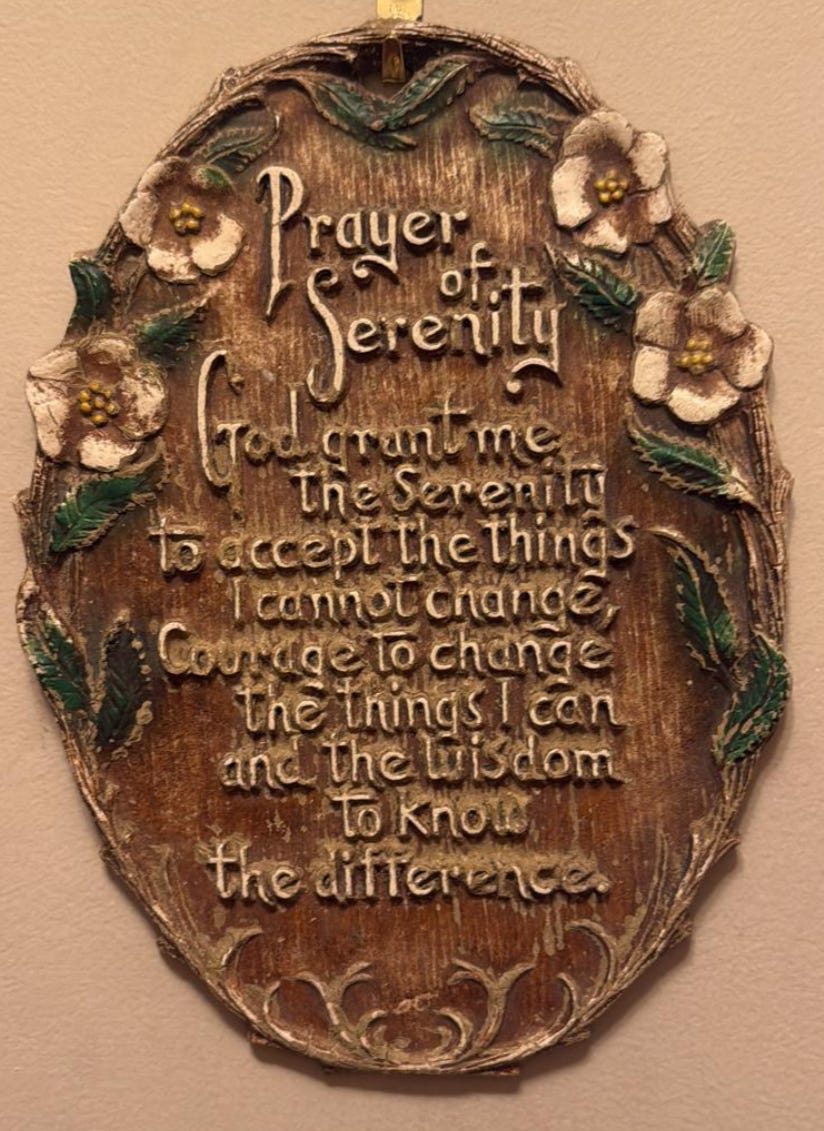
Mom loved this prayer. Mom lived this prayer. When we cleaned out our family home before selling it, my sister Ann claimed this art and it is now hanging in her kitchen. I don’t have a physical reminder. But given how much I saw Mom demonstrating it, I didn’t need it. This prayer is etched into my brain, and onto my heart.
Prayer of Serenity
God grant me the Serenity to accept the things I cannot change,
Courage to change the things I can,
and the Wisdom to know the difference.
The Prayer of Serenity has been adopted by Alcoholics Anonymous, as it perfectly captures the struggle we face in life to control what we can control and to let go of the rest. My family’s genes gave us a proclivity to addiction (accept). My father’s biggest addiction was alcohol. Mine is video games. Pop overcame his drinking (courage). I’m doing alright managing my video games (courage in progress).
Your overall effectiveness as an individual comes down to how well you can recognize what things you can change and what things you can’t change, and then how well you can direct all of your energy to what you can change. This is Stephen Covey’s first habit in “The 7 Habits of Highly Effective People”2. Habit #1 is called “Be Proactive”, where Covey introduces the two circles: the Circle of Concern and the Circle of Influence.
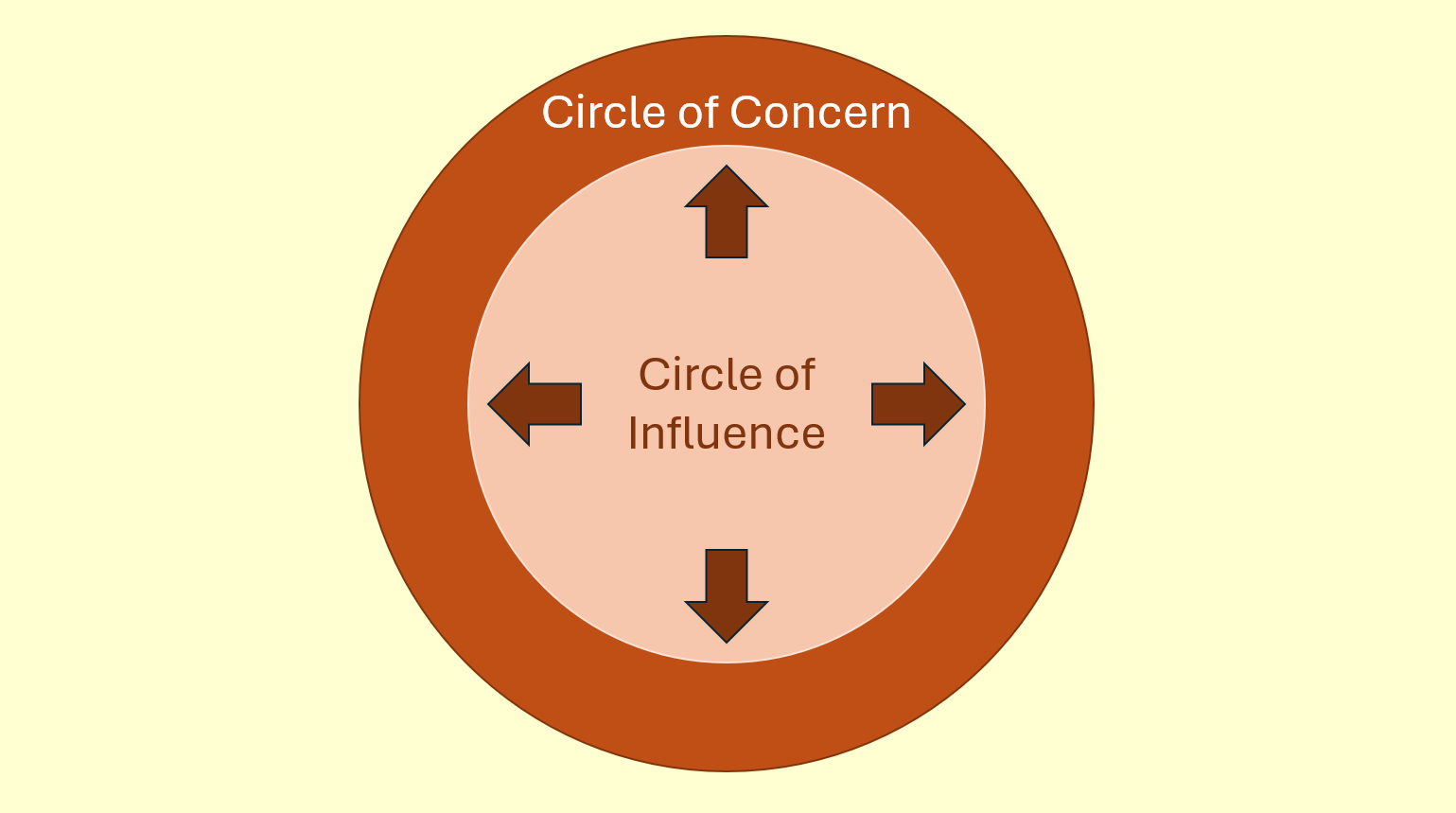
Your Circle of Concern contains everything that you think about. Embedded inside this circle is the smaller Circle of Influence that captures everything that you can influence. The weather and the stock market are inside your Circle of Concern but outside your Circle of Influence. Building your habits and helping your neighbor clean their yard are within your Circle of Influence.
Covey uses the arrows to highlight that, by focusing your efforts on the inner Circle of Influence, you grow that circle. And while you will never get to the point of being able to control the weather, through these expanding efforts, you will discover that you have more influence than you realize.
This concept was a light bulb moment for me, and has done wonders for focusing me ever since. When I dwell on things outside my Circle of Influence, I am powerless -- the victim. When I focus on things inside my Circle of Influence, I am empowered -- the change agent. Covey’s 7 habits book remains at the top of my list because of the level of change it instigated in me, beginning with habit #1.
Action-oriented
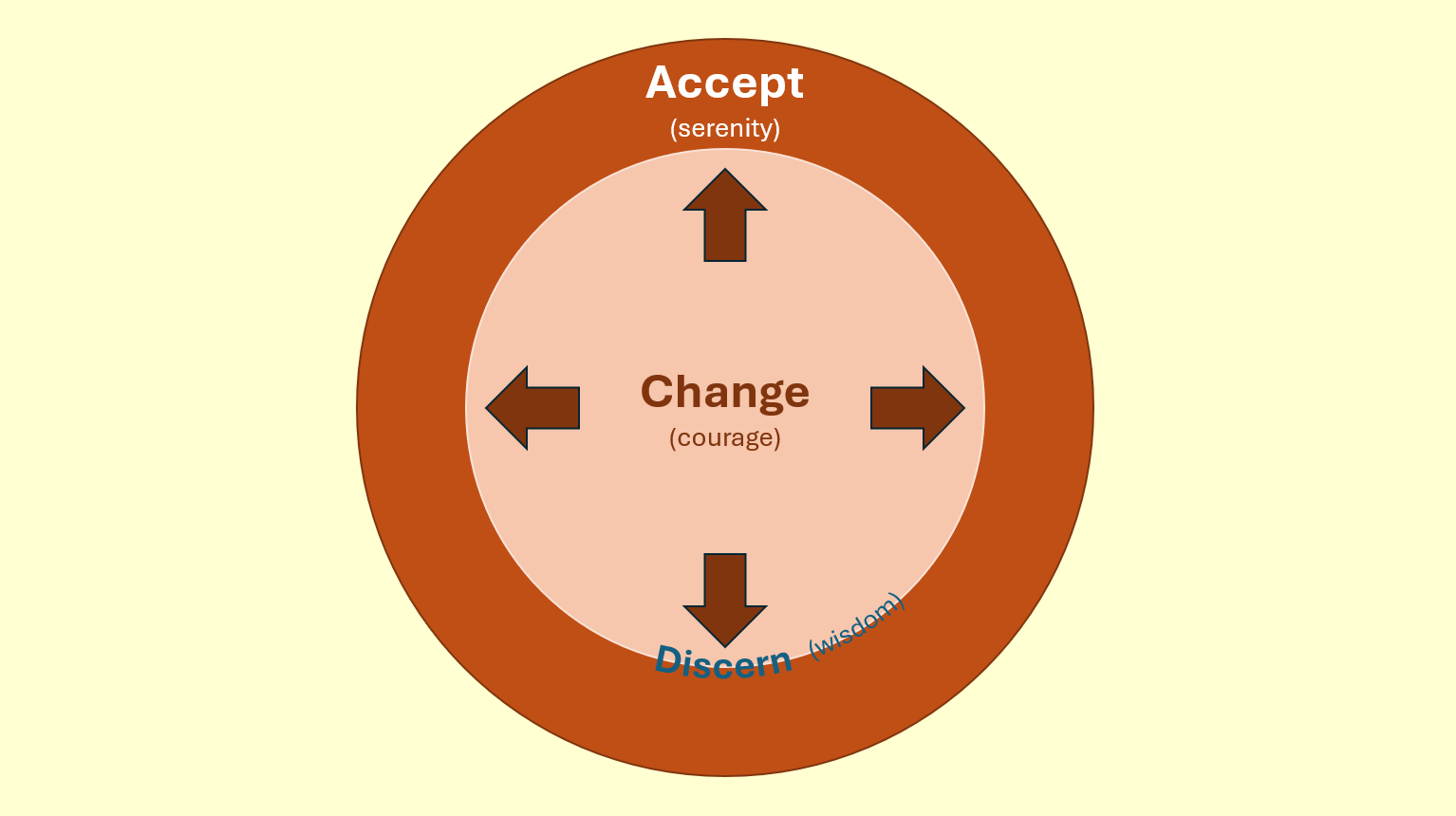
Mom’s Prayer of Serenity and Covey’s circles have come together in my brain as one blended image. The three actions (accept, change, know) of the Prayer of Serenity replace Covey’s terms.
The Accept ring
For the things outside of your control, your action is to accept them. Let go. Don’t worry. Move on.
A precursor to the Prayer of Serenity appeared in the Christian Gleaner and Domestic Magazine in 18273.
How to go smoothly through a crooked world
For every ailment under the sun
There is a remedy, or there is none;
If there be one, try to find it;
If there be none, never mind it.
Acceptance is the punchline of this rhyme. Try to fix it. If you can’t, let it go.
The Change circle
The Change circle is what you should call home. This is where you get to work. This is where you make a difference. The courage that you demonstrate in the Change circle is what grows your Change circle. Change yourself (private victory) or your environment (public victory) for the better, and you will discover ways that you can further improve.
Minimize the time spent in the Accept ring so that you can maximize the time spent in the Change circle. You’re revving your Energy Flywheel4 when you’re in the Change circle.
The Discern dividing line
Wisdom is the punchline of the Prayer of Serenity. The key to this whole system working is you being able to discern what is actionable vs. what you have to just accept. This dividing line is a muscle you will build. Much like with the Triage Shield5 work, the secret is practice. Practice makes faster. Intentionally decide, for each concern, do you need to Change or Accept. Here’s a good exercise to do to help raise your awareness6.
Pull out a piece of paper, or open a notebook page on your computer screen.
Write out everything that was on your mind throughout the course of the day.
Do a pass over that list, and for each item, mark it either as Change or Accept.
If you are “on the fence” on any item, try to break that concern down into all of its relevant sub-concerns. Keep breaking it down until each sub-item (or sub-sub-item) can be identified.
Let’s use the standard “money management” concern as a good example of #4. This concern is usually a dark looming cloud. But when you repeatedly apply your discern muscle, it becomes more manageable. Money management is a mix of Accept and Change, so break it down …
Investing - still a mix …
Portfolio Strategy - Change - what’s the winning long-term strategy?
Market Volatility - Accept - we have no control over the market
Earning - still a mix …
New Job - Change - Is my current job a good return on investment? Should I find a better job?
Job Market - Accept - I have to accept the reality of any restlessness in the job market
Promote - Change (grow circle) - I don’t directly control the amount of money I’m paid. But through increased performance, I can be promoted, which does give me more money.
Spending - I have a family, and we’ve made decisions for that family. But we can revisit periodically as our needs change. Breaking it down …
Housing - Accept - we’ve already had the discussion about moving and, comparing options, we love where we’re at.
Cars - Change - we had a set of cars designed around raising two boys. They’re grown up now. So what cars do we need now?
Food - still a mix …
Groceries - Accept - grocery prices are going up, but we’ve got a good diet and have been in good health because of it.
Eating Out - Change - we don’t really have a plan around when we eat out, and we should just so that we can better plan.
This list would now narrow my focus to the things I can do something about. The dark cloud becomes smaller. Name it to tame it.
You may notice a couple of “Accepts” in my money example above that I am, in fact, able to control (e.g. Housing and Groceries). If you can willingly move an item out of your Change circle, that’s an example of proactively Choosing Your Battles7. The key to maintaining your sanity is by being selective. In “The Inner Game of Tennis”8, Timothy Gallwey concludes, “Stability grows as I learn to accept what I cannot control and take control of what I can.” The Prayer of Serenity, aka The Prayer of Sanity, aka The Prayer of Stability.
Footnotes
Scalable Collecting, Suffering = Pain x Resistance, and I Have a Dog-shaped Hole in My Heart
The 7 Habits of Highly Effective People, Stephen Covey (Goodreads)
The “Choose Your Battles” section of Play Your Part