


Office moves are a great time to reflect on what you’re holding on to and what you’re letting go of. I used to have a very packed office that got more and more packed with each additional year of team gifts and books and shirts and what-not. That changed overnight, all because of one piano key.
I met Karl Stock on June 3, 1991, my first day on the job. Karl was my first skip manager at Microsoft1. I learned a ton about people management from Karl over the four years that I worked with him. But more than that, I have had a terrific longstanding friendship with Karl. We’ve hiked and biked all over the place. And in recent years, on multiple occasions, I’ve visited Karl and his family down in Arizona2.
There are countless treasured conversations I have had with Karl over the years, including one piano story. When Karl’s kids had grown and moved out, Karl and Martha decided to move to a smaller place on Bainbridge Island. Karl is a people person, and while he had collected many things in his house over the years, he hadn’t thought much about those things. In their downsizing move, he was surprised to find out that he was having a hard time letting go of certain things … because of the memories that they held.
He had a beautiful grand piano. Both of his kids had learned to play on that piano. Just looking at the piano reminded him of sitting with them at the piano or hearing them from the other room as they played. It made no sense to keep this piano, and yet he couldn’t imagine parting with it. I asked, “What if you just take one piano key with you? Would that be enough to remind you of all of these wonderful memories?”
I didn’t think much about this conversation at the time, but a few years later it was my turn to practice what I was preaching, when me and my siblings got together to clean our childhood home out before we sold it3. Forty years of memory accumulation. I was glad we had seven of us to work through this. It was an incredible experience to have all of us together again under the roof, one last time.
As the cleaning process went on, each of us began building our own separate save pile. These were the things that each of us was going to take with us. The rest went into the huge dumpster that had been dropped off in our driveway the morning we got there.
My save pile was too big. Unlike all my brothers and sisters who had driven to the house, I would be flying home. So I needed to be much pickier with what I took. That’s when the piano key question came to me. With the “a piece is enough to remind me of the whole” mindset, I did a second pass and my save pile fit in my carry-on. And then when I got back to my home in Bellevue, I decided to do a little spring cleaning of some of my other save piles. I turned the resulting collection of piano keys into a memory wall hanging in my shop.
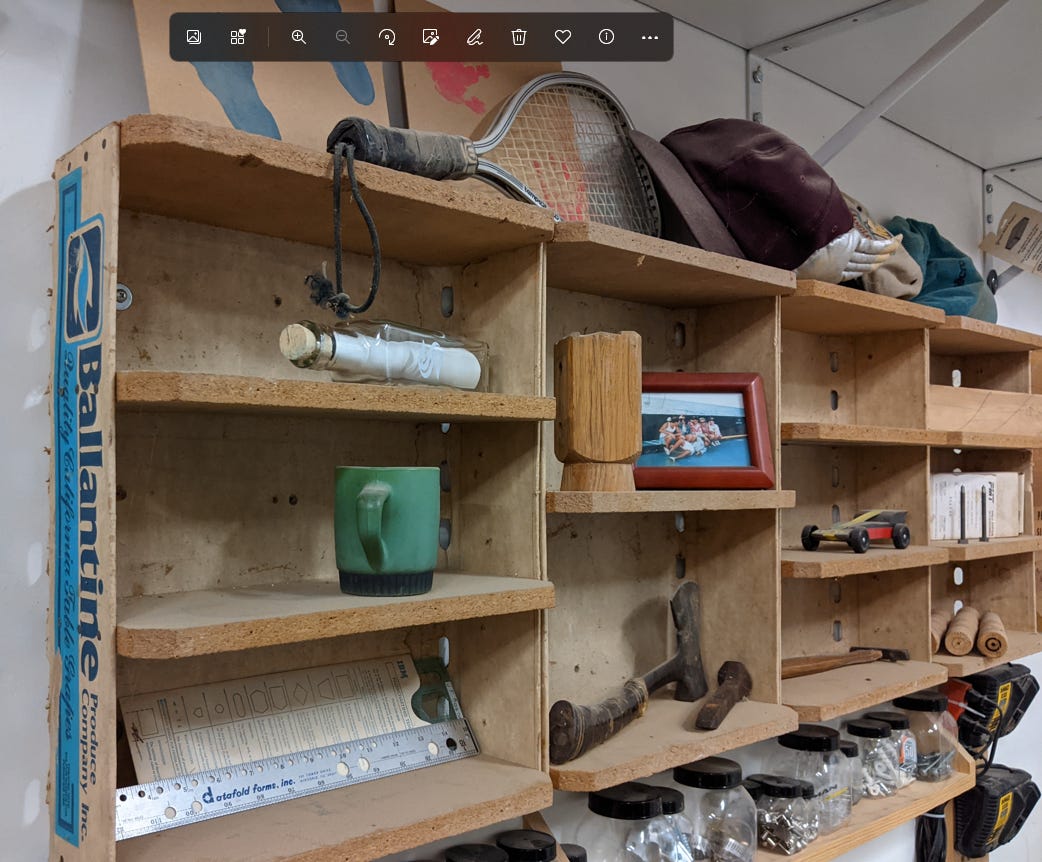
To anyone else, it looks like a bunch of nothing. But to me, it’s a flood of warm fuzzies. The bed post from the bunk bed that I slept on the entire time I lived in Richmond. The first hammer of my dad’s (his small tack hammer) that I ever used. The railroad spike from the train tracks in my parents’ hometown of Shamokin, PA. etc. etc. All presented on shelves that were converted grape crates that I made for college, from the trash I found in the back of the Ukrop’s supermarket I used to work at.
And then I brought my piano key mindset into the office. The result was an office full of memories that’s packable in less than an hour. My office stayed that way right up until the end, when Charu and Luke and I packed it all in an hour and drove off into the sunset.
The Mindset
In Anne Morrow Lindbergh’s “Gift from the Sea”4, she has a chapter named “A Few Shells”. That chapter perfectly captures the value of being selective about the things that you collect.
“One cannot collect all the beautiful shells on the beach. One can collect only a few, and they are more beautiful if they are few.” The more selective you are, the more powerful your selections become. Choose wisely!
“One sets it apart by itself, ringed around by space ... For it is only framed in space that beauty blooms. Only in space are events and objects and people unique and significant.” I love Anne’s point about the significance of space. When it’s cluttered, all you’re seeing is a pile of things. But when you separate things out, you can appreciate each thing, individually, fully.
Totems are small objects that are full of significance. In earlier posts, I had called out two other totems I selected, my Angst Mug5 and Hobbes’ Bear6. There are two more significant totems I want to share with you: the totems representing my Mom and my Pop. I’ll cover Dad’s totem in this post, and then get to Mom’s in my next post.
The Electrician’s Light
When our family got together in September of 2002 at our childhood home in Richmond, Virginia, it was to bid our Pop a farewell. His cancer had taken a final hold, and a man that we had all remembered as active, jovial, and loud lay silently in front of us. When he passed a day later, we all started sharing stories of our full-of-life dad. We congregated out in the garage, which was Pop’s shop. There was no better way to feel close to Pop than to sit in his shop, surrounded by so many of his tools, his collectibles, and his creations. Thirty years of memories.
We all began scanning his shop for souvenirs to remind us of Pop … to take home with each of us. I began searching for my totem, the one object that would trigger the fullest recall of Pop. I looked around the shop at such memorable items as a desk that I remember watching him build when I was eight, a blacksmith’s vice that Pop had gotten from his Pop’s workshop in Pennsylvania perhaps as many years ago as I am old, and a plethora of tools that I can recall him showing me how to use. I looked and I looked, but couldn’t find my totem. And in the week that followed, as my brother John and I began the process of cleaning out Pop’s shop and storage area, I continued the hunt. No luck.
A couple of weeks passed, and I was in our home in Seattle cleaning out some boxes when I came across an old lamp. As I sat looking at this lamp, a growing stream of childhood memories began to flow. This was a lamp that Pop built for my brother John when he was probably five years old. This lamp had, at some point, made it to my desk. And it followed me to college and out to Seattle. Now, as I looked at it, amidst the swirl of memories it triggered, I realized why it was the perfect totem. This lamp symbolized Pop.
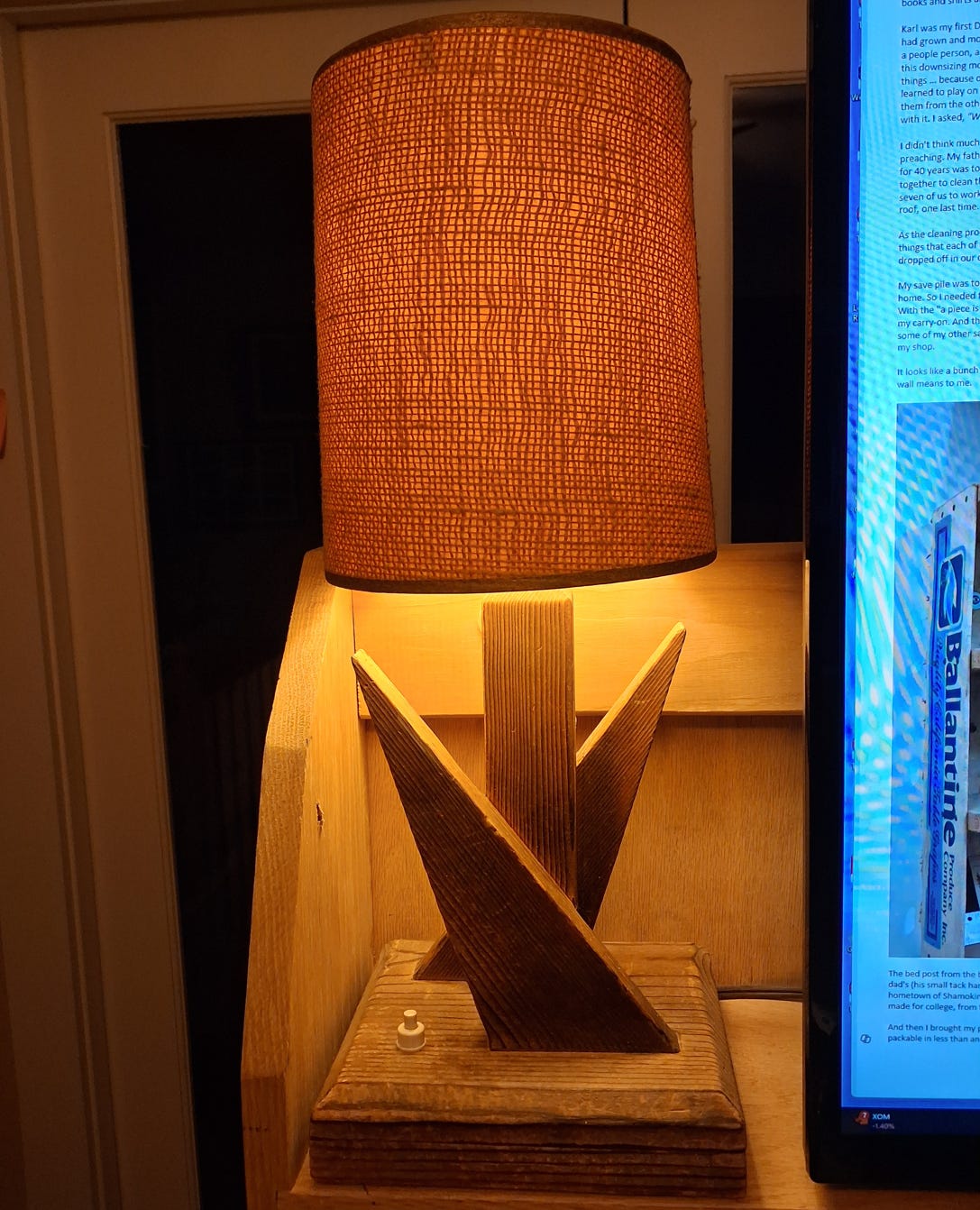
Pop was a craftsman and an electrician. This lamp captures both of those skills. The lamp’s design is unique, yet simple, much like its builder. The lamp is durable, having survived three boys who weren’t the gentlest of lamp-keepers. Pop was as solid as a rock (after all, he had to survive those aforementioned three boys and four more children), a dependable spouse, father, friend, and worker.
This lamp is fed its life-giving current through an electrical circulatory system. And anyone who ever spent time with Pop saw how much he was part of the circulatory system of life. A human’s circulatory system is behind the scenes, but you can see it if you look hard enough. But despite its lack of exposure, it is a vital network for the body. Pop’s life was one of significant, yet discrete, effort. The lamp is significant, but is rarely recognized as being significant.
I thought I had known this about Pop all along, but I never realized how deep and wide the network that he wired ran. Not until, on his passing, those that his life had touched came forward to recognize him. We didn’t even know the lady who helped us at the funeral home, but she greeted us by saying, “Your Joe was such a terrific man … you probably don’t know this, but he did some work on our house quite a few years back.” Upon returning to Seattle, we found a bouquet of flowers sent in sympathy by my son’s Montessori school. Their card read, “We are reminded every day of Joe … when we use the multi-purpose room and office.” Pop had done electrical work for their school during one of his visits to Seattle. At Pop’s funeral service, Father Shrieve compared Pop to Joseph the carpenter, and there was warm laughter from the congregation as Shrieve detailed his analogy, showing just how many people Pop had touched with his efforts.
There is a poem by George Webster Douglas that my sister Beth had framed for Pop. It reads:
A father is neither an anchor to hold us back,
Nor a sail to take us there.
But always a guiding light whose love shows us the way.
This is, for me, the key to why this lamp is my perfect totem for Pop, my small reminder of this giant of a person.
Today, this lamp sits next to my monitor. I have kept it turned on 24/7 for the last 24 years. Burning in tribute to a man whose light still shines in all those that he touched. And burning as Pop’s “guiding light”, reminding those that he touched to carry his torch further, and touch others.
Footnotes
The “My favorite morale ‘projects’” section of Morale Matters
The “5) Share a Love Story” section of Lead with Love
Beautiful