


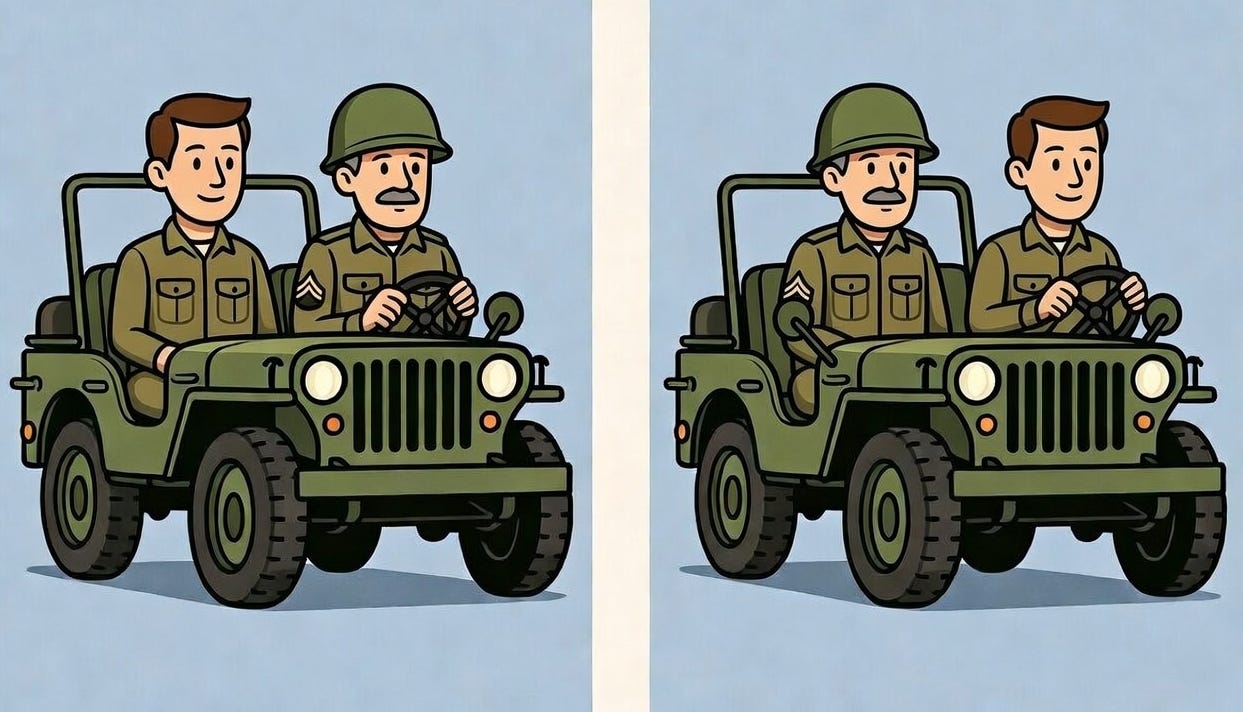
My brother John is a retired Army Colonel, and over the years he and I have spent a lot of time sharing leadership pro-tips from our respective jobs. He told me several times about the Right Seat and Left Seat Ride Program that he participated in on each change of command. Right Seat refers to the role of passenger. Left Seat refers to the role of driver.
Here are the relevant excerpts from USAREC Regulation 350-1, Training and Leader Development1:
“The Right Seat and Left Seat Ride Program gives new leaders an opportunity to accompany departing leaders through their operational area prior to the change of command or transfer of authority/responsibility. The program provides an excellent opportunity for training and mentoring incoming leaders.”
“The Right Seat and Left Seat Ride Program ensures continuity and the passage of knowledge between outgoing and incoming leaders. The program is normally 10 days in duration, which consists of 5 days riding in the right seat and 5 days riding in the left seat.”
“The program is flexible and represents the normal day-to-day activities of a company commander. The departing commander is the trainer for the Right Seat and Left Seat Ride Program. During the first 5 days, the outgoing commander will conduct normal operations with the new commander observing from the right seat. During the last 5 days, the new commander will take the left seat with the outgoing commander serving as an observer and mentor. The outgoing leader will provide their expertise and guidance.”
When John walked me through this, I loved the sound of it and thought about how smooth of a transition this would provide versus the normal role transitions I experienced at Microsoft: (a) leader leaves, (b) there is an interim leader, (c) we hire a replacement leader. I have experienced so much disruption in this latter approach that I was in search of the opportunity to apply this Right Seat / Left Seat procedure.
That opportunity came with my transition into the Director of Learning and Development role I created2. Being an entirely new role, there was no time pressure to get me into the new job immediately. My role had been Software Engineering Manager overseeing a team of 60 people. My team had been purring along, and I wanted to keep it that way.
I talked to Neil, my replacement, about this and he was on board. Then I shared this process with my team in the form of a blog post before the transition started. For the first week, Neil shadowed me to every meeting and stood over my shoulder while I worked through my mail, repo tracking, and OKR tracking processes. The second week I shadowed Neil and stood over his shoulder. It worked beautifully, with Neil saying he felt more prepared than he ever had for a new role.
Putting it into practice
The military has an excellent Team External Brain3. They are very good about writing processes down, so my studying of the Right Seat and Left Seat Ride Program was eased by the documentation that I could readily find online. Beyond reading about the process itself, I also found the Army’s one page form that is used by the transitioning leaders4. The straightforward form states two steps, with free form responses from both leaders.
STEP 1: Incoming leaders ride with outgoing leaders for the first five days of the program. The outgoing leader conducts normal operations with the incoming leader observing from the right seat. (Cover what went GOOD, BAD, and what needs IMPROVING)
STEP 2: Incoming leaders assume the left seat, with the outgoing leader serving as an observer and mentor for the last five days of the program. The outgoing leader will provide expertise and guidance as needed. (Cover what went GOOD, BAD, and what needs IMPROVING)
In my implementation, Neil and I didn’t use this exact form. But there was definitely plenty of notetaking. I had been cultivating our Team External Brain for years, so my notes mostly took the form of direct updates to our knowledge base. Whenever we spotted a shortcoming in the process, I would just update the documentation in real time.
Neil tracked his own observations outside of this documentation. These were his own personal notes for what stood out to him in this role that he would need to pay special attention to. For instance, in his old team, their focus had been entirely on internal source code, so his new team’s involvement in open source would be a new experience for Neil.
Continuity book
Despite the Army’s excellent record of documentation and formalizing their processes, I discovered a very interesting aspect of the Right Seat and Left Seat Ride Program that is outside of formal procedure. Soldiers are encouraged to create and maintain a Continuity Book for each role they have. This book includes duties, responsibilities, procedures, points of contact, and personnel and equipment data. It’s the soldier’s External Brain5. And then the soldier leaves that role, they give their Continuity Book to their replacement.
Retired Colonel Leonel Nascimento recognized the value of the Continuity Book, not only for your own efficiency, but for the ramp-up and long term efficiency of those who follow you. Nascimento, as a Captain, included these pro-tips in his detailed write-up6 (his reference to “computer disks” gives you an indication of when he originally wrote this advice 🙂):
Start Now and Keep Revising It. The continuity book should not be put together the week before the replacement takes over. In fact, the departing soldier should begin assembling it when he first assumes his position. This will allow him to begin recording continuity information during his time in that position and will ensure that the data in the book is accurate and detailed. Moreover, the developmental process involved in putting together the document will greatly increase the author’s own familiarity with his duty position.
Use It Daily. The author should assemble the book with an eye to making it relevant and useful for himself. He will know he has achieved this when he refers to it to accomplish routine activities. This technique has two advantages. First and foremost, the soldier developing the document can use it as a handy reference. A second advantage, one that is important to both the unit and the replacement soldier, is that the book is tested by the author on a daily basis for relevance and usefulness.
Make the Continuity Book One of the Goals and Objectives in the Author’s NCOER Checklist or OER Support Form. A soldier and the soldier’s rater should agree on the importance of developing the document during the rating period. This ensures that the author is both afforded the time and given the credit for producing it.
Make the Document Revision-Friendly. With the current ease of accessibility to computers in both the workplace and at home, soldiers should assemble information for the continuity book using computers. This allows the author to quickly update old information. Additionally, he/she can save the data on computer disks. This allows a replacement to further revise and update the information to pass on to future replacements. However, remember to save the data in a manner which allows the replacement soldier to access it. Normally, the optimal method of doing this is to save it on a computer disk using a software program (pay attention to the version) that the replacement can access using the computer at the unit.
To summarize his advice: Don’t start your transition document when the transition is about to happen. No doubt you will forget stuff. Instead, start building it the day you start the role. It will be your own cheat sheet to make you more efficient, and your regular use of it will validate its accuracy. Creating a success metric for the management of your Continuity Book is a great way to hold yourself accountable. And having it stored electronically allows for easy access, updating, and sharing.
Going one step further on this last point, there is a huge uplevel opportunity that comes from comparing Continuity Books across team members. Whatever you discover to be leverageable across the team is an opportunity to promote External Brain information to the Team External Brain.
As Stephen Covey’s 2nd habit7 states: “Begin with the end in mind.” For every role that you take, you’re going to be handing it off at some point. Make that hand off as smooth as possible. Model this behavior enough and you may even experience the payoff of having a Continuity Book waiting for you when you take a new role.