



Since my exit from Microsoft, I have been doing monthly visits to Microsoft campus, with the goal being to stay in touch with my Microsoft family. It lets me find out what new problems they’re tackling, and also allows for a continuation of the coaching relationship I have with many colleagues there. This is mainly across the teams that own the Windows product.
The “AI race” had already started at the tail end of my time there. And now the teams are showing the fatigue that comes from a prolonged race (3.5 years and counting). But starting about four months ago, I noticed a new common sentiment emerging across all of the different Microsoft family members I would visit. Teams are now working Saturdays … and some Sundays. I was introduced to the term “996” -- “work from 9am - 9pm 6days a week” -- which is a term I’m very glad I had never heard of before.
Further, all of the learning structure we had (Hour of Learning, Day of Learning, Week of Learning) has fallen by the wayside. It’s not that any of it was overtly canceled. It was simply that with everyone going at a fever pitch for the race, there were no spare cycles for discretionary effort such as these learning efforts.
I returned to Microsoft last week for a shorter campus visit just ahead of the holidays. And I was happy to witness a couple of things. Chris and his colleagues were wrapping up a holiday lunch where the leaders had gotten together to not talk shop. And as I was walking up from the parking garage, I ran into Carl who was unloading bags and bags of treats to celebrate his 25th work anniversary. My perfect timing allowed me to help him carry the treats, and hear more about his plans for the anniversary celebration, which centered about encouraging his teammates to stop by, have a seat, and share their stories from over the years at Microsoft.
After hearing so much negativity and angst over the last several months, it was great to see at least a small concentration of happiness. I left campus that day reflecting on a key fact: morale matters.
I have always operated my teams in a “morale first” manner. I have been accused of over-indexing on morale, to which I will gladly plead guilty, being an intentional balancing force against the predominant percentage of leadership that underinvests in morale. Work teams get their work done. Work families get their work done and grow.
Perhaps most importantly for this AI race period, continued investment in team morale is what keeps a team together and better equipped to persevere the hard times.
More than just “events”
It is common to hear the term “morale event” in team conversations and team plans. But if that’s the extent of the morale conversation, then you shouldn’t expect much improvement in team cohesion. Teams need to talk more about morale strategies and morale plans.
Alison and Darren Hill wrote “Work from Anywhere: The essential guide to becoming a world-class hybrid team.”1 We leveraged this book heavily during the forced remoteness of COVID, and there were great tips about how to operate more effectively as a unit while not being physically co-located. But a key point in their learnings was that it was essential to get the team together occasionally to establish and reinforce human connection. Here are key excerpts relevant to the topic of morale.
“Gather with real purpose: Using gatherings to move past transactional work and form deeper personal relationships and personal growth is going to be the playground of world-class teams into the future.”
“Forget transactional: don’t fall into the trap of gathering your people to do work they could have easily done through a virtual or remote platform. What a waste of time! Create some clear principles that the time you spend together face to face is critical to connection, culture and trust-building2 rather than business as usual tasks.”
“Focus on culture and connection.”
I have used the phrase “gather with real purpose” countless times since reading their words (it has even shown up here as a post title last summer3). It is a great call to action regarding the need to have a morale plan. When building your morale plan, think of these four altitudes.
Daily - What are the little things that can give everyone a regular touchpoint of team humanity? Lunch train or team coffee is a common implementation of daily morale. You don’t need 100% participation every day. But you need the opportunity to be there, predictably.
Weekly - Once a week, I had a team lunch on the calendar. Grab your food and come together in a conference room. I would have at most 20 minutes of “shop talk”, and then it would be open conversation.
Monthly - One of my favorite bosses was Laura, who ran “Monthly Cupcakes” meetings. These were all hands meetings for our entire 200-person team, but with cupcakes in the name, there was a clear signal that it wasn’t just work. Similar to my weekly lunch format above, there was a prepared slide deck, but then there was ample time given for socializing.
Quarterly - Here’s where you can spend a bit more money, and take the team offsite together. These are what are typically called morale events, but here, they are not standalone, but rather are part of the four-altitude strategy.
As you build your plan, keep in mind the rules of engagement from Alison and Darren above. Make sure real connection is happening. I remember an unwritten success metric (a success metric that I kept private from the team when I was sharing my commitments) from Zune was that team members would have each other’s phone numbers on their phones, have their gamer tags connected on Xbox, and have each other’s music on their Zunes. For me, it was all about connections that went beyond the office walls.
My favorite morale “projects”
I want to end with four of my favorite morale projects from my time at Microsoft. Two of them were ones I attended, and the other two were ones I initiated.
Karl Stock was my first skip-level manager at Microsoft. He was, in the truest sense of the term, my mentor. Karl is my role model for morale-first leadership. He was a good manager and a good engineer, but he was a great leader. He cared. He listened. Karl saw the big picture and had a deep understanding of the “whole selves”4 that worked for him. Karl’s creativity set up very unique and memorable morale “experiences.”
Bad Movie Night
A team sitting in the dark together for two hours is not getting that team any closer. The only way that a movie is a morale event is if it is done like Mystery Science Theatre 3000 (MST3K)5. And that’s what Bad Movie Night was. We went to Chili’s and had dinner … and a healthy share of top shelf margaritas. Then we walked over to Crossroads Cinema and watched a bad movie together. With Monday being typically a very dead night in the theatres, it meant we were most likely the only people in the theatre, so we could banter throughout the movie. And then we would all joke about the movie afterwards. The movie wasn’t the centerpiece. It was just a piece.
Commence Construction
Deep in the three-year Win95 project, in a winter with not much else going on, Karl proposed a smaller format morale event: him and I building a launch ramp for skating that we could then bring to campus. Inline skating had captured the attention of a few members of the team (me mostly) and this became the perfect excuse for us to spend some quality time together.
Here were a couple of fun outcomes of that project (apologies for the low resolution … this is 1994 technology):
But the real reason this project bears mentioning is that it planted a seed for construction being a great theme for morale projects. So when it came time for me to organize my own morale projects …
Video Arcade Machine
When the WPF team was going to a movie for a morale event (and it wasn’t MST3K), I suggested an alternative morale event for several team members (Jevan, Roger, Ben, and Seema): let’s build an arcade cabinet for the team. Obviously, we wouldn’t be able to completely build a cabinet in a two-hour period. But that’s fine. The middle-of-the-day movie just gave us an excuse for a middle-of-the-day drive to my house to draw up plans and discuss the project. Then, over the course of several evenings, we would meet at my shop to make progress. Twenty years later, this arcade machine is still alive and well on Microsoft campus. I need to play Jevan in a game of Robotron at some point … for old-time’s sake.
Self-opened Space
The Windows Phone project was very intense, and when my team first formed, I grabbed open space next to the design studio so that my team had more minute-by-minute contact. In this setting, we were all better-informed, we fed off of each other’s positive energy, and we quickly spotted and fixed any problems that arose. So when we were moved into traditional offices, I brought my reciprocating saw into the office and cut holes between offices to connect four offices together. Then it became a team project to properly trim these openings and create clean framed openings between our offices.
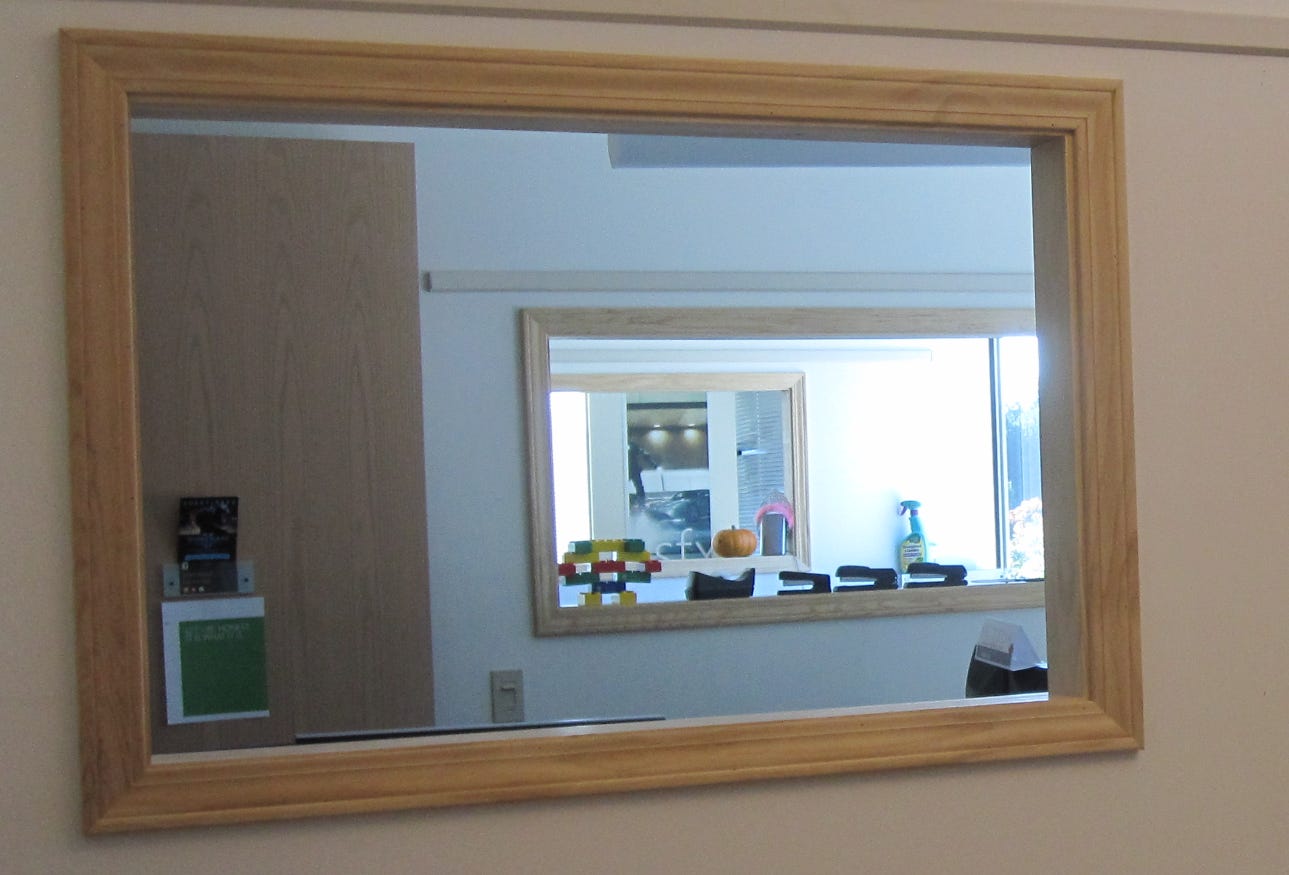
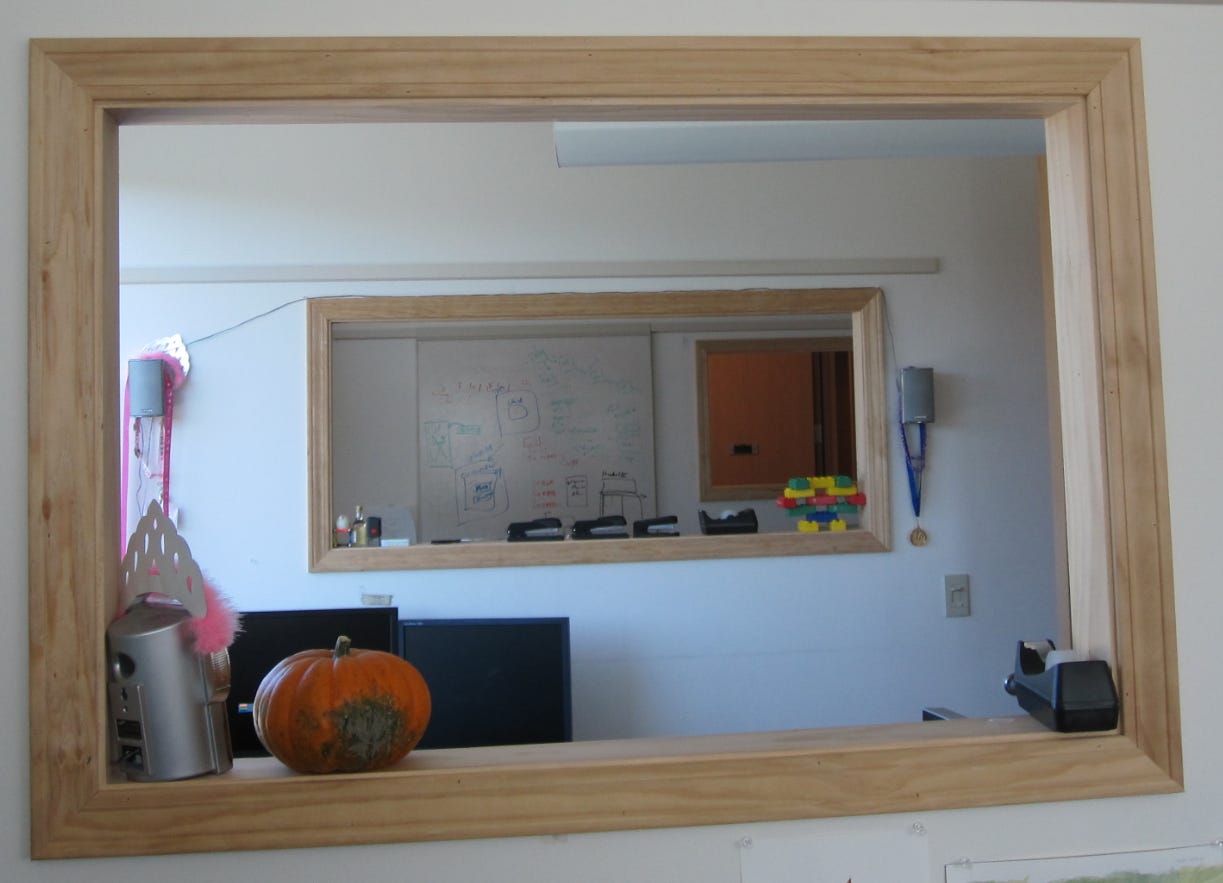
We were united in one space again. All of our chatter resumed, and our team thrived. It was awesome, right up until Microsoft’s Facilities team found out what I had done. I’ll summarize that turn of events as: upper management saw that it helped this critical team continue to produce, handled the beef with Facilities, and then very clearly stated to me, “Just don’t let it happen again.” I never brought my Dewalt power tools into the office again (this is a lie, but that’s another story).
I love that you have photographic evidence. I also have a "never again" story with facilities...