


I graduated from Virginia Tech in 1991. I hadn't been very involved with the college as an alum until the last five or so years (perfectly timed with my own kids heading away to college and me having more time). I helped establish a chapter of the Alumni Corporate Network1 between Microsoft and Virginia Tech. These networks are designed to create partnerships with Virginia Tech and companies through the alumni at those companies. These networks are helping Virginia Tech create more meaningful connections with the corporate world.
When I exited Microsoft, I reached out to my alma mater to say, "Just because I'm leaving Microsoft and have to leave this Alumni Corporate Network, this isn't the end of our relationship. I have more time on my hands now and would like to collaborate more with the school." We have continued to build our relationship since then, but still entirely virtually. In March, I sent them an email saying, "I'm finally coming back to Blacksburg. I'm going to be in town for a week, and I'm all yours. Help me fill up my calendar."
It was a terrific week where I did a deep dive with the school, focused mainly on the Computer Science Department. It was very educational, and I made many more connections with faculty, administration, and students. The biggest win of the week was that I was finally getting to sit down in-person and connect with these people that I had only ever worked with through a computer screen. And then, to add even more in-person appeal, on my last day there, Christine (head of the CS department) and I made pancakes for the CS students.
That week spent with Virginia Tech had a deepening effect on our relationship. I have since joined the CS department's advisory board, and I am partnering with more of the CS student organizations. Quality in-person time together has been a vital energy injection into our relationship.
Un-person
In March of 2020, all of society was forced to separate. It wasn't a choice. It was a safety measure. In the five years since, we have been slowly returning to being as socially connected as we were before COVID. There was never a global edict forcing us to reconnect. So it will understandably take longer than the overnight separation took.
In the tech industry, we've seen many companies trying many different policies to spur more in-person work. But as a policy, there is ample amount of gaming the system, like coming in for an hour, or finding a closer office location, or in extreme cases (and far more risky), having an employee swipe other coworkers' badges in when they enter.
Returning to work has to be less about policy and more about purpose. The COVID separation has made us all realize that we can be productive as a team without sitting next to each other. The resistance to a return to work policy stems from this knowledge. We need to instead focus on what has been missing from our remote work environment. It's not about returning to the office. It's about returning to being connected.
Belong
We are social creatures that thrive with social connection. It doesn't matter whether you're an extrovert or an introvert; you still need other people.
In a remote work setting, transactional teamwork is thriving thanks to the technology we have. Email, chats, and video conferencing allow high bandwidth communication flow. But observe the quality of these electronic interactions more closely. How rarely are the emails and chats going beyond the transactional level? Is the level of engagement in virtual meetings lower and lower over the years of this being the default meeting format? Are employees' peer networks weaker than they were before 2020?
In a remote work setting, when do we have the opportunities for non-transactional connection? In my post last week2, I called out one example of a non-transactional connection: "20% of our organization has never seen a fully operating Microsoft campus, where a walk down the hall would expose you to dozens of workspace variations." Take that same 20% and apply many other valuable side effects of being in person. They've never bumped into a colleague in the kitchenette. They've never brainstormed over a whiteboard. They've never stood over someone's shoulder to watch that person do something, or had someone stand over their shoulder.
These are the subtle but still important experiences that build up a sense of belonging to your team and to your company. It's not everything. But it's also far from nothing. Here's how this builds over time, benefiting both the employee and the company:
A sense of belonging increases employee engagement.
🔽🔽🔽
Increased employee engagement raises the amount of discretionary effort that employees are willing to contribute to the system.
🔽🔽🔽
Increased discretionary effort results in higher overall team productivity.
Gather With Purpose
There are three concrete things that we can do to increase the sense of belonging on the team. I'll order them from cheapest to most expensive, both in terms of time and money.
Come to The Office Occasionally … Willingly
If working remote is what you've been doing, then it's easy to just continue that. The easiest thing to do is just keep doing what you've been doing. So if there's a policy change to force you to change this habit, resistance is the default response. I would like to encourage a "be the change" mindset here, instead.
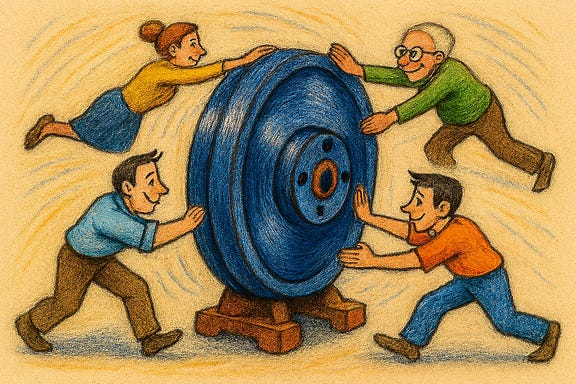
Don't go into the office mad that you had to deal with the morning commute, and you're going to have to deal with the commute home at the end of the day. Focus on the opportunity, and seize that opportunity. What haven't you been able to make as much progress on, that having your colleagues next to you can help accelerate you? Where and how can other people be energy injectors into your Energy Flywheel3.
Start New Employees With a Two Week In-Person Experience
The first month for a new employee is critical. It is when the employee needs the most support, and it is also when there is the most value in in-person connection to get as clean and complete of a signal from new employee and new team. At an absolute minimum, the manager and "onboarding buddy" should also be on campus during this period. But the ideal experience is the entire feature team being on site for this new employee experience. Give new employees a significant jumpstart to their team rooting with this upfront time together.
In 2022, Microsoft published a great article capturing the importance of bonding for new employees4. And it's every bit as relevant today as it was three years ago. Here are some key points from that article:
"43% of leaders say relationship-building is the greatest challenge in remote and hybrid work."
"While a majority of hybrid employees seem to be maintaining their work relationships, only half of remote workers say they have a thriving relationship with their direct team, and even fewer have a strong relationship with those outside their team."
"The data shows that employees hired since March 2020
are less likely to feel included (60% versus 64%),
have weaker relationships with their direct team (51% versus 55%), and
are at greater risk of attrition (56% versus 38% are likely to leave their employer in the year ahead)."
There is an opportunity to directly offset these challenges, capitalizing on the rush of energy surrounding an employee's start on a team. The employee is excited to be joining, and their team is excited to be welcoming them.
Get the Entire Organization Together 1-2 Times Per Year
I don't think it's important for everyone to return to work five days a week. I intentionally used the word "occasionally" in my first recommendation above. Occasional in-person connection with your teammates will renew your bond and keep your team thriving.
At the macro level, there is value in bringing all of the team together at least one time per year to have a week-long event devoted to quality "team time". All hands meetings, morale events, team-wide training, strategy sessions, planning sessions, and leadership offsites all benefit from being in person. In "Work From Anywhere"5, Alison and Darren Hill highlight the importance of team bonding and the role of such summits in that. Here are some excerpts:
"Honor that precious face-to-face time as much as possible. This may mean during face-to-face catch-ups, you ditch the business strategy talk, de-emphasize the numbers, and direct your energy to driving connection, culture, and a sense of belonging."
"At Pragmatic Thinking, our gatherings are an opportunity to openly discuss our team culture and our goals, ask questions, share and, often, literally take the cake and eat it too."
"Make these gatherings intentional and extraordinary experiences and your people will repay this investment."
"Gather with real purpose: Using gatherings to move past transactional work and form deeper personal relationships and personal growth is going to be the playground of world-class teams into the future."
"Perhaps these connections happen only once per year for your org or team. Make them intentional and extraordinary experiences and your people will repay this investment."
"Forget transactional: don't fall into the trap of gathering your people to do work they could have easily done through a virtual or remote platform. What a waste of time! Create some clear principles that the time you spend together face to face is critical to connection, culture and trust-building rather than business as usual tasks."
"Focus on culture and connection."
Hybrid work is the way. But it has to be humanful hybrid work for the individuals and the company to thrive.