


I don’t have a fear of commitment, but I do have a huge fear of overcommitment.
I bought my first house when I was 26. It was a dated house, and my goal was to remodel it myself to learn more about how to do all these “house things” that I’d seen my father and brothers do. I had no timeline set for the overall project; it was just my spare time project. And it was every bit as educational as I was hoping. Beyond learning an incredible amount about how a house works and many aspects of construction, the bonus learning for me was the repeated lessons on dependability, thanks to the assortment of subcontractors I worked with during my remodel.
There were a few aspects of the remodel that I decided to outsource: plumbing, tile, and hardwood floors. I used references whenever possible to find out about the quality of each contractor’s work before selecting them. But I never thought to probe into their track records for dependability. I learned the hard way that predictability of their schedule can be even more important than the quality of their work.
After a particular tile installer repeatedly didn’t show, I remember being particularly frustrated. The next day, when my plumber Terry came, I was apologizing that some of his finish work was still on hold behind the tile guy. This sparked a very insightful conversation into the industry. I said, “Terry, you don’t seem to have a problem with your schedule, but you appear to be in the minority.”
Terry nodded his head and gave me his story. “I know where these guys are. I was there, too. More jobs means more money. And it’s kinda fun to push yourself and see what you can accomplish. But then you end up overdoing it. And if you don’t notice it soon enough, you’re buried in your own promises.” I would summarize the rest of his explanation as moving from more money to enough money.
Overcommitment can be motivated by money, by status, or by a desire to please others. Regardless of the impetus, the same countermeasure applies: recognizing that the path to earning more trust with your team1 is not by committing to more things, but by completing all the things you commit to.
Sustainability meets dependability
The structure of the predictable high school schedule combined with our family’s routines did a lot to help me stay on top of my commitments. But when I encountered the much more free-formed college life, with less time in classes and few established routines outside of class, my ADHD really challenged my follow-through.
I discovered overcommitment as a forcing function to help me focus. As I signed up for more classes, and took side jobs on campus, the added stress on my system pushed me in the right direction. Somewhat counterintuitively, the more work I took on, the more successful I was at completing the work.
The college semester design gives you an almost complete reset every four months. So I never experienced the long-term damage of sustained overcommitting. Just when I was approaching my wits end, burning the candle at both ends as I completed my larger coding projects amidst the prep for finals, the end of the semester would arrive and wipe the slate clean.
The professional world is when I quickly saw the long-term effects of an “overcommit to focus” strategy. Six months into my full-time job at Microsoft, I was looking for the pause. It took years of me trying different strategies to give me focus while not overcooking me. It finally clicked for me when I understood my own Energy Flywheel2.
The focus that came from intentionally managing my energy givers and energy takers was incredible, and was as sustainable as my energy management. I didn’t need the overcommit hack to propel me forward. I had found clean energy. 🙂
“In order to say ‘yes’ to this, what must you say ‘no’ to?”
Microsoft has required training for all managers that includes Michael Bungay Stanier’s “The Coaching Habit”3. Inside this training are seven essential questions that can enhance any coaching conversation. The question that directly helps counter overcommitting is question #6: “If you’re saying ‘yes’ to this, what are you saying ‘no’ to?” In my own usage of this, I’ve changed it slightly to emphasize the need to make a choice, and own the consequences. My variant is, “In order to say ‘yes’ to this, what must you say ‘no’ to?”
There is finite time, so you inevitably have to make choices for yourself. You have to prioritize your options and choose the best fit for you. Then you have to make clear to your colleagues what you are saying “yes” to as well as what you are saying “no” to. Your “no” will undoubtedly disappoint people, but they are at the same time appreciative of the clarity and definitiveness of your answer. Contrast that with saying “yes”, only to have the overcommitment bury you, making you unable to deliver. Now these same people will be far more disappointed, and the stakes will be higher because there was an expectation of delivery.
My last engineering manager role was on a team led by Panos, a very charismatic and passionate leader. He was an inspiring individual, and he built a team of inspirational leaders around him. They had established five culture tenets that summed up the philosophy and espoused approach of the team. Among these five was the “Grab an Oar” tenet, which reminded people that we were all in the boat together, and that every individual needed to step up and take action to help move our boat forward.
I initially really enjoyed working in Panos’ organization. But over time, I recognized that there was a key thing missing from the team’s culture. No one was asking what “no”s were necessary to satisfy the “yes”s. In all of our product planning meetings, you were being driven to say yes to one thing and yes to another thing and yes to another thing. I co-opted their culture tenet to highlight a key word missing from these conversations. I started saying, “Grab an Or“. Give us options, so that we don’t end saying “yes” up front to too many things, only to disappoint leadership in the end with the promises that were unmet. Let us say “or” sometimes instead of “and” all the time.
Say “no” up front to the less important things to create the space needed to say “yes” to the more important things. And then deliver completely!
Establish a brand of “Does Finish”
I love the phrase, “Undercommit; overdeliver.” I have heard many negative reactions to this phrase, and the most common pushback is that this phrase promotes “sandbagging”, where you just promise well short of what you’re actually capable of, so that you can wow people by overshooting your stated goal. Yes, that abuse is possible. But what I love about this phrase is that it’s telling you the right side to err on.
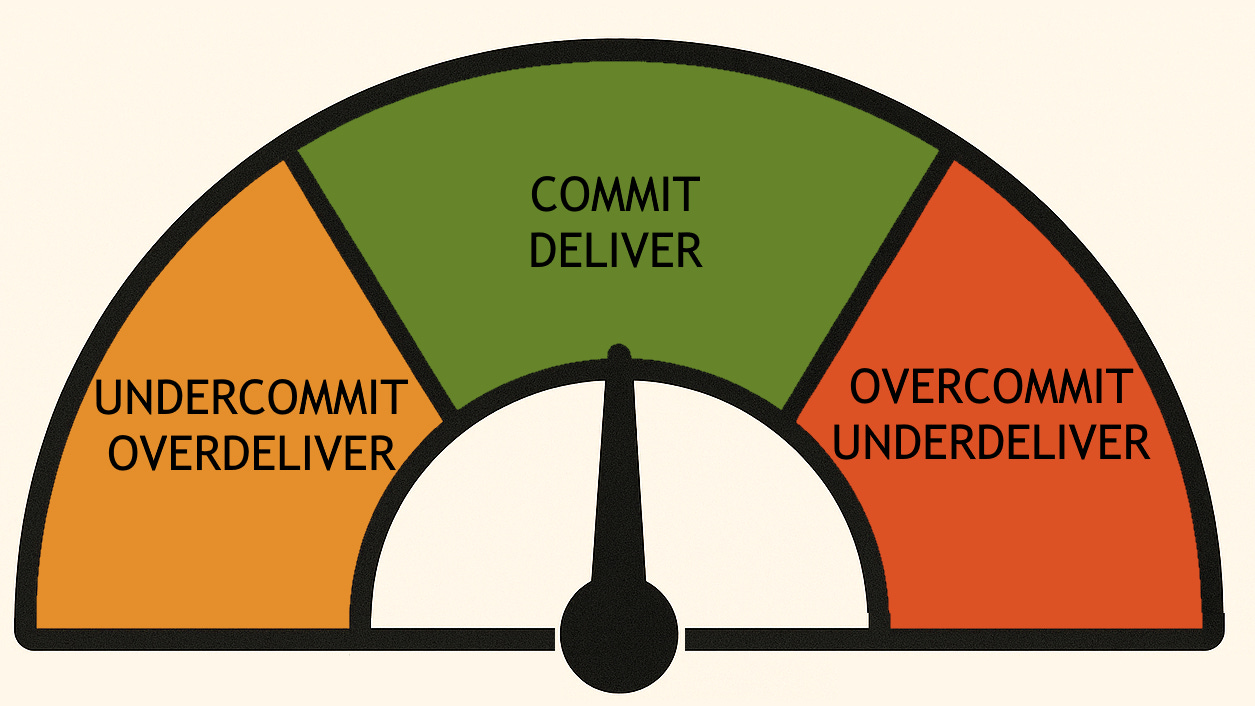
You have “undercommit; overdeliver” at one end of the spectrum, and “overcommit, underdeliver” at the other end of the spectrum. Indeed, the ideal would be right in the center, to hit “commit; deliver.” But if you can’t nail that center line, which side do you want the tendency to be on?
A “Can Do” attitude is awesome.
I want to say yes to asks.
I want to make people happy.
I want to deliver.
I want to push myself.
A “Does Finish” attitude builds off of “Can do”, but adds two very important wants to the top of the list:
I want people to be able to rely on me.
I want to keep delivering.
I want to say yes to asks.
I want to make people happy.
I want to deliver.
I want to push myself.
Awesome that you brought up how this topic relates to TRUST. One of the key aspects of the definition of Trust I use is "your belief in my *reliability*". That is "Does Finish" - over and over again!