


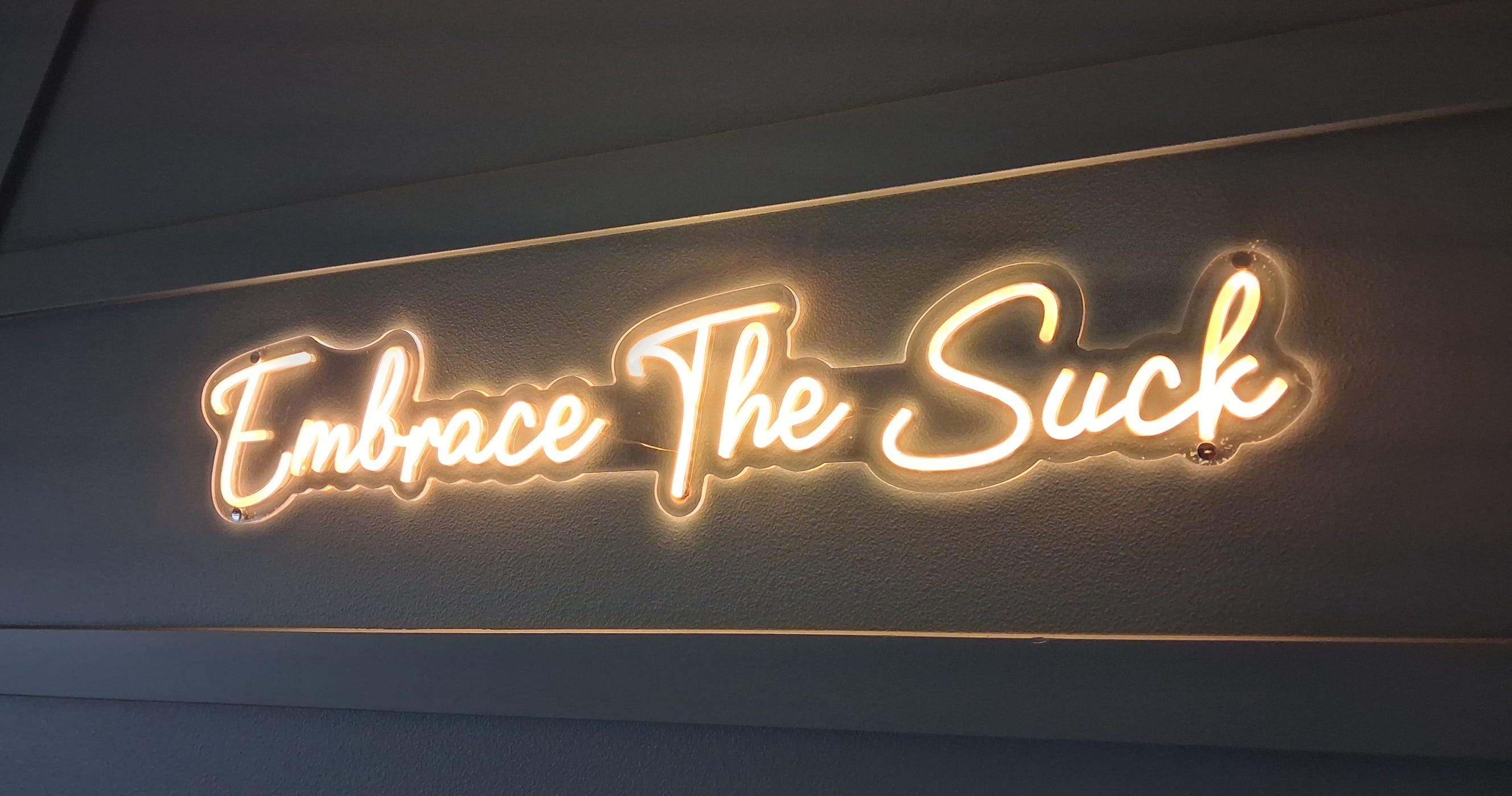
My brother-in-law Rishi didn’t coin the phrase “Embrace the Suck”, but he preached it. Certainly he’d say this to his colleagues at his CrossFit sessions, but he also leveraged it more broadly, including shortly after he was admitted into the cancer treatment center and began his extended hospital stay:
“I look at it this way, regardless of how all this turns out, which is out of my control, my hope is that how Ritu and I approach this life-altering obstacle will help shape Ayanna and Jax as they move forward in their lives.
I have had zero hardship in my life; loving parents who are still together, college paid for, no real struggles academically and socially. I have a great wife, great family, great friends, great career. The first time I have to deal with real adversity I’m not going to back down and I will embrace the suck.“
We lost Rishi three months later. We continue to keep his memory fresh in our minds and in our hearts, with the assistance of several strategically placed memorials. The two that I see the most often are the above “Embrace the Suck” faux neon sign that we made for our workout room, and the “What Would Rishi Do?” purple and gold bumper sticker that I put, appropriately, on my bike.
“Embrace the Suck” rose out of the military as an articulation of the mindset that helps you persevere through unavoidably unpleasant situations, and even celebrates this challenging environment that leads to your own growth. Focus on the task at hand, and push through the physical and mental pain, and you’ll be a better person for it.
There are two other places where I’ve more recently seen this theme emerge. The first was in my reading of The War of Art, by Steven Pressfield1, and the second was in an episode of the Huberman Lab2 podcast. The suck they both talk about doesn’t come from physical challenges; their suck is an ever-present mental challenge that you have to intentionally and repeatedly battle. Pressfield uses the term “resistance” and Huberman uses the term “friction”, but they’re both talking about the “suck” worth facing, because it betters you.
Resistance: creator’s block
In The War of Art, Steven Pressfield describes the biggest challenge to you creating anything: your own self-imposed resistance. “Resistance is not a peripheral opponent. Resistance arises from within. It is self-generated and self-perpetuated. Resistance is the enemy within.” Resistance is the voice inside of your head that’s telling you that you can’t do it, or that what you have to say isn’t valuable, or that you should be doing something else, or that you can always do this tomorrow. It is an ever-changing and ever-present enemy. “The battle must be fought anew every day.”
Pressfield’s solution completely resonates with me because I found this same solution probably ten years ago, and have been reaping the rewards ever since. When I talk being Habit-Propelled3 and my need to Timebox Everything4, those are two key pieces of my Workout Mentality5 that forces me into the present tense, and builds momentum through compounding interest. Steven frames it Stoically: “This very moment, we can change our lives. There never was a moment, and never will be, when we are without the power to alter our destiny. This second, we can turn the tables on Resistance. This second, we can sit down and do our work.” “The most important thing about art is to work. Nothing else matters except sitting down every day and trying.”
The War of Art emphasizes the need to Play the Long Game6. “The professional … understands delayed gratification.” “He conserves his energy. He prepares his mind for the long haul. He sustains himself with the knowledge that if he can just keep those huskies mushing, sooner or later the sled will pull in to Nome.” “He is prepared, each day, to confront his own self-sabotage.”
Steven also covers purpose, explaining that whatever it is that you are trying to create is you sharing your own native genius, your unique value proposition. This is you “contributing a verse” to the “powerful play”7. “Our job in this lifetime is not to shape ourselves into some ideal we imagine we ought to be, but to find out who we already are and become it.” What you are creating matters because it is the result of your own Grand Synthesis8.
Tying it back to the theme of this post, the struggle to create is where real growth happens. “The instinct that pulls us toward art is the impulse to evolve, to learn, to heighten and elevate our consciousness.” The war against your own resistance is most definitely a battle worth fighting. Recognize what the potential payoff will be and get to work. Embrace the resistance.
Friction: growing your will to live
David Goggins is a motivational speaker, and the story he tells is very much his own inspirational story. He went from being too overweight to join the military to being the only US Armed Forces member to complete Navy SEAL training, Army Ranger School, and Air Force Tactical Air Controller training. He is also an ultramarathoner that has run 240-mile runs. David has embraced the suck to get to where he is now, and he continues to embrace the suck to push himself further.
Andrew Huberman is a neuroscientist who runs the Huberman Lab podcast. I have learned a lot of fascinating science listening to this podcast. Andrew had David on his podcast to talk about inner strength. What I loved the most about this episode was David talking very practically about his approach, and then Andrew explaining to him the science behind why that works for David. The whole episode is worth watching, but if you’re short on time, I want to direct your attention to a 13-minute absolute gem9 within this episode: a scientific explanation of willpower2.
(language disclaimer: The full episodes includes the disclaimer at the beginning that there’s going to be a lot of cursing. That’s good to point out. I would call it effective cursing because (a) it’s not directed at anyone and (b) it is appropriate to the setting. David describes a lot of the inner dialogue that you will have as you fight for the willpower. Whether you verbalize that or not, that inner dialogue is sure to be profane … it’s the most unfiltered conversation with yourself. Gloves off. No holds barred.)
Andrew introduces the concept of the anterior midcingulate cortex (aMCC). “There’s a brain structure called the anterior midcingulate cortex. What’s interesting about this brain area is there’s now a lot of data showing that when people do something … that they don’t want to do, it’s not about adding more work, it’s about adding more work that you don’t want to do, this brain area gets bigger… The anterior midcingulate cortex is smaller in obese people, it gets bigger when they diet. It’s larger in athletes, it’s especially large or grows larger in people that see themselves as challenged and overcome some challenge. And in people that live a very long time, this area keeps its size. In many ways, scientists are starting to think of the anterior midcingulate cortex not just as one of the seats of willpower, but perhaps actually the seat of the will to live.”
David responds simply with, “Now we’re talkin’!” I think whenever you get David to say that, it’s an “achievement unlocked” moment.
Andrew completes his framing, “Friction is the critical ingredient. People think ‘oh, if it’s the effort, then I’m getting better.’ That’s part of it, necessary, but not sufficient, as we say in science. But the suck part, … the stick, the friction, being haunted, it’s the suck part that grows this anterior midcingulate cortex.”
Learning this science raises my awareness10 of the value of suck in my growth and in my desire to keep growing. I become less interested in trying to avoid the friction. In fact, immediately after listening to this episode I got on my bike and went for a ride, and where I normally would have chosen a flatter route for my return, I opted to add two more climbs11. Thanks David and Andrew!
There are two key lines in this podcast that capture the importance of regularly returning to the suck. Andrew shares a quote from his friend, “The amazing thing about addiction is there’s a cure. The problem is, it only works one day at a time.” And David says, “Even the richest of the rich, who have everything, they always ask me this question, ‘I feel like I’m missing something.’ … You’ll never hear me say I’m missing something. I found it years ago. You find it in the suck. And you find it repeatedly in the suck.”
Embrace the friction.
I love the connection made in this post between friction/hard and learning. We dont actually learn without some level of struggle/hardship/edfort. #alwayslearning.
Chris, I was gonna share this to your learning comment on my Touch Grass post, but sharing it here will connect more of the dots: After my Touch Grass post, Nick sent me a link to this awesome article: https://www.bailliegifford.com/en/uk/individual-investors/insights/ic-article/2026-q1-ai-isn-t-coming-for-your-job-it-s-coming-for-your-mind-10061431. Of the different topics that Tom Slater covered, one was how AI was making the learning too easy. One of the side effects that Tom identified was: “The effort that builds durable learning had been bypassed entirely.” If you have the time, I highly recommend reading this article ahead of our meeting this week. Lots of gems to discuss!