



When a team reorganization gave me a dev manager position in Windows, one of the first problems I spotted was that we didn’t have good clarity on how all the different roles and responsibilities of our team were being handled. If I asked enough individuals, I could eventually figure out each. But there was a lot of hunting involved.
My solution was to add a “Team Chessboard” table to one of my whiteboards. I created seven columns:
Team Member - Name of the team member.
Key Strengths - Beyond the standard engineer skills we expected, what does this individual excel at, to the point that they model this skill and could even teach the team how to grow this skill?
Ambassadorships - What is this individual passionate about? What do they advocate for? This could include aspects of software engineering, things that improve team dynamics, or aspects of team culture.
Team, Organization, Division, and Company - These represent the four meaningful altitudes in our company. What responsibilities does this individual have at these different altitudes?
With this table on my whiteboard, as I had 1:1s with my 8 leads and skip 1:1s with the 40 developers that reported to those leads, I would ask for their additions to this table. I would create a row for them and we would fill in the columns accordingly. “I organize all of the team’s lunch and learns.” “I am passionate about design.” They were also welcome to call out additions to make to the other rows. “Linda is our Watson contact for the division.”
Along the way, many people asked about why I called this the “Team Chessboard.” I said, “We’re not playing checkers, we’re playing chess. Our team is not a collection of uniform one-dimensional pieces. We are an aggregation of individuals, each with unique abilities. The pieces need to make their value adds known, and the players need to strategically utilize all the pieces for maximum win potential.”
Obviously, talking about people as game pieces can be dehumanizing. When I spotted any negative reactions, I would first say, “Well certainly you’d rather be a chess piece than a checkers piece, right?” That helped some, but my second response was far more empowering. “The players of this game are the leaders on our team. So, if you want to lead1, our Chessboard presents you with that opportunity.” (At the bottom of this post, I’ll share the evolution of this metaphor that gives team members even more power. But first I want to expand on what our Team Chessboard unlocked for us.)
This table grew over time, with regular “oh yea” additions, as new responsibilities were given to us, and as individual team members came and left. I never thought to do anything more with this until an office move forced my hand. The chessboard had lived entirely on my whiteboard for several months. Now I’d have to take a picture and recreate it in my new office, or … I could seize this opportunity and make an addition to our Team’s External Brain2.
I created a “Chessboard” page in our Team’s OneNote and transcribed the content from my whiteboard.
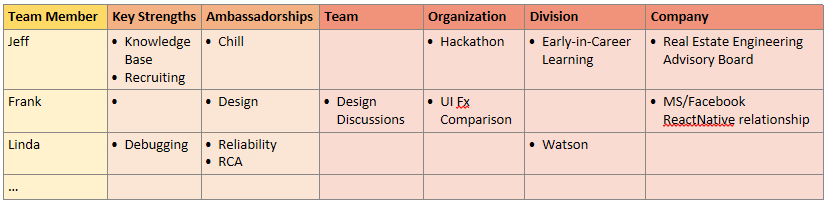
Over time, our published Team Chessboard accrued win after win. Here are the five key wins, in the order we discovered them.
Create clarity
Encourage contribution
Model scope growth
Publicize opportunities
Turn our Rewards Discussions into team strategy sessions
1) Create clarity
Most directly, this table was meant to create clarity, Microsoft Leadership Principle #13. Every team has a distribution of roles and responsibilities. And any decent manager is aware of the key strengths of the individuals on their team. But few teams have written it down. This simple move from implicit to explicit4 made it straightforward for anyone on the team to readily answer the question of who owns which responsibility.
2) Encourage contribution
Having this table available to the team in a read/write form, alongside all other team knowledge that the team was already contributing to, was an implied invitation to make changes to the table. As a mental list scattered across the brains of the leadership team, this summary was completely inaccessible. In editable table form, anyone could easily spot incorrect or missing information and correct it. This made it easy to keep this chessboard up to date.
3) Model scope growth
Individuals are told that as they move up in level, their scope necessarily broadens5. This makes sense intuitively. But what is lacking are good examples of what that scope growth actually looks like. The Team Chessboard gives numerous concrete examples. As we have career discussions with team members, we would guide them on the general trend of:
Junior level developers (SDE I) are still figuring out the ropes and probably not given any broader responsibilities.
Staff level developers (SDE II) should have responsibilities at the Team altitude.
Senior level developers (Senior SDE) should have responsibilities at the Organization altitude.
Principal level developers (Principal SDE) should have responsibilities at the Division altitude.
Partner level developers (Partner SDE) should have responsibilities at the Company altitude.
If they needed examples of responsibilities at their target altitude, they could use this table. And if they needed more details, they could ask the owner.
4) Publicize opportunities
It is quite common for new responsibilities to arise in an industry as dynamic as ours. The typical way to find a match for an added responsibility would be for the manager to add this to an agenda item for the next leads meeting and ask around the table to see if anyone had a match on their team. But with the Team Chessboard in place, we had a new place to advertise these opportunities. I created an Up for Grabs row at the bottom of the table.

This made leaders more aware of what responsibilities were currently slipping through the cracks. And any engineer hungry for more could look at this row to see if they could take on any of these unclaimed duties.
5) Turn our People Discussions into team strategy sessions
With all four of the above wins now in operation, my leads and I realized a true golden opportunity. We held People Discussions three times a year6. In a People Discussion, we discuss every member of the team and assess what has gone well for them and what opportunities for improvement we see. When it came time for leads to bring the summary of these discussions back to the engineers in the form of their performance evaluations, it was common for the engineers to want clearer guidance on how they can better set themselves up for success.
Our solution was to make the Team Chessboard a tool that we would leverage in our People Discussions. When we realized that, say, a senior developer was light on their contributions to the broader Organization, we could turn to the Chessboard and see if anything in Up for Grabs would be a good fit for this engineer. If we didn’t find something there, we could look at the entire Organization column and see if there was a balancing opportunity with another engineer.
Now, when the lead had the conversation with that senior developer, it became much more upbeat. “We identified that you don’t have enough work at the Organization scope in this review period. You can remedy that by taking on our Shell Liaison responsibility. Does that sound like a fit for you?”
Uplevel the game
It was about 10 years ago when I first started building a Team Chessboard. And from how it has evolved, I think it would be better to call the game Three Dimensional Chess. But even that is too limiting. The Team Chessboard is an ever-growing gameboard, with added dimensions of complexity to the board itself, and with added abilities to the game pieces on the board. Rooks that can fly. Knights that have night vision. And even entirely new pieces.
The rules and the play of the game are not static. Each piece brings unique abilities that fundamentally change the parameters of the game. It is exactly as Gordon MacKenzie said, “When you come into an organization, you bring with you an arcane potency, which stems, in part, from your uniqueness. That, in turn, is rooted in a complex mosaic of personal history that is original, unfathomable, inimitable. There has never been anyone quite like you, and there never will be. Consequently, you can contribute something to an endeavor that nobody else can. There is power in your uniqueness -- an inexplicable, unmeasurable power.”7
Speaking to the leaders of the team: as a player of the game, you need to be dynamic, and you need to be aware8 of everything the game pieces can do. If you’re not paying enough attention, don’t be surprised if you discover game pieces leaving your board … to go play somewhere else.
Speaking to the individuals of the team: as a piece on the game board, you need to be highlighting your capabilities and looking for opportunities to uplevel the game9. And if your team hasn’t explicitly created a Team Chessboard yet, then consider this one of your Ambassadorships, and start pushing for it.
Footnotes
The “When do you become a leader?” question that starts Play Your Part
The “Work: People Discussions” section of Your Team’s External Brain
The “Unique Value Proposition” section of You Are a Grand Synthesis
In looking at this idea through the lens of Trust (which I'm doing a lot of late) there are definite connections. I the clarity you create, for everyone, you increase awareness across, and confidence in, the team members. These are key drivers of Trust! So this tool definitely contributes to increasing personal and team level trust!