



I was raised by two optimistic parents. My mother loved the phrase, “If you can’t say something nice about someone, then don’t say anything at all.” My father’s favorite day of the year was winter solstice, not because it was the shortest day, but because for the next six months, ever day was going to be longer than the previous day.
Do two optimistic parents raise a doubly optimistic child? In my case, they didn’t directly cause it, but their early indoctrination into the world of optimism no doubt planted the seed. I credit a single three month experience of mounting pessimism for pushing me to overshoot doubly optimistic and go straight to over-the-toptimist. The over-the-toptimist label was given to me by a coworker, Jevan, and staying true to my position, I thanked him for this label that was at least partially intended as a ding against me.
I am the youngest of seven kids. I grew up in a very high energy household. Each member of the family had their own rollercoaster of highs and lows, and the largeness of our family with these seven kids and two very present parents meant that you had your own large support network whenever you needed it. I leaned on different family members at different times to help me with my own lows.
College was, among other things, an opportunity to experience this rollercoaster without much family support. I was 200 miles from my family, I didn’t have a car, we didn’t have smart phones and the internet, and my sole interaction with my family was a weekly collect call to catch up with mom and dad.
What I did have was a very solid friend group. From my tightest high school friend circle of 15 people, seven of us went to college together. And my closest friend, John, was my roommate. This became the foundation of my college support group, and the launching of my “second family”. It wasn’t that we did everything together, but we were around and there for each other when someone was having their own low.
Fall of my sophomore year, I left my first family in Richmond and returned to this second family in Blacksburg. But sophomore year started very differently than freshman year. The novelty of being in college had worn off. This was the year that things got more serious. School work started to get more intense, driving us to spend more time with our in-major colleagues. More of us took jobs to pay for our expenses, having run through our savings in freshman year. New friendships from both of these weakened the ties of my second family. This included even with my roommate John.
I began to struggle with the weight of school and work. But without a shoulder, these struggles were not tamped down in the early stages. This led to a growing darkness that impacted more of my day to day activities. I was surrounded by fellow students, in classes, in the dorm, at my work, but I was not feeling close enough to any one of them to make a call for help. When Thanksgiving break finally came, I had become withdrawn enough that I didn’t seize the opportunity with my family to let it all out, and to let them help me.
I returned from Thanksgiving break, seeing the three weeks ahead before the longer Christmas break as bleak. It was a blur to me, and all I recall saying about it was, “I survived it.” The longer Christmas break was when enough of the family was around to spot that I was off and eventually get me to open up.
“Your focus determines your reality”
The two week Christmas break was an undoing of the 12 weeks that preceded it. In short, I regained perspective. A short amount of my therapy came from conversation with my siblings on this topic. The bulk of my therapy was just being around my family and doing what we do. It reminded me of the normal that I had been missing.
I returned to campus in January in a much more recharged and centered place. I was better to myself, which resulted in me being better to my friends (a great example of the value of The Oxygen Mask Principle1). I was better at school. I was better at work. Near the end of winter quarter, as I was reflecting on this complete turnaround between fall and winter, I realized that I had experienced a philosophical shift in my mindset. This is the articulation I captured at the time:
I am constantly being bombarded by stimuli. There isn’t time for me to process all of them. And even if I just focused on the positive stimuli hitting me, there still isn’t enough time for me to process all of the positive stimuli. Given that, I better have a good reason for giving the negative stimuli my attention.
Basically, I had committed to not letting the negative stimuli win. Years later, when I encountered Stephen Covey’s Seven Habits of Highly Effective People2, his words reinforced my earlier conclusion: “In the space between stimulus (what happens) and how we respond, lies our freedom to choose. Ultimately, this power to choose is what defines us as human beings. We may have limited choices but we can always choose. We can choose our thoughts, emotions, moods, our words, our actions; we can choose our values and live by principles. It is the choice of acting or being acted upon.”3
A few decades before Covey, psychologist Rollo May said similar words in a 1963 article. “Freedom is the individual’s capacity to know that he is the determined one, to pause between stimulus and response and thus to throw his weight, however slight it may be, on the side of one particular response among several possible ones.”
Hundreds of years earlier, Marcus Aurelius captured this as a Stoic sentiment: “Choose not to be harmed -- and you won’t feel harmed. Don’t feel harmed -- and you haven’t been.”
So it’s not like I had discovered something new. But the depth of reinforcement I found for this mindset made me confident that I was on to something. It made me more intentional about my optimism.
Chicken and egg
There are articles on psychology sites about the performance theatre problems associated with the “service with a smile” culture. The root of this is feeling the need to fake it. But there’s another angle of this to consider. What defines “faking it”? If you’re smiling outside while you’re struggling inside, is that faking it? Or is that your own attempt to help you power through the struggle … a life preserver that you’re throwing yourself? Is that just your own internal battle with positive and negative stimuli?
Chris Anderson is a great colleague that I had the pleasure of working with for over a third of my Microsoft career. In response to the routine, “How are you doing?” question, Chris always responds with a passionate, “Great!” or “Awesome!” It is so ubiquitous, that even over-the-toptimist me found myself wondering, “Is Chris really Great/Awesome all the time?” But I looked at what he accomplishes, how he approaches his work, and the way he inspires those he leads, and it all looked pretty awesome indeed.
Is the smile the effect of the great, or the cause of the great?
Private victory to public victory
When you’ve mastered internal optimism, it’s time to take your show on the road. I often advise leaders on the ripple effect of their negativity. My favorite line is, “When you have a bad day, your team has a bad day.” This guidance, along with observing expert leaders like Chris bringing sustained positivity, I vowed to more intentionally show up positively. I wanted to be an Ambassador of Up.
To help get me there, I enlisted the help of two of my most trusted colleagues. Jevan and Jeff reported directly to me for an uninterrupted period of more than 14 years. Throughout numerous reorgs (lead of 14, manager of 60, manager of 120, architect), the two constants I had were Jeff and Jevan. With the amount of trust we had built, we were all very comfortable giving constructive feedback to each other … regularly. I told them about the intentionality I wanted to bring to my optimism, and then asked them to be my second and third set of eyes to help me with this. They became my vigilant observers, with the green light to immediately call me out when I was bringing unwarranted negativity into the conversation.
Jevan and Jeff came through for me! They would make a subtle gesture to me in the room (we had our hand signals), they would send me a text or an email, or they would bring it up in a 1:1. And I became a better leader for it. This consistent modeling of optimism led to my entire team becoming a bit more optimistic. And this helped us collectively power through more adversity in our work. We would identify the negative, and even discuss the negative, but we wouldn’t be overpowered by the negative.
Present day applications of optimism
Three weeks after my bike accident that resulted in my left arm and both hands being pretty unusable4, today I returned to the keyboard to see how things felt. I went easy on myself, setting my timer for only 30 minutes5. After 30 minutes, I was going strong, I aimed for another 30 … and did it. 60 minutes was all I needed to wrap this post up, build my artwork, and get it ready for posting tomorrow. It feels very good to be typing again. Three weeks ago, I had no idea how long it would be.
The optimist’s path to recovery involves data. Just as I used data in the analysis of my accident to make me feel better about this wreck (having gone three years without a wreck before that weekend), I made a spreadsheet of all the things I was supposed to be doing for my recovery. Stay on top of pain, but don’t overly rely on pain meds. Eat regularly, get good sleep, ice, and elevate. Then, later on, adding to that physical therapy, massage, and heat. My job was recovering, and the spreadsheet kept me focused on the progress.
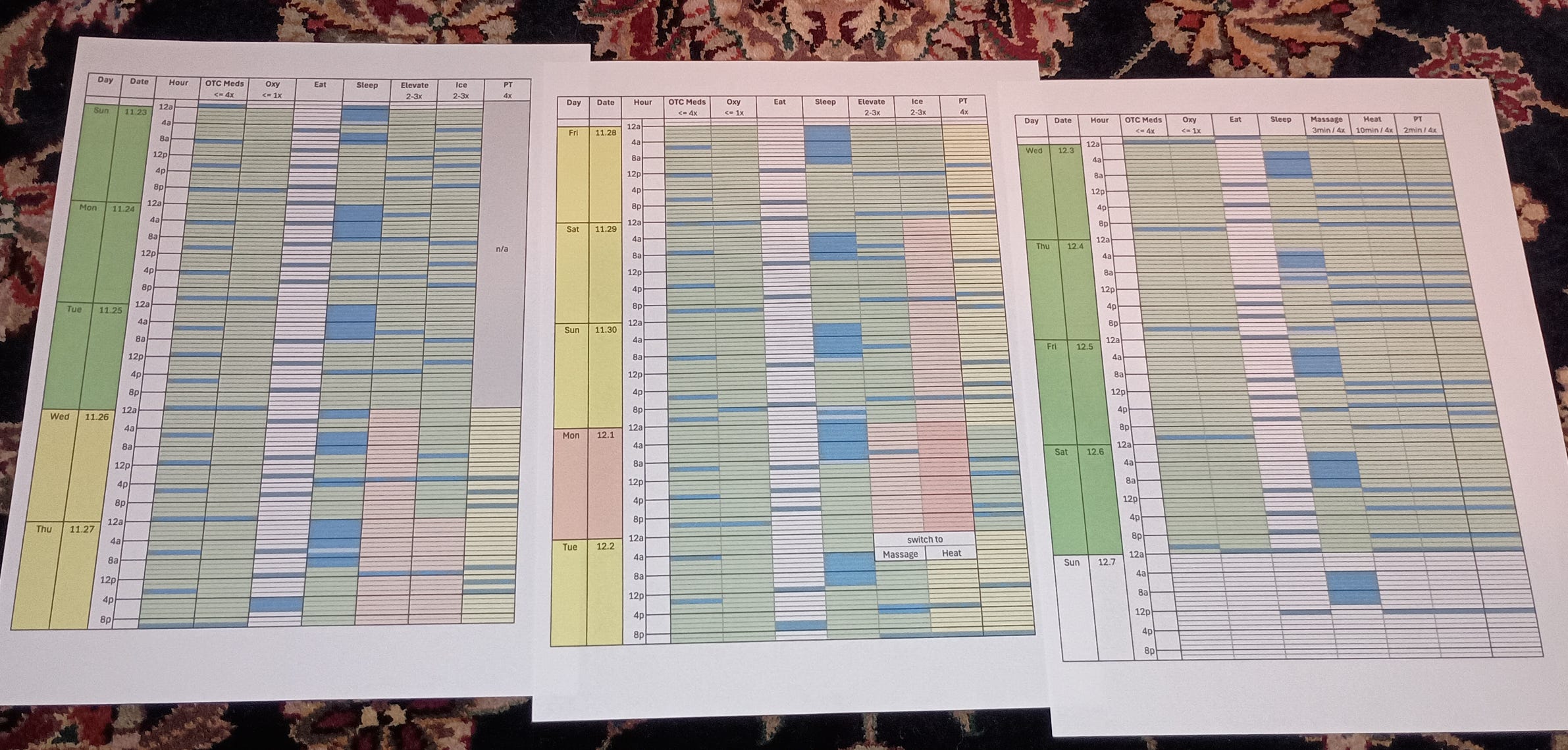
Optimism is fuel for your Energy Flywheel6. Wherever you’re going, optimism will get you there faster.
Choosing your attitude is incredibly powerful, and it is something IN our control!